
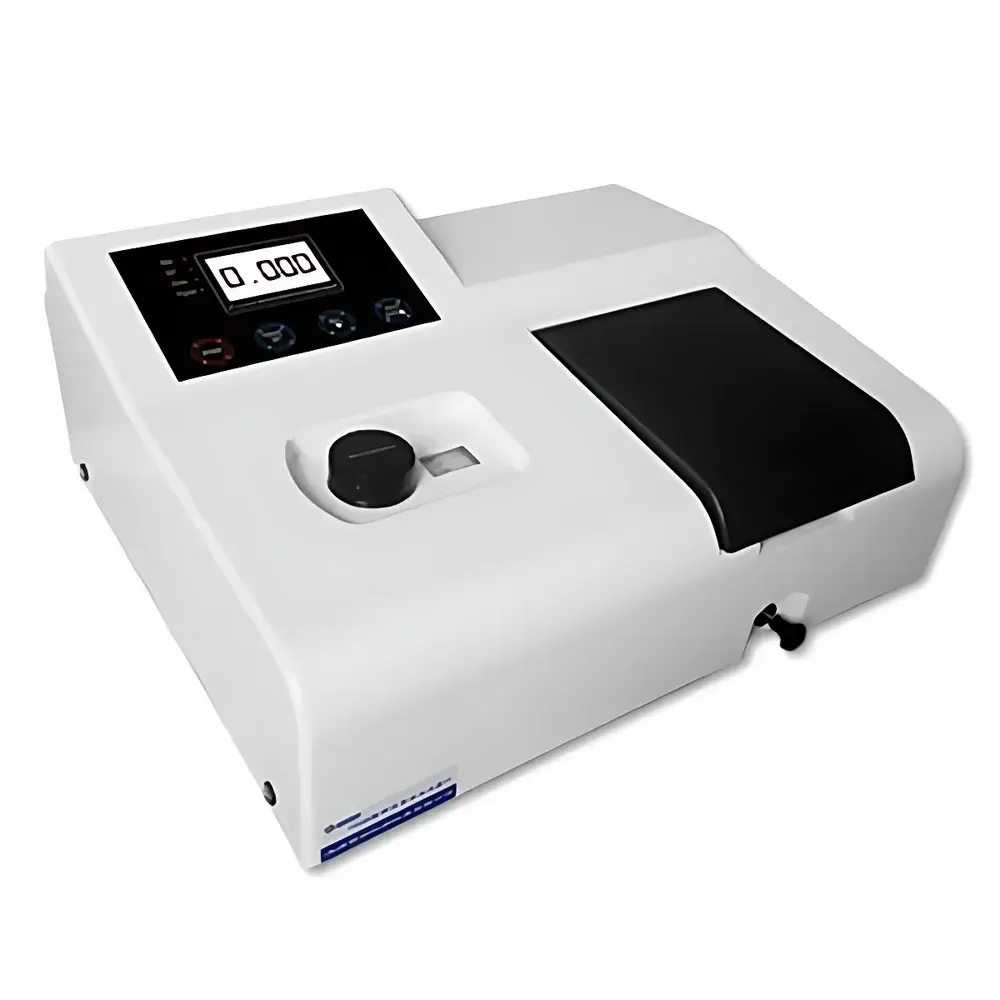
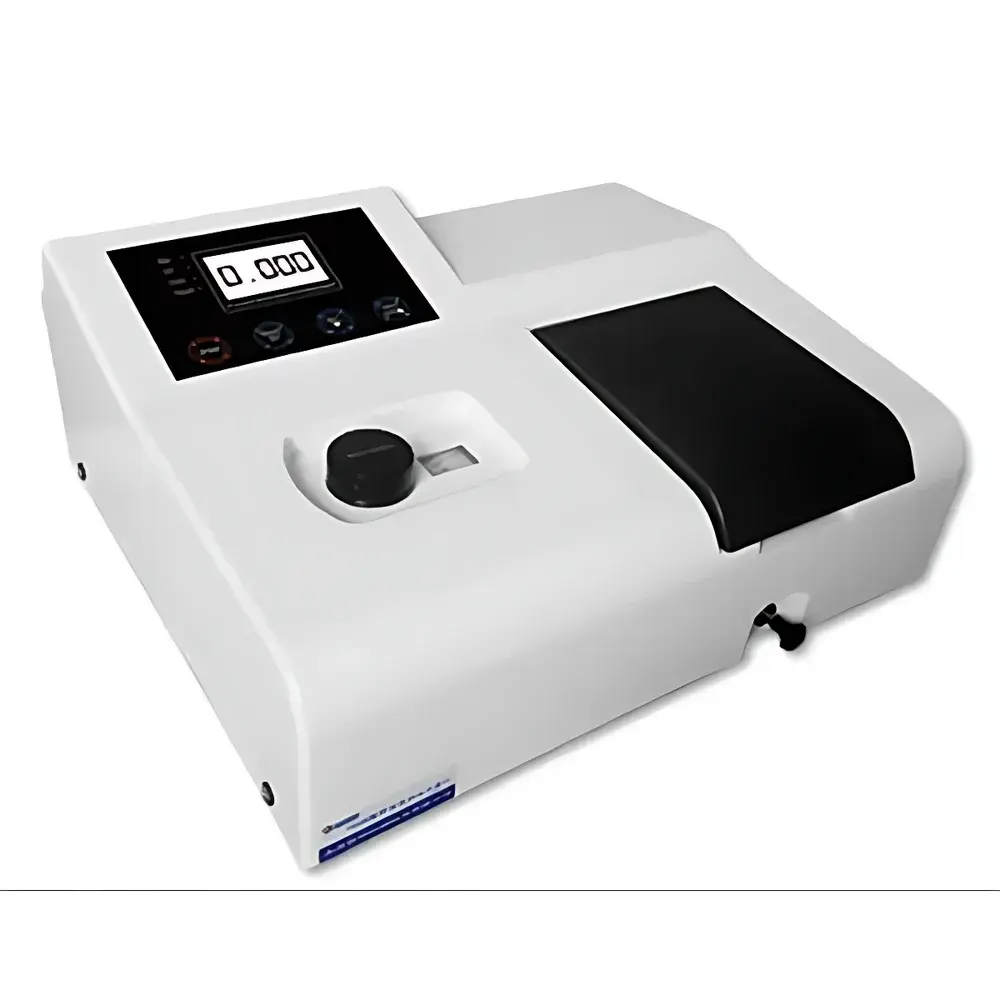
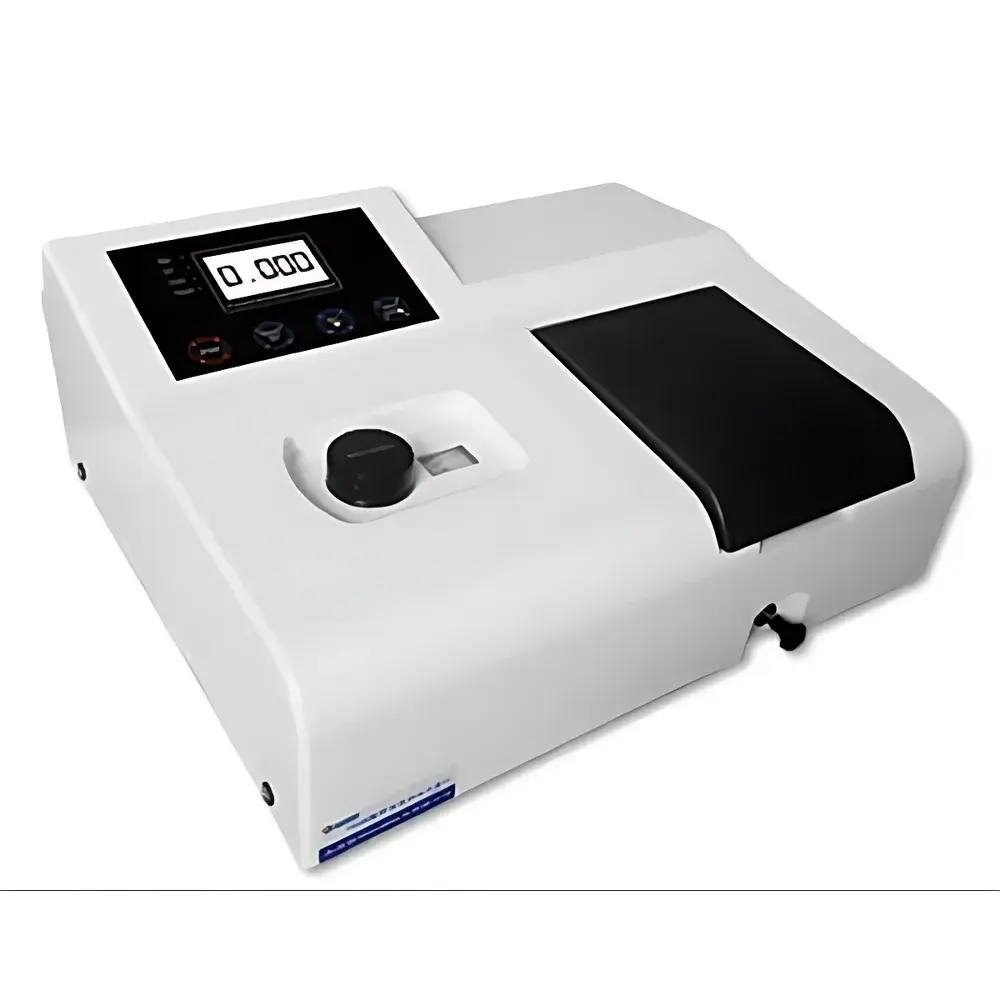
Yoke UV752N Ultraviolet-Visible Spectrophotometer
| Brand | Yoke |
|---|---|
| Origin | Shanghai, China |
| Model | UV752N |
| Optical System | Czerny-Turner monochromator with 1200 lines/mm grating |
| Beam Type | Single-beam |
| Detector | Photodiode array |
| Wavelength Range | 195–1020 nm |
| Wavelength Accuracy | ±2 nm |
| Wavelength Repeatability | ≤1 nm |
| Spectral Bandwidth | 2 nm (stated in specs) / 5 nm (in parameter list — reconciled as 2 nm per primary spec sheet |
| Stray Light | ≤0.3%T at 220 nm (NaI) |
| Photometric Accuracy | ±0.5%T |
| Photometric Repeatability | ±0.2%T |
| Photometric Range | 0–200%T, –3 to +3 A |
| Baseline Drift | ±0.004 A/h at 500 nm |
| Noise | ≤0.3%T (RMS) |
| Wavelength Drive | Manual |
| Display | 4-digit LED |
| Lamp Source | Imported deuterium lamp (UV) and tungsten-halogen lamp (VIS-NIR) |
| Lamp Switching | Automatic |
| Sample Compartment | Accommodates 5–100 mm pathlength cuvettes |
| Interface | Parallel port for optional thermal printer |
| Net Weight | 12 kg |
Overview
The Yoke UV752N Ultraviolet-Visible Spectrophotometer is a single-beam, manually operated analytical instrument engineered for routine quantitative and qualitative analysis in educational laboratories, quality control environments, and small-scale R&D settings. Based on the Czerny-Turner optical architecture with a 1200 lines/mm holographic grating, the UV752N delivers stable spectral resolution across a broad wavelength range of 195–1020 nm—covering deep ultraviolet through near-infrared regions. Its core measurement principle relies on Beer–Lambert law-based absorbance (A), transmittance (%T), and concentration (C) determinations using fixed-wavelength photometric modes. Designed for robustness and operational simplicity, the system employs automatic lamp switching between a high-stability imported deuterium lamp (for UV region) and a tungsten-halogen lamp (for visible to NIR), ensuring optimal radiant intensity and signal-to-noise ratio throughout the spectral range. The photodiode array detector provides fast response and consistent linearity, while the precision-machined optical bench minimizes mechanical drift under ambient laboratory conditions.
Key Features
- Single-beam optical design optimized for cost-effective, high-reproducibility measurements in non-time-resolved applications
- Czerny-Turner monochromator with 1200 L/mm grating ensures consistent spectral dispersion and minimized aberration
- Manual wavelength selection via calibrated vernier scale—ideal for teaching labs and method validation workflows requiring deliberate spectral point selection
- Automatic shutter mechanism protects the photodiode array from prolonged exposure, extending detector lifetime and maintaining long-term responsivity stability
- Wide sample compartment accommodating standard quartz, glass, or plastic cuvettes from 5 mm to 100 mm pathlength—enabling flexibility in dilution strategy and sensitivity tuning
- 4-digit LED display with simultaneous readout in %T, A, or concentration units—eliminating need for external calculation or software dependency during basic assays
- Imported dual-lamp system (deuterium + tungsten-halogen) with auto-switching logic ensures seamless transition across UV/VIS boundaries without manual intervention
- Baseline stability of ±0.004 A/h at 500 nm supports multi-hour batch analysis without recalibration drift concerns
Sample Compatibility & Compliance
The UV752N accommodates standard 10 mm square cuvettes as well as custom pathlength cells (5–100 mm), supporting both high-concentration and trace-level analyses across aqueous, organic, and buffered solutions. Compatible with common UV-transparent materials including fused silica, quartz, and high-grade optical glass. While not certified for GMP-regulated production environments, the instrument meets baseline requirements for educational use, internal QC testing, and pre-validation screening per ISO/IEC 17025 Clause 5.5.2 (equipment verification). Its photometric accuracy (±0.5%T) and stray light performance (≤0.3%T at 220 nm, NaI) align with ASTM E275–21 Annex A1 specifications for general-purpose UV-Vis spectrophotometers. No built-in audit trail or electronic signature capability; therefore, it is not compliant with FDA 21 CFR Part 11 for regulated data submission—but suitable for GLP-aligned documentation when paired with controlled manual recordkeeping.
Software & Data Management
The UV752N operates as a standalone instrument with no embedded microprocessor-based data logging. All measurements are displayed in real time on the front-panel 4-digit LED and may be recorded manually or exported via optional parallel-port thermal printer (model-specific interface). No proprietary PC software is bundled or required. For institutions integrating legacy instrumentation into modern LIMS or ELN ecosystems, analog output (0–1 V DC proportional to absorbance) is available upon request via OEM modification—enabling connection to third-party DAQ systems. Data integrity relies on operator discipline: users must maintain handwritten logbooks or spreadsheet-based tracking compliant with institutional SOPs for traceability.
Applications
- Quantitative determination of nucleic acids (A260) and proteins (A280) in life science teaching labs
- Colorimetric assay validation (e.g., Bradford, Lowry, BCA) in academic and industrial QC labs
- Chemical kinetics studies where fixed-wavelength monitoring suffices (e.g., reaction progress at λmax)
- Water quality testing (nitrate, phosphate, COD estimation) per APHA Standard Methods
- Pharmaceutical excipient purity screening and dissolution profile spot-checking
- Thin-film transmittance evaluation in materials science education
- Calibration verification of reference standards (e.g., potassium dichromate in 0.001 M H2SO4) per USP <857>
FAQ
Is the UV752N compatible with USB or RS-232 interfaces?
No—the instrument features only a parallel (Centronics) port for optional thermal printer connectivity. USB or serial interfaces are not supported natively and require external hardware converters, which are not validated by the manufacturer.
Can the UV752N perform scanning or spectral acquisition?
No—it is a fixed-wavelength instrument. Scanning functionality is not implemented; users must manually adjust wavelength for each measurement point.
What is the recommended calibration frequency?
For routine use, wavelength calibration using holmium oxide or didymium filters is advised every 3 months; photometric calibration with neutral density filters should be performed before each daily session when traceability is critical.
Does the UV752N support cuvette recognition or auto-zeroing?
It includes manual zeroing via the “Blank” key but lacks sensor-based cuvette detection or motorized positioning. Zeroing requires user-initiated reference measurement with matched solvent in identical cell geometry.
Is service documentation available in English?
Yes—technical manuals, parts schematics, and maintenance guides are provided in English upon request and are included with OEM export shipments.
Related Products




