
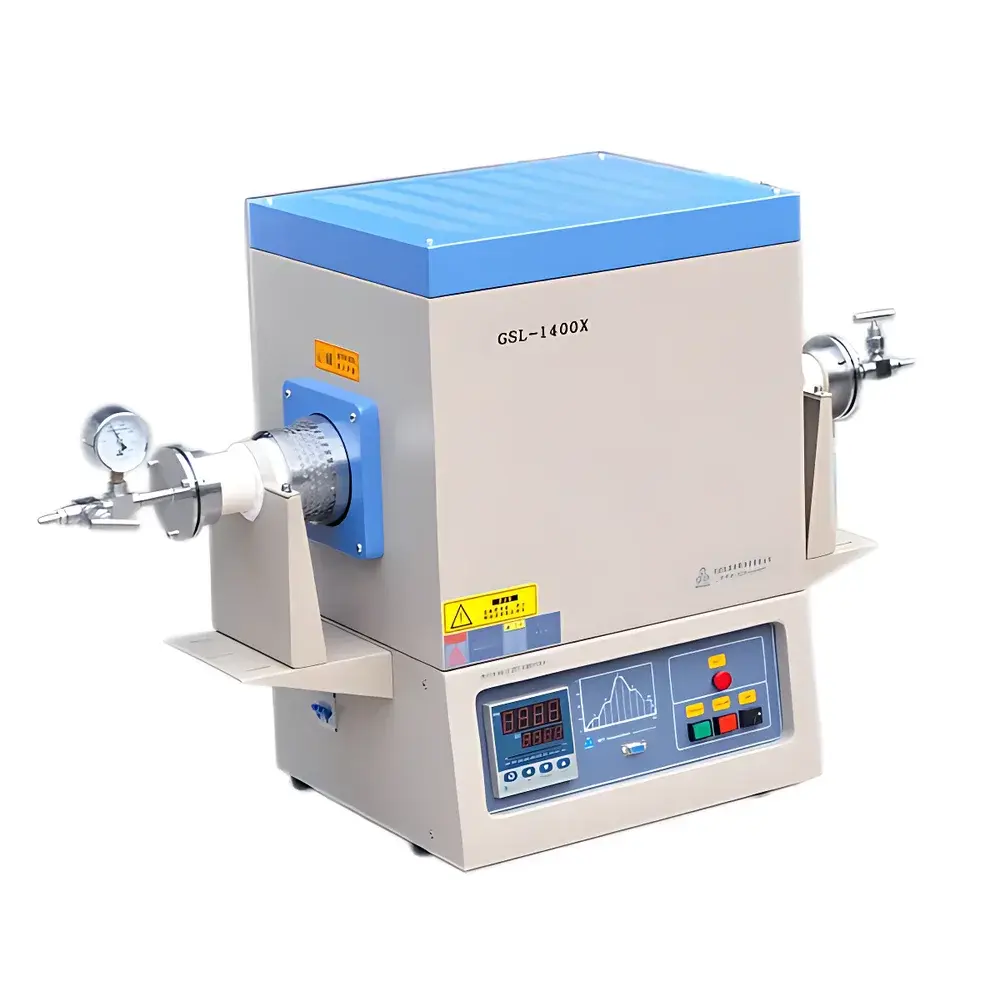
KEJING GSL-1400X High-Temperature Horizontal Tube Furnace
| Brand | KEJING |
|---|---|
| Model | GSL-1400X |
| Max Temperature | 1400 °C |
| Operating Temperature Range | Ambient to 1300 °C (continuous), 1400 °C (short-term) |
| Temperature Uniformity (at 1300 °C) | ±1 °C |
| Heating Elements | Four 1600 °C-rated SiC rods |
| Rated Power | 4 kW |
| Chamber Dimensions (furnace cavity) | 290 × 180 × 160 mm |
| Standard Tube Dimensions | 60 mm OD × 1000 mm L (99.8% Al₂O₃ high-purity alumina tube, rated to 1650 °C) |
| Constant-Temperature Zone Length | 120 mm |
| Control System | 30-segment PID programmable controller with SCR phase-angle firing |
| Cooling | Dual-layer air-cooled housing |
| Insulation | Polycrystalline alumina fiber + imported 1750 °C-grade alumina reflective coating |
| Vacuum Compatibility | Dual stainless steel vacuum flanges (equipped with mechanical pressure gauge and stainless steel stop valve) |
| Certifications | CE compliant |
Overview
The KEJING GSL-1400X is a precision-engineered horizontal tube furnace designed for controlled high-temperature thermal processing in research laboratories and small-scale production environments. It operates on the principle of resistive heating via silicon carbide (SiC) elements, delivering stable, repeatable temperature profiles up to 1400 °C within a sealed, inert or vacuum-compatible atmosphere. Its core architecture integrates thermally optimized insulation — including polycrystalline alumina fiber and a proprietary 1750 °C-rated alumina reflective coating — to minimize radial heat loss and enhance energy efficiency. The furnace’s dual-layer air-cooled outer shell ensures safe surface temperatures during extended operation and contributes to long-term structural integrity. Designed for integration into materials synthesis workflows (e.g., CVD, annealing, sintering, crystal growth), the GSL-1400X meets fundamental requirements for reproducibility, safety, and atmospheric control under ISO/IEC 17025-aligned laboratory practices.
Key Features
- High-purity 99.8% alumina tube (60 mm OD × 1000 mm L, 1650 °C max service temperature) with optional 80 mm diameter configuration
- Dual stainless steel vacuum flanges pre-installed with mechanical pressure gauges and stainless steel isolation valves
- Four 1600 °C-rated SiC heating rods arranged symmetrically for uniform axial and radial temperature distribution
- 30-segment programmable PID controller with SCR phase-angle firing, enabling precise ramp/soak profiles and real-time over-temperature protection
- Optimized thermal insulation system: multi-layer polycrystalline alumina fiber + high-emissivity/low-conductivity 1750 °C alumina coating
- Air-cooled double-wall housing (590 × 490 × 740 mm external dimensions; net weight: 150 kg) with integrated forced-air ducting
- CE-certified design compliant with EN 61000-6-3 (EMC) and EN 61000-6-4 (immunity) standards
Sample Compatibility & Compliance
The GSL-1400X supports diverse sample geometries through its standard 60 mm internal-diameter quartz or alumina tube — suitable for powder beds, rod-shaped precursors, thin-film substrates, and ceramic green bodies. Optional KF25 quick-connect fittings and stainless-steel bellows enable rapid evacuation to ≤10⁻³ mbar when paired with a compatible rotary vane or turbomolecular pump. For process-critical applications, the furnace accommodates digital Pirani vacuum gauges (range: 3.8 × 10⁻⁵ to 1125 Torr) without gas-specific correction factors. All wetted components — including O-rings (silicone or Viton), flange gaskets, and tube end plugs — are selected per ASTM F2211 and ISO 2859-1 sampling plans. While not certified to GLP or GMP Annex 1, the unit’s traceable temperature control, documented calibration points, and built-in thermal runaway safeguards align with foundational QA/QC expectations for academic and industrial R&D settings.
Software & Data Management
Temperature profiling and remote monitoring are enabled via the optional MTS-02 PC-based control software, preinstalled and factory-validated prior to shipment. This Windows-compatible application supports real-time data logging (timestamped temperature, setpoint, power output), export to CSV/Excel formats, and user-defined alarm thresholds. All control parameters — including segment duration, ramp rate, and soak dwell time — are stored in non-volatile memory and survive power interruption. The system generates audit-ready logs with operator ID fields (when integrated with domain-authenticated login), satisfying basic FDA 21 CFR Part 11 readiness criteria for electronic records. No cloud connectivity or third-party telemetry is implemented — data remains fully on-premise unless explicitly exported by the user.
Applications
- Controlled-atmosphere annealing of transition metal oxides, perovskites, and battery cathode precursors
- Chemical vapor deposition (CVD) precursor decomposition and thin-film nucleation studies
- Thermal gravimetric analysis (TGA) support via integration with balance feedthroughs
- Sintering of nanostructured ceramics and metal-organic framework (MOF) derivatives
- Calibration and validation of thermocouples and infrared pyrometers at elevated temperatures
- Pre-treatment of catalyst supports (e.g., γ-Al₂O₃, SiO₂, TiO₂) under reducing or inert atmospheres
FAQ
What vacuum level can be achieved with the standard configuration?
With the included mechanical pressure gauge and stainless steel valves, base pressures of 10⁻² to 10⁻³ mbar are attainable using a two-stage rotary vane pump. For lower pressures, we recommend adding a digital Pirani gauge and compatible high-vacuum pumping station.
Is the furnace suitable for hydrogen or ammonia atmospheres?
Yes — the alumina tube and stainless steel flanges are chemically resistant to H₂, NH₃, N₂, Ar, and forming gas mixtures below 1300 °C. For prolonged H₂ exposure above 1100 °C, we advise using MoSi₂ heating elements (available as custom upgrade).
How often does the heating element require replacement?
Under continuous operation at ≤1300 °C with proper cooling cycles, SiC rods typically last 1,500–2,000 hours. Replacement intervals extend significantly with intermittent use and adherence to recommended ramp rates (<10 °C/min above 1000 °C).
Can the furnace be integrated into an automated reaction platform?
Yes — the MTS-02 software provides RS485/Modbus RTU communication protocol support for PLC-level integration. Analog 4–20 mA output signals for temperature and power are available upon request.
What maintenance is required to sustain ±1 °C accuracy?
Annual verification with a calibrated NIST-traceable Type S thermocouple is recommended. Routine inspection of flange seals, tube integrity, and cooling fan functionality ensures long-term repeatability. Calibration certificates are provided with each unit.
Related Products



