
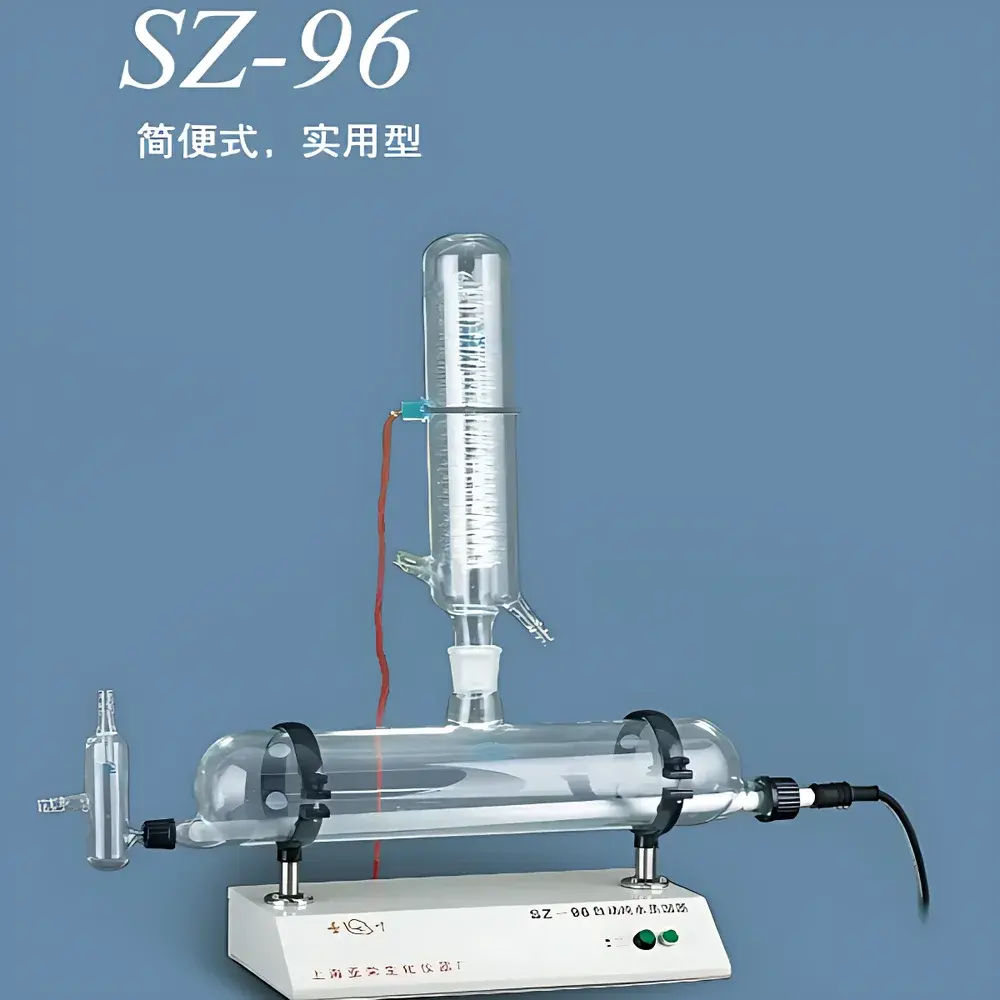
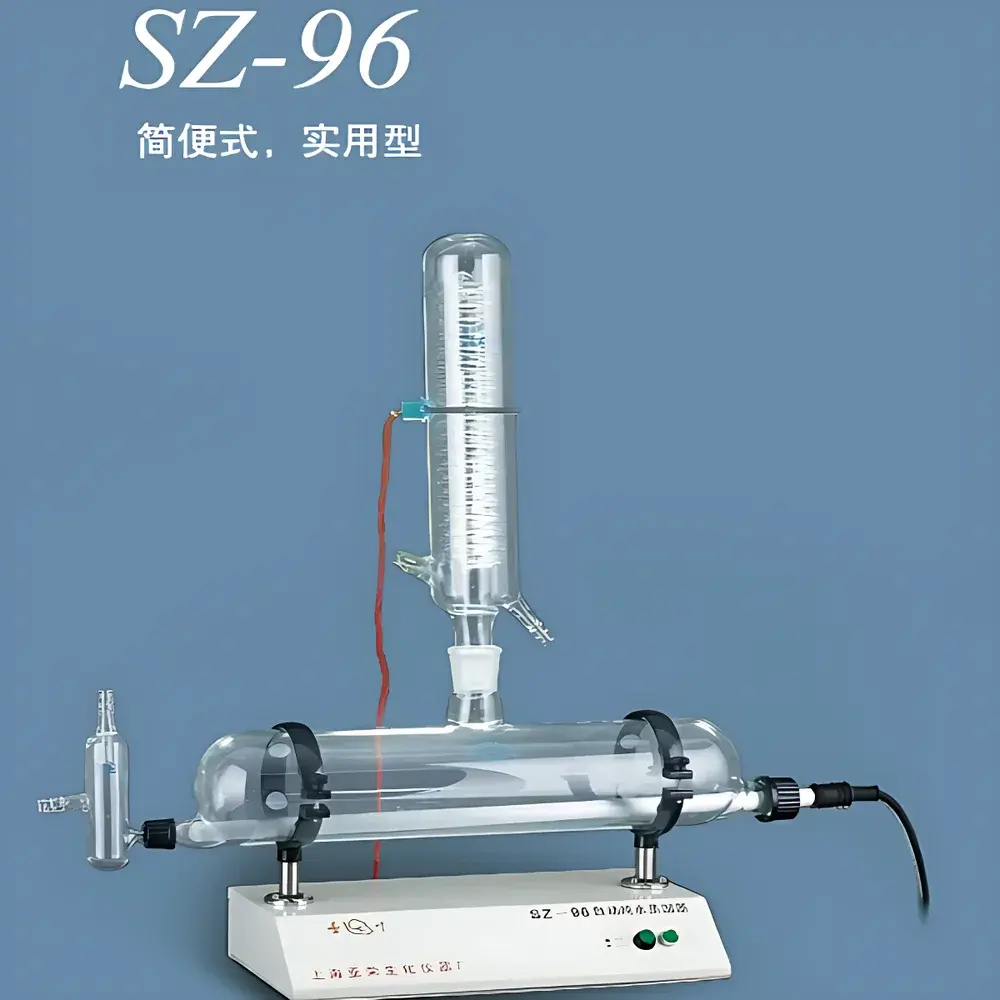
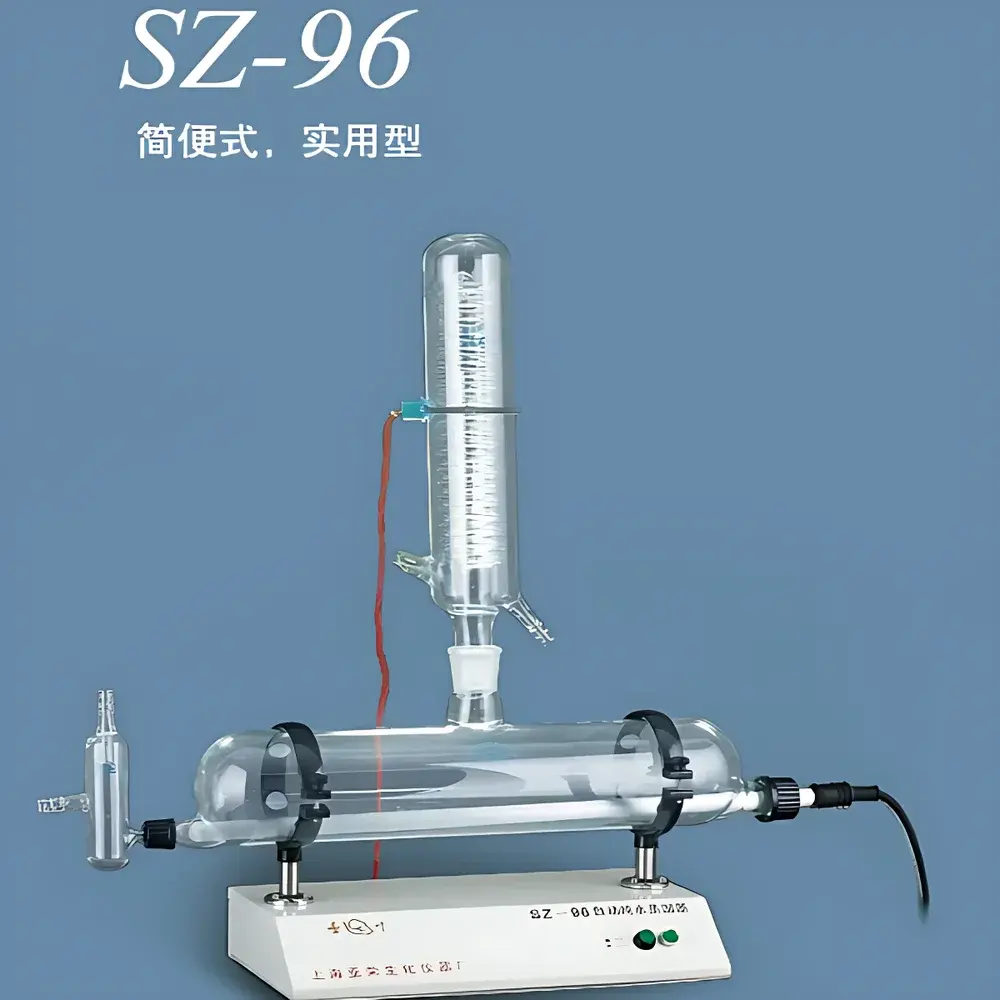
Yarong SZ-96 Quartz Glass Automatic Distillation Apparatus
| Brand | Yarong |
|---|---|
| Origin | Shanghai, China |
| Model | SZ-96 |
| Distillation Rate | 1800 mL/h |
| Heating Method | Quartz Tube Heater |
| Cooling Method | Recirculating Condensation System |
| End-Point Control | Dual-mode via Temperature Controller + Reed-Type Water Level Sensor with Relay Protection |
| Heating Element | Integrated Quartz Tube Heating Unit |
| Construction Material | High-Purity Quartz Glass Body |
| Instrument Type | Benchtop Automatic Distiller for Purified Water Production |
| Compliance | Designed for GLP-compliant laboratory environments requiring trace-metal-free water |
Overview
The Yarong SZ-96 Quartz Glass Automatic Distillation Apparatus is a benchtop, fully automated water purification system engineered for the production of high-purity distilled water in analytical, pharmaceutical, and quality control laboratories. It operates on the principle of thermal phase separation—boiling feed water in a quartz chamber, condensing the vapor through a precisely temperature-regulated recirculating condenser, and collecting the condensed distillate free from non-volatile contaminants including ions, organic residues, particulates, and microorganisms. Unlike stainless-steel or borosilicate glass distillers, the SZ-96 employs high-purity fused quartz for both the boiling flask and condenser components, minimizing leaching of alkali metals (e.g., Na⁺, K⁺) and heavy metals (e.g., Fe, Ni) during prolonged operation—a critical requirement for trace elemental analysis (e.g., ICP-MS, AAS), cell culture media preparation, and reagent-grade water specifications per ASTM D1193 Type I and ISO 3696 Grade 1.
Key Features
- Quartz tube heating element ensures uniform thermal distribution, rapid heat-up response, and zero metallic contamination—eliminating risks associated with metal-sheathed heaters.
- Recirculating condensation system maintains stable coolant temperature and flow rate, enabling consistent condensation efficiency across variable ambient conditions without reliance on municipal tap water.
- Intelligent end-point control integrates dual independent safety mechanisms: a calibrated temperature controller monitors vapor-phase temperature to detect dry-boil conditions, while a reed-switch-based water level sensor provides real-time feedback on reservoir fill level; both signals interface with a fail-safe relay circuit that interrupts power automatically when thresholds are breached.
- Benchtop modular architecture features tool-free access to heating assembly and condenser core, facilitating routine maintenance, quartz component inspection, and validation of thermal contact integrity.
- Front-panel digital indicators display operational status—including heater activation, cooling circulation confirmation, and alarm-triggered shutdown events—supporting audit-ready process documentation.
Sample Compatibility & Compliance
The SZ-96 is validated for use with deionized (DI) or reverse osmosis (RO) feed water having conductivity ≤5 µS/cm. It is not intended for direct distillation of seawater, brines, or highly turbid or organically loaded wastewater. Its all-quartz fluid path complies with USP requirements for purified water generation systems and supports adherence to FDA 21 CFR Part 11 when integrated with compliant data logging software. The apparatus meets CE marking requirements for electrical safety (EN 61010-1) and electromagnetic compatibility (EN 61326-1). Routine performance qualification includes verification of distillate resistivity (>10 MΩ·cm at 25°C), total oxidizable carbon (TOC) <10 ppb, and bacterial colony count <1 CFU/100 mL—parameters routinely verified during IQ/OQ protocols in GMP and GLP environments.
Software & Data Management
While the SZ-96 operates as a standalone analog-controlled unit, its relay output terminals (dry contact) are compatible with external programmable logic controllers (PLCs) or SCADA systems for centralized monitoring. Optional RS-485 interface modules (sold separately) enable integration into LabVantage, STARLIMS, or custom LIMS platforms for time-stamped event logging—including start/stop timestamps, overtemperature alerts, and low-water cutoff triggers. All logged events include hardware-generated UTC timestamps and are stored with immutable audit trails satisfying ALCOA+ principles (Attributable, Legible, Contemporaneous, Original, Accurate, Complete, Consistent, Enduring, Available).
Applications
- Production of ASTM Type I ultrapure water for HPLC mobile phase preparation, blank matrix generation, and calibration standard dilution.
- Feedstock water purification for ultra-low-background radiochemical assays and neutron activation analysis.
- Distilled water supply for electrophysiology rigs, patch-clamp recording chambers, and semiconductor wafer cleaning baths where sodium and chloride ion carryover must be below detection limits.
- On-demand generation of contaminant-free water in ISO Class 5–7 cleanrooms supporting biopharmaceutical formulation and sterile filtration validation.
- Backup purification source during RO system downtime or seasonal fluctuations in municipal water quality (e.g., increased silica or hardness).
FAQ
What feed water quality is required for optimal SZ-96 performance?
Deionized or reverse osmosis water with conductivity ≤5 µS/cm and silica content <0.1 mg/L is recommended. Pre-filtration through a 0.45 µm membrane is advised if particulate load exceeds 1 ppm.
Can the SZ-96 be operated continuously for 24 hours?
Yes—its quartz heating element and sealed recirculating coolant loop support unattended operation up to 72 hours, provided feed reservoir volume is sufficient and ambient room temperature remains between 15–30°C.
Is third-party calibration certification available?
Yarong-certified field service engineers perform IQ/OQ validation per ISO/IEC 17025-accredited procedures; full calibration reports—including temperature sensor NIST-traceable verification and distillate purity testing—are issued upon request.
How often should the quartz boiling flask be inspected for scaling?
Visual inspection is recommended every 200 operating hours; light mineral deposits may be removed using 5% v/v nitric acid soak followed by triple-rinse with Type I water—never use abrasive cleaners or ultrasonic baths.
Does the SZ-96 meet ISO 15195 requirements for reference measurement laboratories?
While not a primary reference instrument, its quartz construction, documented thermal stability (±0.5°C over 8-hour run), and traceable purity output support its use as a secondary reference generator in metrology labs aligned with ISO 15195 Clause 6.3.2.



