
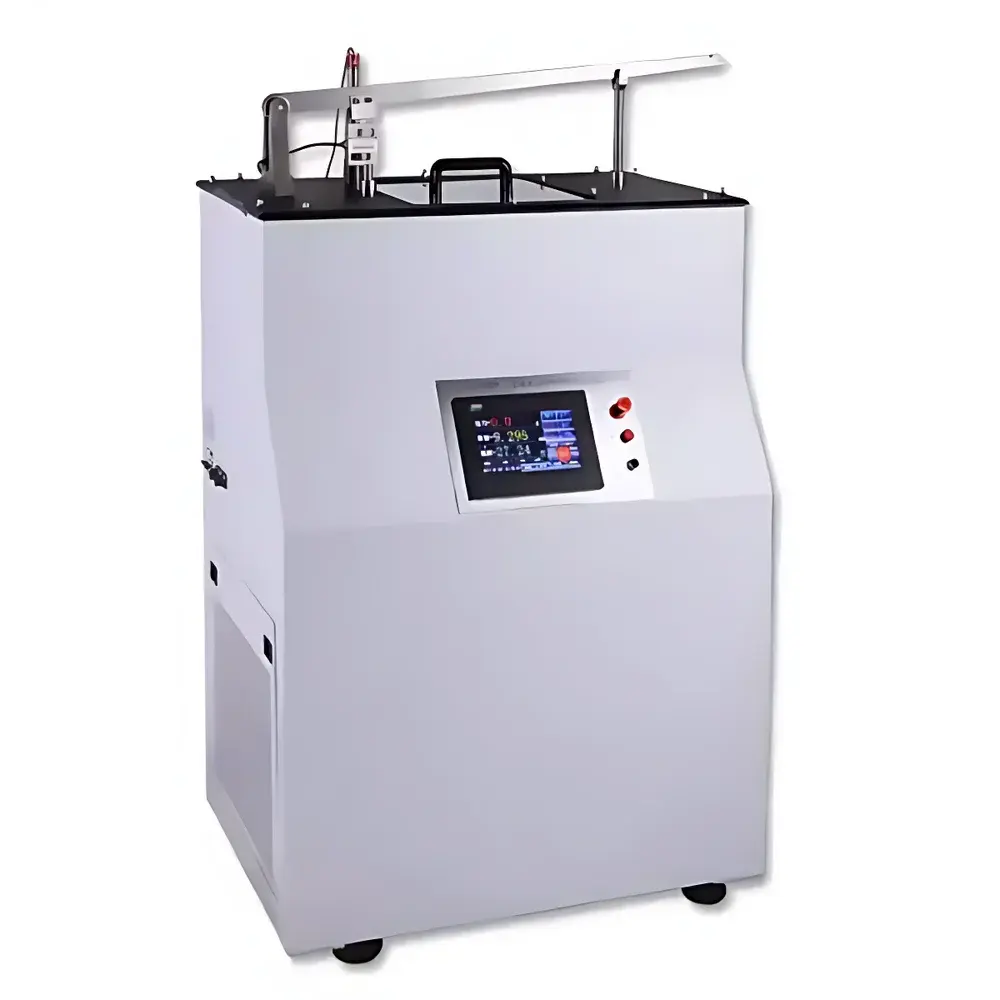
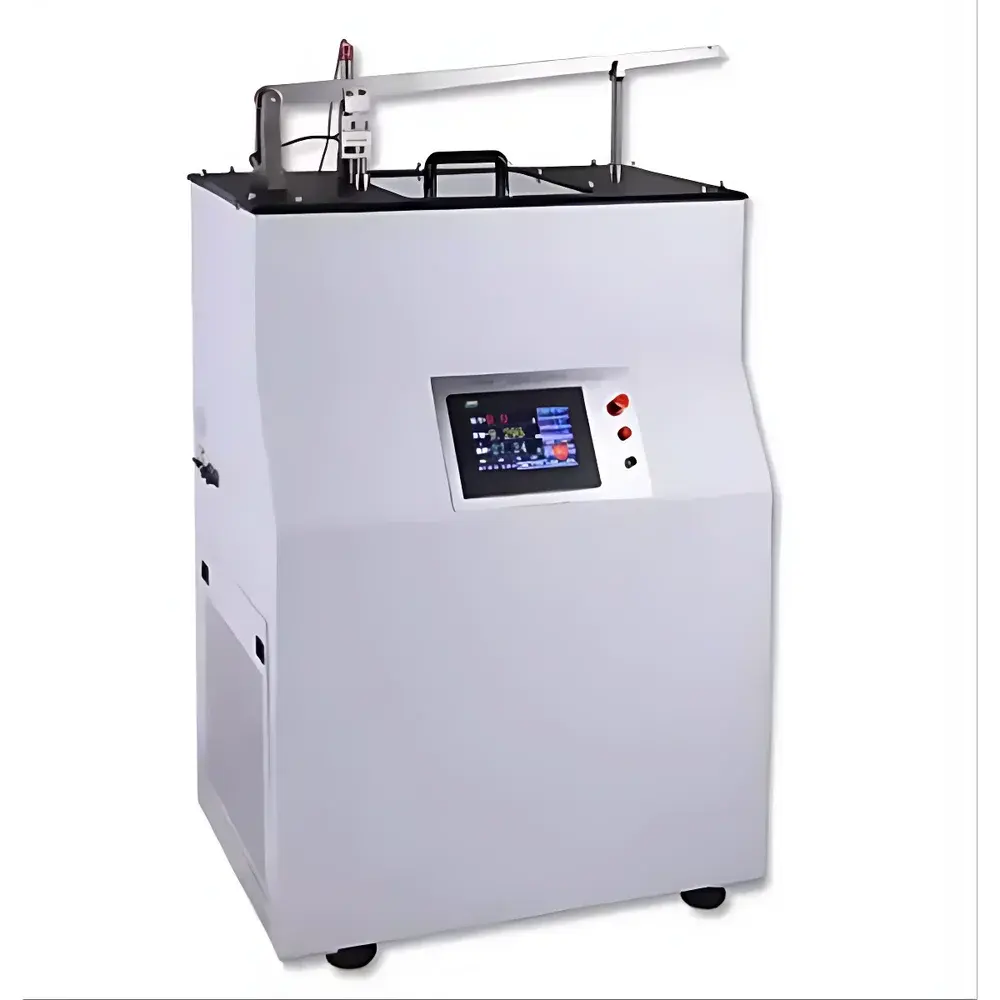
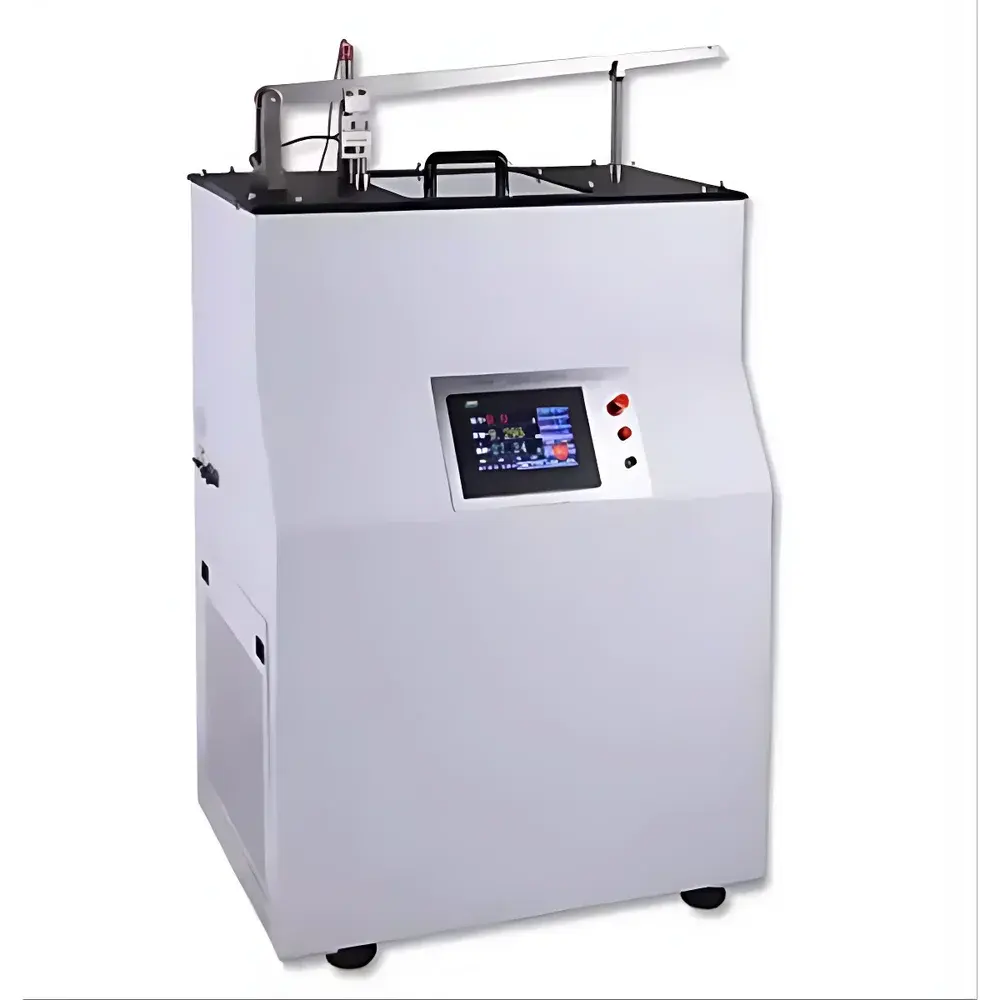
Changji Instruments SYD-0728 Bending Creep Tester for Asphalt Mixtures
| Brand | Changji Instruments |
|---|---|
| Origin | Shanghai, China |
| Model | SYD-0728 |
| Load Range | 0–300 N |
| Load Measurement Accuracy | ≤ ±0.1 N |
| Deflection Measurement Range | 0–20 mm (mid-span) |
| Deflection Resolution | ≤ ±0.01 mm |
| Temperature Control Range | −2 °C to 40 °C |
| Temperature Stability | ≤ ±0.5 °C |
| Power Supply | AC 220 V ±10%, 50 Hz |
| Total Power Consumption | 3.2 kW |
| Dimensions (L×W×H) | 810 × 540 × 1300 mm |
| Net Weight | 86 kg |
| Communication Interface | RS232 serial port |
Overview
The Changji Instruments SYD-0728 Bending Creep Tester is a precision-controlled mechanical testing system engineered for the standardized evaluation of viscoelastic deformation behavior in hot-mix asphalt (HMA) specimens under sustained flexural loading. Designed in strict compliance with JTG E20-2011 (China’s Standard Test Methods for Bitumen and Bituminous Mixtures), specifically test method T 0728-2000 “Bending Creep Test for Asphalt Mixtures”, this instrument quantifies the time-dependent mid-span deflection response of beam-shaped asphalt specimens subjected to constant stress at controlled environmental temperatures. The test principle is grounded in linear viscoelastic theory, where creep compliance (J(t)) is derived from measured strain evolution over time under fixed load—enabling critical assessment of rutting resistance, thermal cracking susceptibility, and long-term structural integrity of pavement materials.
Key Features
- High-fidelity dual-sensor architecture: Integrated high-resolution load cell (±0.1 N accuracy) and linear variable differential transformer (LVDT)-based displacement transducer (±0.01 mm resolution) ensure traceable, low-noise data acquisition across the full 0–300 N / 0–20 mm operational range.
- Intelligent temperature conditioning system: Hybrid thermoregulation combining Peltier-assisted refrigeration and resistive heating achieves stable thermal environments from −2 °C to +40 °C, with real-time bath temperature monitoring and ≤ ±0.5 °C uniformity across the specimen immersion zone.
- Embedded control interface: Industrial-grade color graphic touchscreen running a deterministic real-time OS (P8 kernel) enables intuitive parameter configuration, automated test sequencing, on-device curve visualization, and dynamic identification of steady-state creep regions via slope-based algorithmic analysis.
- Full bidirectional RS232 communication: Enables remote initiation, real-time telemetry streaming, and synchronized timestamping (hardware RTC) for audit-ready data capture—compatible with laboratory information management systems (LIMS) and validated data processing workflows.
- Structurally optimized test frame: Rigid steel chassis with precision-aligned three-point bending fixture minimizes parasitic deformation, ensuring mechanical boundary conditions conform to ASTM D7460 and EN 12697-26 specifications for flexural creep testing.
Sample Compatibility & Compliance
The SYD-0728 accommodates standard beam specimens measuring 250 mm × 30 mm × 35 mm (L × W × H), prepared per JTG E20-2011 or equivalent protocols (e.g., AASHTO TP 10, EN 12697-26). Specimens are fully immersed in a thermostatically controlled fluid bath to eliminate surface thermal gradients. The system supports testing at conventional service temperatures (e.g., 15 °C, 25 °C) as well as low-temperature conditions (−10 °C to 0 °C) relevant to thermal cracking analysis. All measurement subsystems are calibrated per ISO/IEC 17025 requirements, and raw data files include embedded metadata (test ID, operator, calibration certificate IDs, environmental logs) to support GLP/GMP documentation and regulatory submissions (e.g., FHWA, DOT, or EU road agency technical reports).
Software & Data Management
Data output is structured in ASCII-delimited format (.csv), containing synchronized timestamps, applied load (N), mid-span deflection (mm), bath temperature (°C), and calculated creep compliance (1/kPa). Optional PC software provides batch statistical analysis (mean, SD, CV%), automatic fitting of Burgers or Findley power-law models, and generation of ASTM-compliant creep master curves using time–temperature superposition (TTS). Audit trails record all user actions—including parameter edits, calibration events, and data exports—with immutable digital signatures meeting FDA 21 CFR Part 11 electronic record requirements when deployed in regulated QA/QC laboratories.
Applications
- Rutting performance prediction of polymer-modified and crumb rubber asphalt binders
- Comparative evaluation of warm-mix asphalt (WMA) additives on low-temperature creep stiffness
- Validation of viscoelastic continuum damage (VECD) model inputs for mechanistic-empirical pavement design (MEPDG)
- Quality assurance testing for asphalt mixture production compliance (e.g., ASTM D3666, EN 13108-1)
- Research-grade characterization of aging effects (RTFO/PAV) on long-term deformation resistance
FAQ
What standards does the SYD-0728 comply with?
It is designed and verified per JTG E20-2011 T 0728-2000, and its mechanical and thermal performance aligns with key international references including ASTM D7460, EN 12697-26, and AASHTO TP 10.
Can the instrument operate unattended overnight?
Yes—the embedded controller supports scheduled test initiation, automatic shutdown upon completion, and continuous data logging with non-volatile memory retention during power interruption.
Is third-party calibration certification available?
Changji Instruments provides NIST-traceable calibration certificates (load and displacement) with optional ISO/IEC 17025 accreditation through authorized metrology partners.
What maintenance is required for long-term reliability?
Routine tasks include periodic verification of bath fluid level and purity, annual recalibration of transducers, and inspection of thermal insulation integrity—documented in the included GLP-compliant maintenance log template.
Does the system support custom test protocols beyond T 0728?
The firmware allows user-defined load profiles (step, ramp, hold), variable temperature ramps, and multi-stage creep-recovery sequences—enabling adaptation to research protocols such as ISO 10113 or modified EN 14399-1 methodologies.
Related Products






