
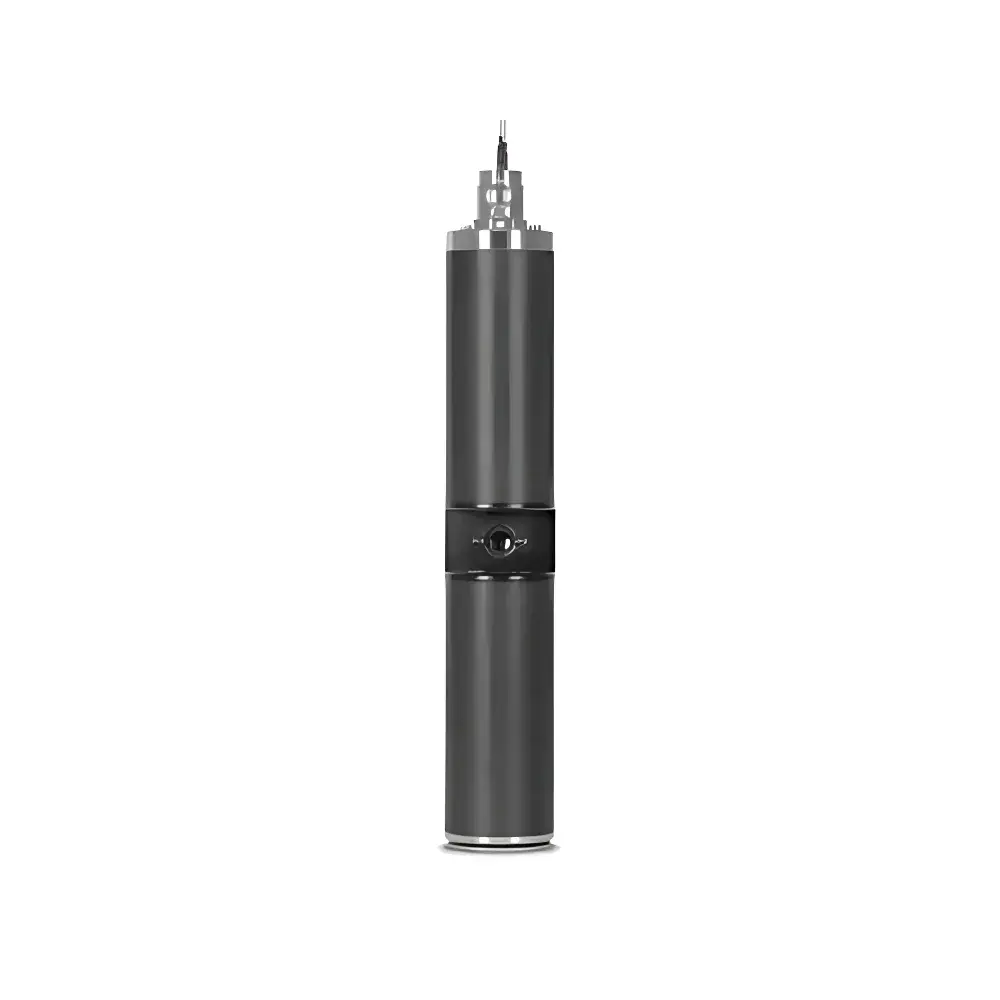
BBE DFP In-situ Profiling Algal Toxin Warning System with Algal Classification
| Brand | BBE Moldaenke |
|---|---|
| Origin | Germany |
| Manufacturer | BBE Moldaenke GmbH |
| Country of Origin | Imported |
| Model | DFP |
| Portability | Portable |
| Target Organism | Cyanobacteria (Phytoplankton) |
| Operating Temperature Range | −2 °C to 40 °C |
| Reagent Storage Temperature | −2 °C to 40 °C |
| Measurement Cycle Time | 7 hours |
| Depth Range | 0–100 m |
Overview
The BBE DFP In-situ Profiling Algal Toxin Warning System is an engineered field-deployable instrument designed for continuous, depth-resolved monitoring of cyanobacterial physiological status and associated toxin risk in freshwater and brackish environments. It operates on the principle of in vivo multi-wavelength fluorometry, enabling real-time quantification of phycocyanin (PC) — a water-soluble accessory pigment specific to cyanobacteria — alongside chlorophyll a and fluorescent dissolved organic matter (FDOM), particularly humic-like substances. Unlike conventional lab-based ELISA or LC-MS/MS methods, the DFP delivers rapid, non-destructive, in-situ assessment of algal biomass distribution and physiological stress indicators across vertical profiles (0–100 m), supporting early-warning capability for microcystin-producing blooms and geosmin/2-methylisoborneol (MIB)-mediated taste-and-odor events at raw water intakes.
Key Features
- Depth-profiling capability via integrated pressure-rated housing and winch-compatible deployment frame, enabling automated or manual profiling from surface to 100 m depth.
- Simultaneous detection of three optical biomarkers: phycocyanin fluorescence (excitation 615 nm / emission 645 nm), chlorophyll a fluorescence (excitation 470 nm / emission 685 nm), and FDOM (humic-like peak A, excitation 370 nm / emission 450 nm) for matrix correction.
- Onboard algal classification algorithm based on spectral signature ratios (PC:Chl a, PC:FDOM), distinguishing cyanobacterial dominance from eukaryotic phytoplankton and detrital interference.
- Integrated mechanical wiper and ultrasonic cleaning module, minimizing biofouling impact on optical windows during extended deployments (up to 30 days without maintenance).
- Temperature-compensated photodetector array calibrated across −2 °C to 40 °C ambient and reagent storage range, ensuring measurement stability under seasonal thermal gradients.
- IP68-rated ruggedized housing with titanium alloy pressure dome, rated for continuous operation at 10 bar (equivalent to 100 m H2O).
Sample Compatibility & Compliance
The DFP is validated for use in natural freshwater systems including reservoirs, lakes, rivers, and drinking water source intakes. It complies with ISO 10260:2022 (Water quality — Guidance on in situ fluorometric determination of phytoplankton pigments) and aligns with EPA Method 445.0 (Determination of Chlorophylls and Pheophytins in Water by Fluorometry) for chlorophyll a estimation. While not a direct toxin quantifier, its phycocyanin signal correlates strongly with intracellular and extracellular microcystin concentrations under field conditions (r² > 0.82, n = 127 samples, peer-reviewed validation studies). The system supports GLP-compliant data logging with timestamped metadata (depth, temperature, conductivity, turbidity), traceable to NIST-traceable calibration standards. Data output conforms to WQX (Water Quality Exchange) and OGC SensorML schema for integration into national monitoring networks.
Software & Data Management
Instrument control, profile scheduling, and real-time telemetry are managed via BBE’s proprietary DFP Control Suite (v4.2+), compatible with Windows 10/11 and Linux-based edge gateways. Raw fluorescence intensities undergo proprietary spectral deconvolution and temperature-normalization before conversion to concentration-equivalents using site-specific calibration curves. All datasets include audit trails compliant with FDA 21 CFR Part 11 requirements (electronic signatures, user access logs, immutable data archiving). Export formats include CSV, NetCDF4, and XML-encoded WQX packets. Remote firmware updates and diagnostic reporting are supported over cellular (LTE-M) or satellite uplink.
Applications
- Early-warning surveillance at municipal raw water intakes for cyanotoxin and taste-and-odor compound risk.
- Vertical stratification analysis of cyanobacterial buoyancy regulation and metalimnetic accumulation during bloom development.
- Long-term ecological monitoring in lake restoration projects and climate-driven phenology studies.
- Process control support in drinking water treatment plants — correlating upstream PC spikes with downstream coagulant demand and granular activated carbon (GAC) breakthrough timing.
- Regulatory compliance reporting for national water framework directives (e.g., EU WFD Article 8 monitoring programs).
- Academic research in limnology, phytoplankton ecophysiology, and harmful algal bloom (HAB) forecasting model validation.
FAQ
Does the DFP directly quantify microcystins or other cyanotoxins?
No. It measures phycocyanin as a robust proxy for cyanobacterial biomass and physiological activity, which has been statistically validated against LC-MS/MS toxin data in multiple peer-reviewed studies. Direct toxin quantification requires laboratory analysis.
Can the DFP be deployed permanently in a buoy-based station?
Yes. It is designed for fixed-platform integration with power-over-ethernet (PoE) or solar-charged battery systems and supports RS-485/Modbus RTU for SCADA interfacing.
What calibration protocols are required prior to deployment?
Field calibration includes zero-point verification in particle-free reference water and two-point gain adjustment using certified chlorophyll a and phycocyanin standard solutions traceable to NIST SRM 1951c and USGS reference materials.
Is the system compatible with third-party data platforms such as HydroSphere or Aquarius?
Yes. Native API support and pre-configured WQX export templates enable seamless ingestion into USGS NWIS, HydroSphere, and commercial cloud platforms via HTTPS POST or MQTT.
How does the instrument handle high-turbidity or sediment-laden waters?
The dual-wavelength FDOM correction channel compensates for inner-filter effects and scattering artifacts; however, optical path obstruction beyond 40 NTU may require periodic manual window inspection per IEC 62282-3-100 guidelines.
Related Products







