
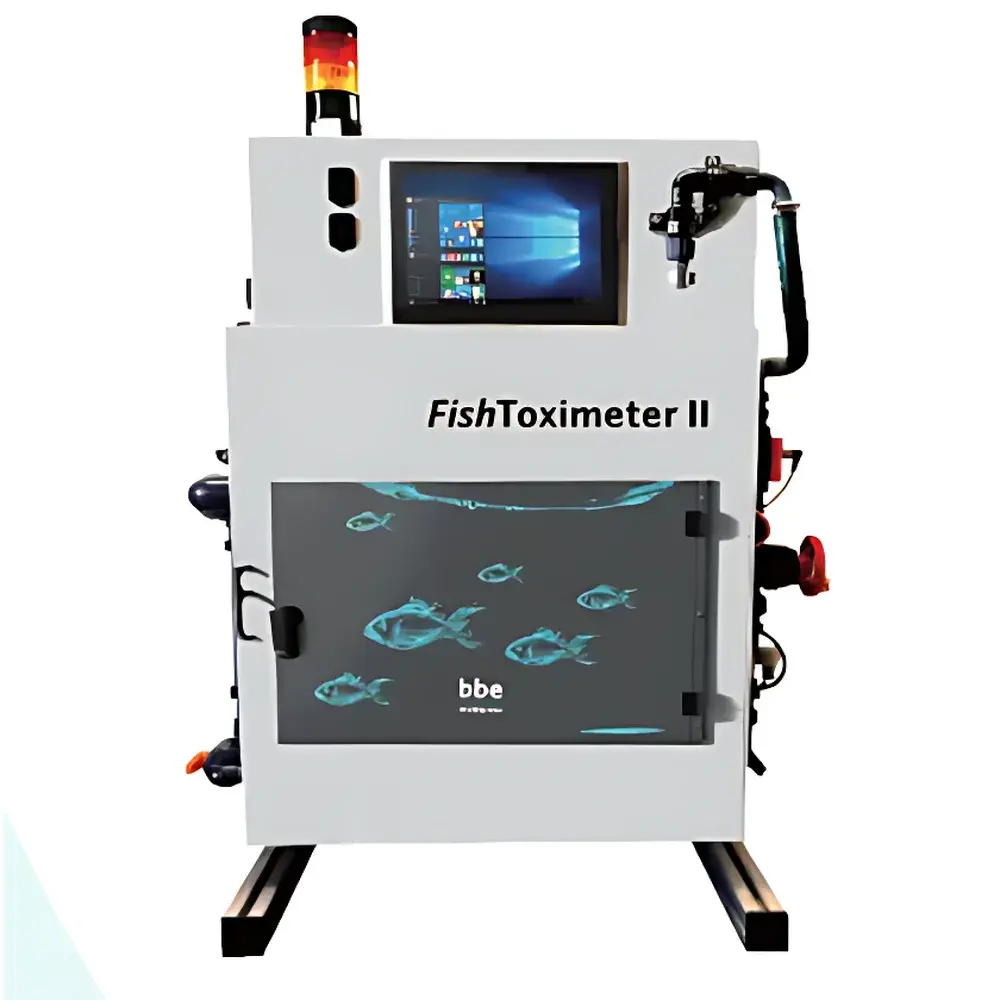
BBE Fish Toximeter II Video-Based Behavioral Toxicity Analyzer
| Brand | BBE Moldaenke |
|---|---|
| Origin | Germany |
| Manufacturer | BBE Moldaenke GmbH |
| Product Type | Online Water Toxicity Analyzer |
| Model | Fish Toximeter II |
| Operating Temperature Range | 5–28 °C |
| Test Organism | Zebrafish (Danio rerio) |
| Detection Principle | Real-time Video-Based Behavioral Analysis |
| Compliance Basis | Extended Dynamic Daphnia Test (EDDT)-aligned methodology, aligned with ISO 10706:2000 (Water quality — Guidance on toxicity testing using fish), EU WFD (Water Framework Directive) monitoring principles |
Overview
The BBE Fish Toximeter II is an online, real-time aquatic toxicity monitoring system engineered for continuous, non-invasive assessment of water quality using zebrafish (Danio rerio) as the biological indicator. It operates on the principle of video-based behavioral toxicology: high-resolution imaging captures spontaneous swimming behavior—including velocity, vertical distribution (swim height), cruising frequency, trajectory complexity (fractal dimension), and mortality onset—under controlled hydrodynamic and thermal conditions. These behavioral endpoints are quantitatively linked to neuro-muscular, respiratory, and sensory disruption caused by acute or subacute exposure to toxicants. Unlike endpoint-based assays (e.g., LC50 determination), the Fish Toximeter II delivers dynamic, time-resolved toxicity signatures with response onset typically within 3–5 minutes following contaminant introduction—enabling early warning for source-water protection, process water safety, and regulatory compliance monitoring.
Key Features
- Continuous online operation with automated sample intake via integrated inlet manifold and flow-regulated measurement chamber (standard dimensions: 27 × 27 cm; customizable upon request)
- Integrated thermostatic control system maintaining stable water temperature between 5 °C and 28 °C—critical for consistent behavioral baseline and assay reproducibility
- Dedicated LED illumination optimized for low-glare, uniform backlighting to maximize contrast in real-time video acquisition
- USB-connected industrial-grade camera with adjustable frame rate and resolution, synchronized with proprietary image-processing algorithms
- Onboard automatic feeding module ensuring standardized nutritional status across test cycles—minimizing confounding physiological variability
- Multi-channel alarm architecture: local audible/visual alerts, remote notification via SMS, email, or fax; configurable threshold logic for individual behavioral parameters
- Modular hardware design compliant with IP65 enclosure rating for deployment in utility corridors, pump stations, and laboratory wet areas
Sample Compatibility & Compliance
The Fish Toximeter II is validated for use with raw surface water, treated drinking water, industrial process influents (e.g., beverage, pharmaceutical, food manufacturing), and wastewater effluents. It detects broad-spectrum toxicity from organic pollutants (e.g., organophosphates, carbamates, phenols, PAHs), inorganic stressors (e.g., Cu²⁺, Zn²⁺, Cd²⁺, cyanide), algal biotoxins (e.g., microcystins), and petroleum-derived hydrocarbons. Its sensitivity profile aligns with the Extended Dynamic Daphnia Test (EDDT) framework—a harmonized European approach referenced in national water monitoring programs. While not a replacement for standardized OECD or ISO acute toxicity tests, the system satisfies Tier-1 screening requirements under the EU Water Framework Directive (2000/60/EC) and supports GLP-aligned operational protocols when deployed with audit-trail-enabled software configuration.
Software & Data Management
The embedded BBE ToxiSoft v4.x platform provides real-time visualization of all behavioral metrics—including overlay of live swim trajectories on calibrated coordinate grids. All raw video streams, processed behavioral time-series, and system metadata (temperature, flow rate, alarm events) are timestamped and stored locally in encrypted binary format. Historical datasets export natively to CSV or Excel (.xlsx) for integration into LIMS or statistical analysis environments (e.g., R, Python pandas). Calibration routines include motion-detection sensitivity tuning, background subtraction validation, and inter-chamber behavioral baseline verification. Software supports 21 CFR Part 11-compliant user access control, electronic signatures, and immutable audit trails—facilitating regulatory submissions and internal QA/QC documentation.
Applications
- Drinking water source protection: Early detection of accidental or intentional contamination at reservoir intakes and river abstraction points
- Industrial process water safety: Continuous monitoring of pre-treatment influents in food & beverage, pharmaceutical, and semiconductor facilities
- Wastewater treatment plant (WWTP) effluent compliance: Screening for chronic toxicity prior to environmental discharge
- Toxicological research: Mechanistic studies on behavioral neurotoxicity, mixture effects, and adaptive responses in zebrafish models
- Academic teaching laboratories: Hands-on instruction in ecotoxicology, environmental risk assessment, and bioanalytical instrumentation
FAQ
What fish species does the Fish Toximeter II use, and why is it standardized?
Zebrafish (Danio rerio) is used due to its well-characterized genome, high fecundity, transparent larvae, and conserved vertebrate neurophysiology—making it a globally accepted model in regulatory ecotoxicology and OECD test guidelines.
Can the system operate unattended for extended periods?
Yes—designed for 7×24 operation with automated feeding, self-diagnostic routines, and redundant data logging; routine maintenance intervals are specified at 30-day intervals under typical municipal water conditions.
Does the instrument require daily calibration with reference toxicants?
No—behavioral baselines are established during acclimation (typically 24–48 h); calibration focuses on optical alignment and motion-detection thresholds—not chemical standards—ensuring operational robustness without consumable reagents.
How is data integrity ensured during power interruptions or network outages?
All critical measurements are buffered in non-volatile memory; system state and last 72 hours of behavioral time-series persist through full power loss and restore automatically upon reboot.
Is the Fish Toximeter II suitable for seawater or brackish applications?
Standard configuration is optimized for freshwater matrices; saline adaptation requires optional corrosion-resistant chamber materials and salinity-compensated behavioral algorithms—available as custom-engineered variants.
Related Products







