
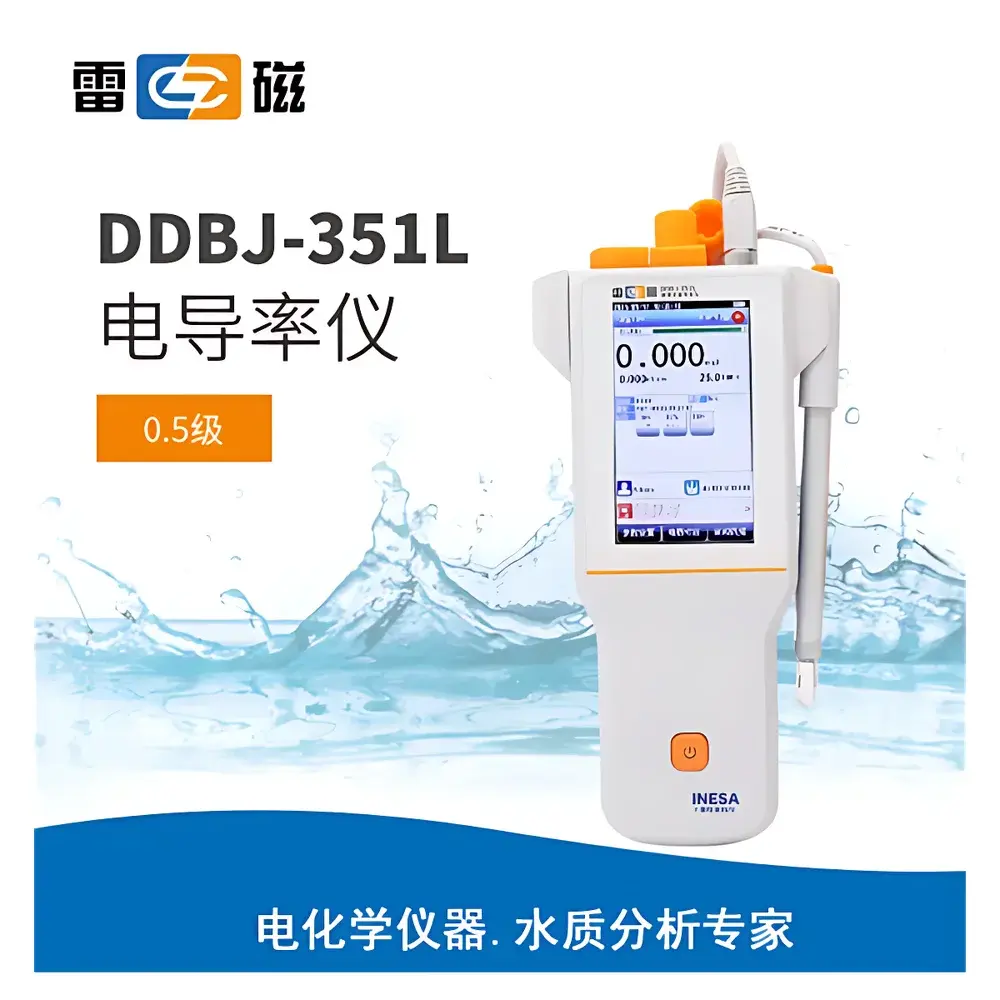
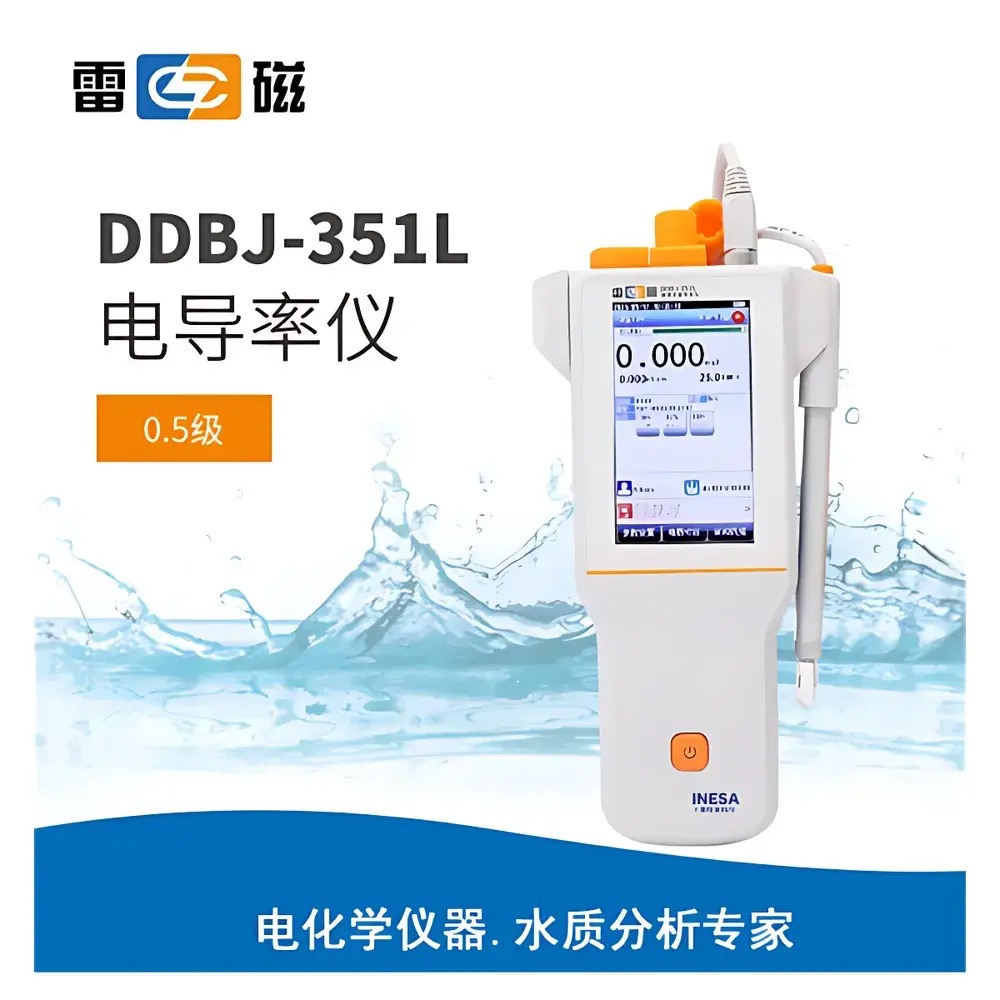
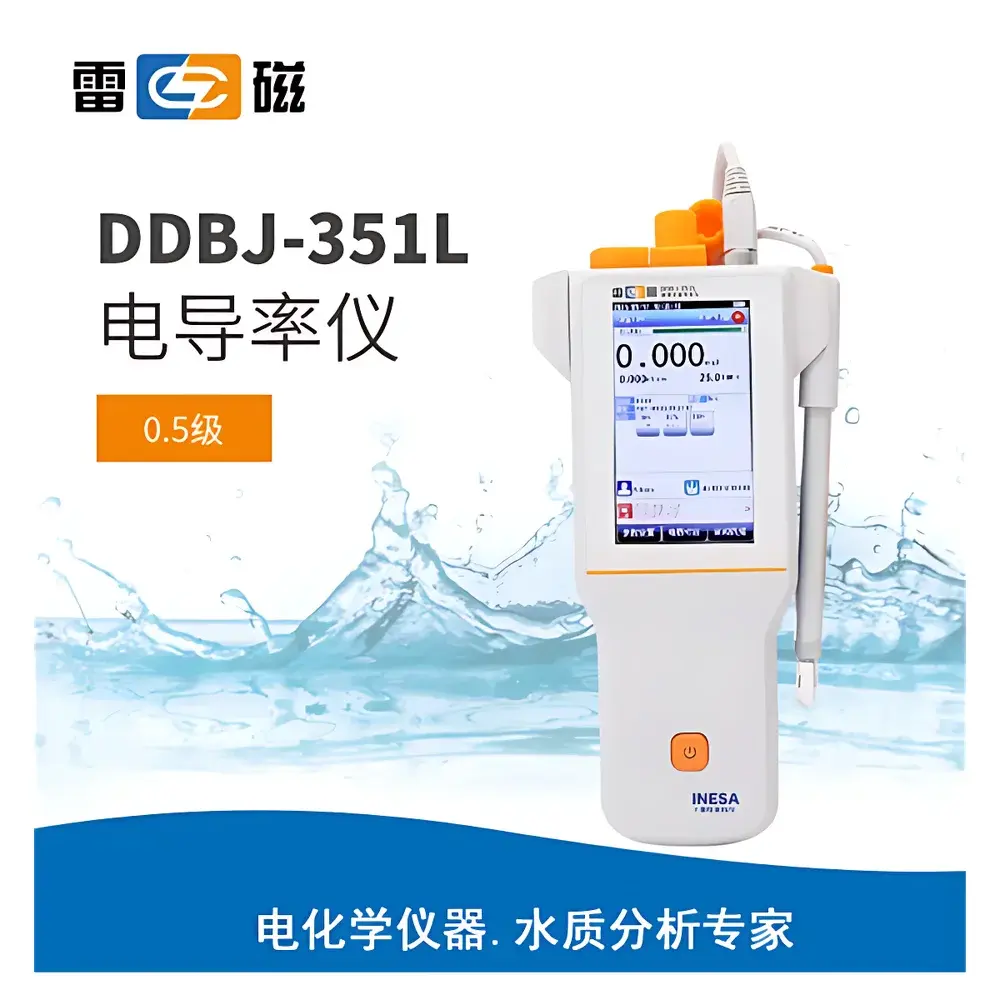
Leici DDBJ-351L Portable Conductivity Meter
| Brand | Leici |
|---|---|
| Origin | Shanghai, China |
| Manufacturer Type | Authorized Distributor |
| Product Origin | Domestic (China) |
| Model | DDBJ-351L |
| Detection Parameters | Multi-parameter (Conductivity, TDS, Resistivity, Salinity, Temperature) |
| Portability | Handheld / Field-Deployable |
| Intended Use | Laboratory, Field Sampling, and Quality Control Environments |
| Conductivity Range | 0.000 μS/cm to 3000 mS/cm |
| TDS Range | 0.000 mg/L to 1000 g/L |
| Resistivity Range | 5.00 Ω·cm to 100.0 MΩ·cm |
| Salinity Range | 0.00–8.00% (w/w) |
| Temperature Range | −10.0 to 135.0 °C / 14.0 to 275.0 °F |
| Accuracy | ±0.5% of Full Scale |
| Minimum Resolution | 0.001 μS/cm (auto-ranging) |
Overview
The Leici DDBJ-351L Portable Conductivity Meter is a high-precision, multi-parameter electrochemical analyzer engineered for reliable field and laboratory measurement of conductivity, total dissolved solids (TDS), resistivity, salinity, and temperature. Based on four-electrode or two-electrode AC conductivity measurement principles—optimized to minimize polarization effects and electrode fouling—the instrument delivers stable, reproducible results across an exceptionally wide dynamic range (0.000 μS/cm to 3000 mS/cm). Its modular electrode architecture supports automatic cell constant recognition and intelligent frequency switching, enabling seamless full-range coverage with a single 1.0 cm−1 sensor while recommending lower-constant electrodes (0.1 or 0.01 cm−1) for ultra-low-conductivity samples (<20 μS/cm), such as ultrapure water or pharmaceutical process streams. Designed for compliance-critical workflows, the DDBJ-351L operates under programmable reference temperatures (5.0–25.0 °C), supports linear, non-compensated, and pure-water-specific compensation models, and meets fundamental requirements for data integrity in regulated environments.
Key Features
- 7-inch HD color capacitive touchscreen with intuitive icon-driven UI and dual-language support (English/Chinese)
- IP65-rated enclosure for dust resistance and protection against low-pressure water jets—suitable for humid labs, cleanrooms, and outdoor sampling sites
- Integrated rechargeable lithium-ion battery with real-time charge status indicator, low-voltage warning, and USB-C/PC-compatible charging
- Smart electrode management: auto-recognition of standard (GB & ISO) calibration solutions; 1–5-point conductivity calibration with alert-driven recalibration reminders
- Advanced endpoint detection algorithms supporting auto-read, timed-read, interval-read, and manual capture modes
- Configurable temperature compensation: selectable reference temperatures (5.0, 10.0, 15.0, 18.0, 20.0, 25.0 °C) and dual-unit display (°C/°F)
- Built-in Bluetooth 5.0 and USB 2.0 interfaces for wireless data streaming and secure PC synchronization; U-disk read/write capability and optional barcode scanner integration
Sample Compatibility & Compliance
The DDBJ-351L accommodates aqueous samples across diverse matrices—including potable water, wastewater, boiler feedwater, pharmaceutical buffers, food extracts (e.g., fruit syrup ash analysis per AOAC 981.12), and sugar refinery effluents. Its auto-ranging resolution (0.001 μS/cm minimum) and multi-compensation logic ensure metrological consistency from deionized water (≥5 MΩ·cm) to saturated brines (up to 8.00% salinity). The system complies with core elements of GLP (Good Laboratory Practice) and supports audit-ready operation: user-level access control with password-protected privilege tiers, electronic signature-capable method storage, timestamped calibration logs, and full traceability of measurement history. While not pre-certified to FDA 21 CFR Part 11, its data export structure (CSV/Excel via Leici LabLink software) and immutable log architecture align with validation pathways for regulated QC/QA laboratories.
Software & Data Management
Data handling is governed by an embedded operating system supporting up to 1000 individual measurement records per parameter type. Each entry includes sample ID, operator ID, electrode serial number, calibration status, ambient temperature, and full metadata tagging. Statistical functions include mean, SD, RSD, min/max, and trend visualization. Export protocols support direct transfer to LIMS via USB or Bluetooth, and raw datasets are compatible with Leici’s LabLink desktop application for advanced reporting, certificate generation (per ISO/IEC 17025 templates), and long-term archival. Firmware updates are delivered via signed OTA packages to maintain cryptographic integrity and functional extensibility without hardware modification.
Applications
- Environmental monitoring: surface water conductivity profiling, groundwater salinity screening, and wastewater discharge compliance (EPA Method 120.1)
- Pharmaceutical manufacturing: USP conductivity verification of purified water and water-for-injection (WFI)
- Food & beverage QA: ash content estimation in sucrose syrups and high-fructose corn syrup (HFCS) per AOAC official methods
- Power generation: cycle chemistry control in steam turbines and condensate polishing systems
- Educational labs: hands-on instruction in solution conductivity theory, Kohlrausch’s law, and temperature dependence modeling
FAQ
What electrode constants are supported, and how does auto-frequency switching improve accuracy?
The DDBJ-351L automatically selects optimal excitation frequencies (10 Hz–10 kHz) based on measured conductance, minimizing capacitive reactance errors and enabling robust performance with 0.01, 0.1, or 1.0 cm−1 cells. This eliminates manual range switching and reduces operator-induced variability.
Does the instrument meet international calibration standards?
Yes—it recognizes GB/T 6682 and ISO 7888 reference solutions and supports multi-point calibration traceable to NIST-traceable KCl standards. Calibration certificates can be generated with uncertainty budgets per ISO/IEC 17025 guidelines.
Can measurement data be integrated into an enterprise LIMS?
Absolutely. Through USB mass-storage mode or Bluetooth RFCOMM profiles, structured CSV exports include all required metadata fields (operator, time, location tag, calibration ID) for automated ingestion into common LIMS platforms.
Is temperature compensation customizable for non-aqueous solvents?
While optimized for aqueous systems, the linear compensation coefficient (α) is user-adjustable within 0.000–10.000 %/°C, allowing empirical adaptation for ethanol-water or glycol-based formulations where published α values differ from standard 2.0%/°C.
How is data security enforced during multi-user operation?
Three-tier role-based access (Admin, Supervisor, Operator) enforces segregation of duties. Passwords require minimum length and complexity; failed login attempts trigger lockout policies, and all critical actions (calibration, method edit, data deletion) generate immutable audit trails with timestamps and user IDs.
Related Products



