
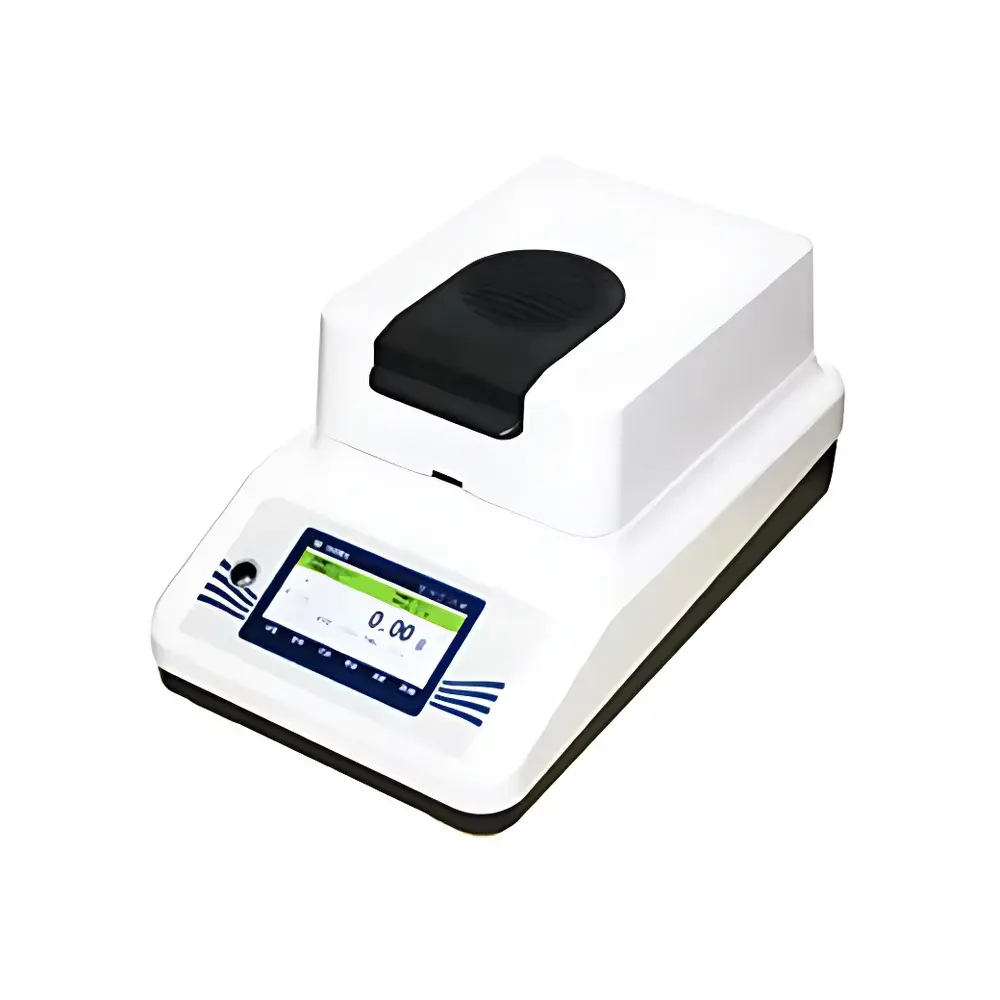
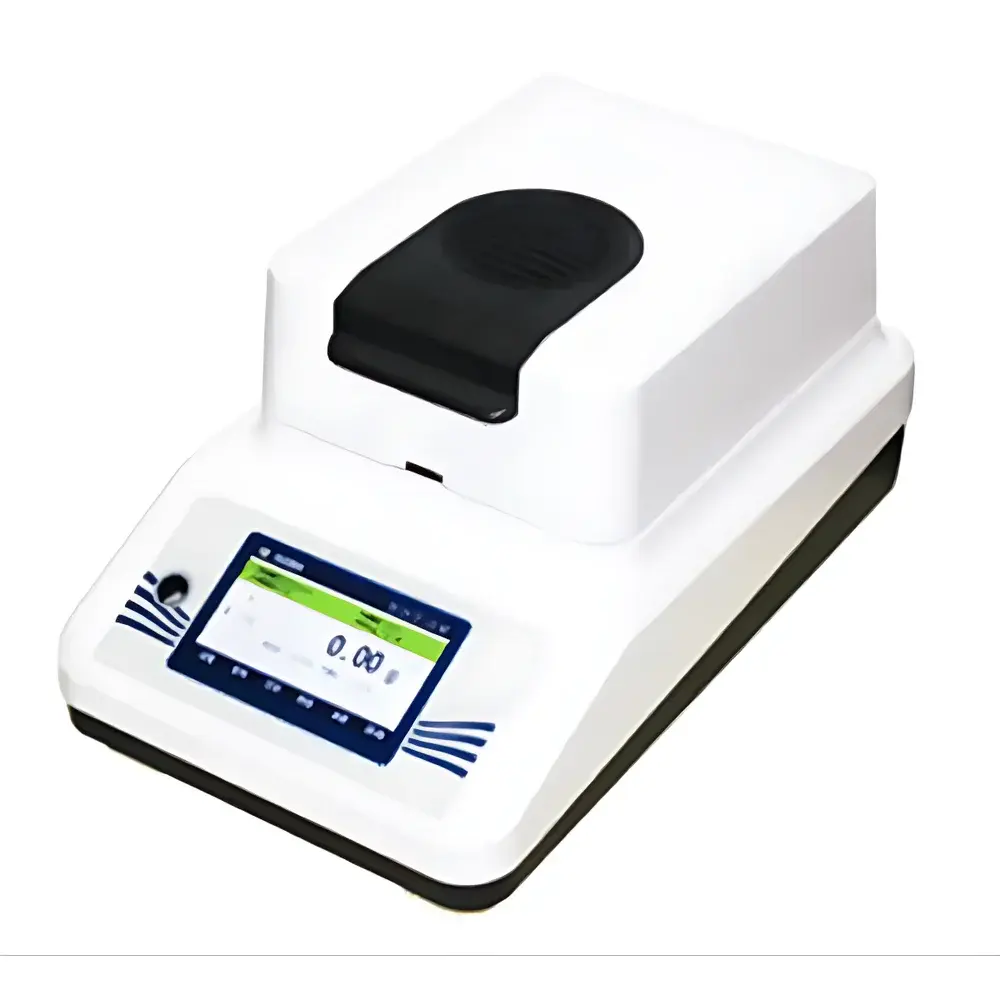
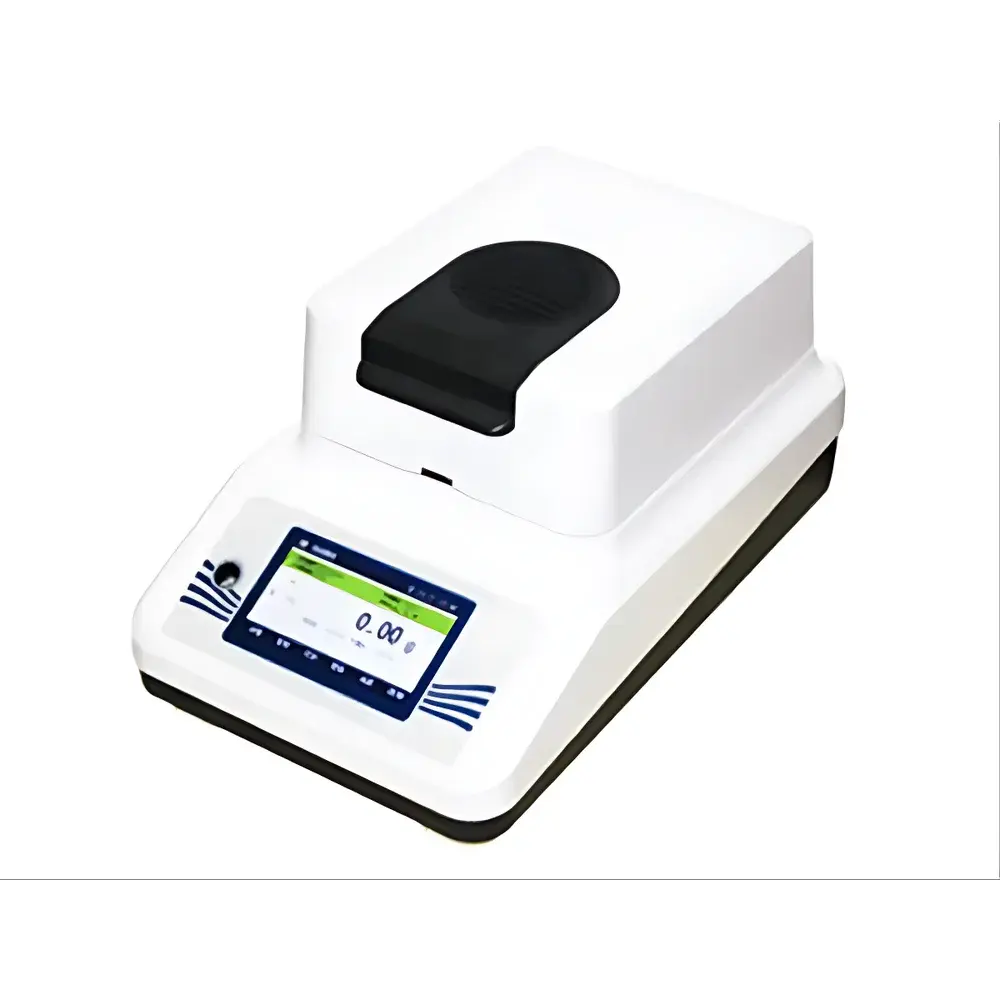
Yoke TSF-10A Touchscreen Halogen Moisture Analyzer
| Brand | Yoke |
|---|---|
| Origin | Shanghai, China |
| Model | TSF-10A |
| Heating Source | Halogen Lamp |
| Display | 4.3-inch Capacitive Touch LCD |
| Readability | 0.01% (moisture) / 1 mg (mass) |
| Compliance | GB/T 29249–2012 |
| Interface | RS232 for Printer & PC Connection |
| Sample Pan Diameter | 90 mm |
| Max Sample Weight | 100 g |
| Temperature Range | 50–180 °C (adjustable in 1 °C increments) |
| Drying Modes | Standard, Rapid, Step, Timer, Auto-Stop |
Overview
The Yoke TSF-10A Touchscreen Halogen Moisture Analyzer is a precision laboratory instrument engineered for rapid, gravimetric determination of moisture content in solid and semi-solid samples using the loss-on-drying (LOD) principle. It operates by applying controlled halogen heating to drive off volatile components—primarily water—while continuously monitoring mass loss via a high-stability, draft-shielded electromagnetic force compensation sensor. The system integrates thermal regulation and real-time mass acquisition into a single synchronized measurement cycle, eliminating reliance on empirical drying time or operator intervention. Unlike conventional oven-drying methods requiring hours and manual weighing, the TSF-10A delivers statistically equivalent results to reference ASTM E1064 and ISO 712 methodologies in typically 3–8 minutes, with full automation of endpoint detection based on mass stabilization criteria (e.g., ≤0.1 mg/min over 60 s). Its design adheres to the metrological requirements defined in GB/T 29249–2012 for electronic moisture analyzers utilizing thermogravimetric principles.
Key Features
- Halogen heating module with precise digital temperature control (50–180 °C, ±1 °C accuracy), enabling rapid thermal response and uniform sample surface heating
- High-resolution electromagnetic force compensation weighing sensor (1 mg readability, ≥100 g capacity) housed in an integrated draft shield enclosure to minimize environmental drift
- 4.3-inch capacitive touch LCD interface supporting intuitive navigation, parameter configuration (drying profile, target temperature, stop criteria), and real-time graphical display of mass vs. time and moisture % vs. time curves
- Five built-in drying modes: Standard (continuous heating until stabilization), Rapid (high-power initial ramp), Step (multi-stage temperature programming), Timer (fixed-duration drying), and Auto-Stop (termination upon user-defined mass change threshold)
- RS232 serial port compliant with standard protocols for direct connection to thermal printers or Windows-based PCs; supports data export in CSV format for traceable recordkeeping
- Robust aluminum alloy chassis with heat-dissipating ventilation design, calibrated per internal self-test routines prior to each measurement cycle
Sample Compatibility & Compliance
The TSF-10A accommodates a broad range of non-volatile and low-volatility matrices including pharmaceutical excipients (lactose, microcrystalline cellulose), food powders (flour, sugar, milk powder), agricultural grains (corn, soybean meal), feed pellets, polymer granules, and inorganic salts. Samples must be homogeneous, non-corrosive, and thermally stable below 180 °C to avoid decomposition artifacts. The instrument meets national verification requirements under GB/T 29249–2012 and supports compliance workflows aligned with GLP and GMP environments through repeatable method storage (up to 20 user-defined profiles), audit-ready printouts with timestamp, operator ID, and method name, and optional integration with LIMS via ASCII protocol. While not FDA 21 CFR Part 11–certified out-of-the-box, its deterministic output and immutable measurement logs support validation under internal SOPs.
Software & Data Management
No proprietary software installation is required: raw measurement data—including start/end mass, final moisture %, drying curve coordinates, and system diagnostics—are transmitted in plain-text ASCII via RS232 and can be captured using terminal emulators (e.g., Tera Term) or imported directly into Excel, LabArchives, or ELN platforms. Each test generates a structured header line (date, time, method ID, sample ID, temperature setpoint, final moisture %, standard deviation across triplicates if enabled) followed by time-stamped mass readings at 1-second intervals. Internal memory retains the last 100 test records with full metadata; external archiving is recommended for long-term regulatory retention. Calibration certificates (linearity, repeatability, eccentricity) are generated using certified weights traceable to NIM (National Institute of Metrology, China).
Applications
This analyzer serves as a primary QC tool in regulated manufacturing settings where moisture specification is critical to stability, flowability, dissolution rate, or microbial resistance. In pharmaceutical production, it verifies residual solvent levels in active pharmaceutical ingredients (APIs) post-fluid-bed drying. In food safety labs, it quantifies water activity precursors in snack products and cereal blends per Codex Alimentarius guidelines. Feed mills use it to optimize pelleting moisture for binder efficacy and storage mold prevention. Research applications include kinetic studies of dehydration pathways in hydrogels and comparative hygroscopicity screening of desiccant materials. All applications benefit from its ability to replace multi-step oven/cooling/balance protocols without sacrificing equivalence to reference methods.
FAQ
How does the TSF-10A ensure equivalence to oven-drying methods?
It replicates the fundamental LOD principle but replaces ambient-air convection with directed halogen irradiation, achieving faster and more reproducible heat transfer. Validation studies per USP confirm correlation coefficients >0.995 against 105 °C forced-air ovens across 12 common matrix types.
Can I validate the instrument for GMP use?
Yes—IQ/OQ protocols are supported via documented calibration procedures, performance qualification using certified moisture standards (e.g., sodium tartrate dihydrate), and configurable pass/fail limits for system suitability checks.
What maintenance is required?
Daily cleaning of the sample pan and chamber with lint-free cloth; quarterly verification of temperature uniformity using a NIST-traceable IR thermometer; annual sensor recalibration by authorized service center.
Is the halogen lamp replaceable by the user?
Yes—the lamp assembly is field-replaceable with no tools required; typical service life exceeds 5,000 hours under standard operating conditions.
Does it support multiple languages?
The firmware interface is English-only; however, exported CSV files retain Unicode compatibility for localization in downstream analysis software.
Related Products




