
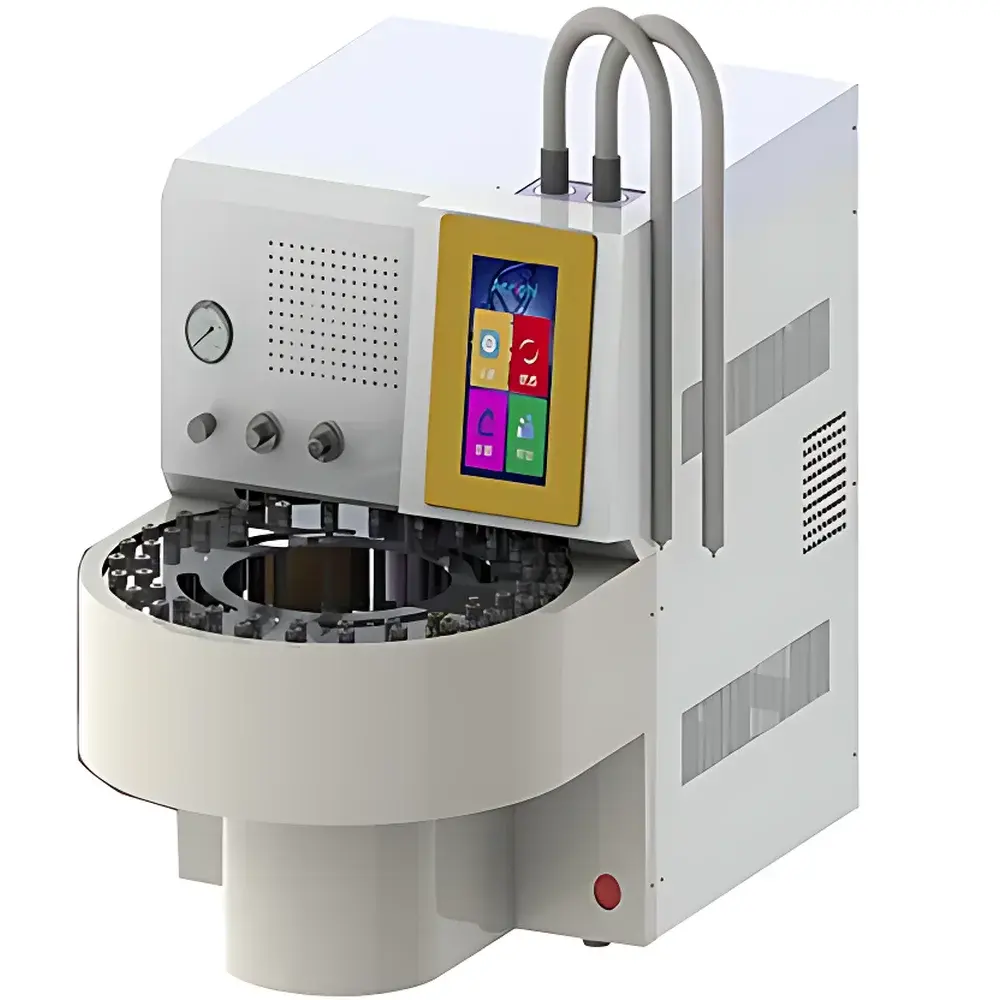
Acrichi ATD I-26D Automatic Dual-Channel Single-Stage Thermal Desorber
| Brand | Acrichi |
|---|---|
| Origin | Beijing, China |
| Model | ATD I-26D |
| Desorption Temperature Range | Ambient to 420 °C |
| Temperature Control Accuracy | ±1 °C (desorption furnace, six-port valve, transfer line) |
| Desorption Flow Rate | 0–300 mL/min, continuously adjustable |
| Desorption/Injection/Activation Time | 0–99 min |
| Sample Capacity | 52 positions (26 × 2 dual-channel configuration) |
| Trap Tube Dimensions | 6.35 mm OD × 88.9 mm L (1/4″ × 3.5″) |
| Power Consumption | 600 W |
| Dimensions (W×D×H) | 810 × 450 × 510 mm |
| Weight | ~35 kg |
| Desorption Recovery Rate | >98% |
| Valve Type | Heated six-port rotary valve |
| Interface | Touchscreen HMI, event-triggered GC start, 10 programmable methods |
Overview
The Acrichi ATD I-26D is an automatic dual-channel single-stage thermal desorber engineered for high-throughput, reproducible volatile organic compound (VOC) and semi-volatile organic compound (SVOC) analysis in conjunction with gas chromatography (GC) or GC–mass spectrometry (GC–MS). It operates on the principle of thermally driven desorption: analytes pre-concentrated on sorbent-packed tubes are rapidly heated under controlled inert gas flow, releasing trapped compounds into the GC inlet via a heated transfer line. Unlike two-stage systems, the ATD I-26D performs direct desorption without cryofocusing—making it optimal for routine environmental air monitoring, indoor air quality assessment, workplace exposure testing, and polymer off-gassing studies where robustness, method consistency, and operational simplicity are prioritized over ultra-trace detection limits.
Key Features
- Dual independent thermal desorption channels enable parallel processing of two sample tubes, effectively doubling throughput without compromising analytical integrity.
- Precisely regulated heating zones—including desorption furnace (ambient to 420 °C), six-port valve manifold (ambient to 220 °C), and transfer line (ambient to 220 °C)—all maintained within ±1 °C accuracy to eliminate cold spots and ensure quantitative analyte transfer.
- Integrated heated six-port rotary valve minimizes dead volume and enhances injection precision; valve and transfer line junctions reside entirely within the insulated thermal enclosure.
- Intuitive 7-inch capacitive touchscreen HMI supports full system control, real-time temperature/flow monitoring, method editing, and event logging—no external PC required for routine operation.
- Programmable desorption, injection, and tube activation durations (0–99 minutes), plus continuous mass flow control (0–300 mL/min) for optimized analyte elution profiles across diverse sorbent chemistries.
- Automated leak detection, thermal fault diagnostics, and audible/visual alarm notifications support unattended overnight runs and GLP-compliant laboratory workflows.
Sample Compatibility & Compliance
The ATD I-26D accommodates standard 1/4″ OD × 3.5″ (6.35 mm × 88.9 mm) stainless steel or quartz sorbent tubes packed with common media including Tenax TA, Carbopack B/C, Carboxen, and graphitized carbon blacks. Its 52-position carousel (26 per channel) enables batch processing aligned with EPA Method TO-17, ISO 16000-6, and ASTM D6196 requirements for ambient and indoor air sampling. While not certified to IEC 61000 or UL 61010 out-of-the-box, the instrument meets CE marking criteria for electromagnetic compatibility and low-voltage safety. Its software architecture supports audit trail generation and user-access-level controls suitable for laboratories operating under ISO/IEC 17025 or internal QA/QC protocols.
Software & Data Management
Onboard firmware stores up to 10 fully customizable thermal desorption methods—including temperature ramps, flow profiles, timing sequences, and GC trigger logic—with password-protected editing and version timestamping. All operational events (e.g., method execution start/stop, temperature deviations, valve actuation, alarm triggers) are logged locally with UTC timestamps. The system exports CSV-formatted run logs compatible with LIMS integration. External GC triggering follows TTL or contact-closure signaling per ASTM E260 and IUPAC GC interface standards. No proprietary data format is used; raw log files are human-readable and parseable by Python, R, or commercial lab informatics platforms.
Applications
- Regulatory compliance testing for VOC emissions from building materials (e.g., carpets, adhesives, paints) per ISO 16000-9 and ASTM D5116.
- Occupational hygiene monitoring of airborne benzene, toluene, ethylbenzene, xylenes (BTEX), and aldehydes in industrial settings.
- Quality control of activated carbon filters, air purifiers, and HVAC duct sampling media.
- Method development and validation for headspace analysis of residual solvents in pharmaceutical packaging per USP .
- Research-scale screening of polymer degradation products, fragrance release kinetics, and electronic cigarette aerosol composition.
FAQ
Does the ATD I-26D support cold trapping or cryofocusing?
No. It is a single-stage thermal desorber designed for direct desorption into the GC inlet. Cryofocusing capability requires a separate secondary trap module not included in this model.
Can I use non-standard tube dimensions?
Only 1/4″ OD × 3.5″ tubes are mechanically and thermally compatible. Adapters for alternative formats are not supplied or validated.
Is remote monitoring or network connectivity available?
The unit lacks Ethernet/Wi-Fi interfaces. Remote status checks require local HMI access or integration via dry-contact outputs to building management systems.
What maintenance intervals are recommended?
Valve rotor seal replacement every 10,000 cycles; quartz liner cleaning after every 200 runs; annual calibration verification of all temperature sensors per ISO/IEC 17025 Clause 6.5.
How is method traceability ensured for audit purposes?
Each run records method ID, operator login (if enabled), start time, actual setpoints vs. measured values, and anomaly flags—exportable as immutable CSV for regulatory review.





