
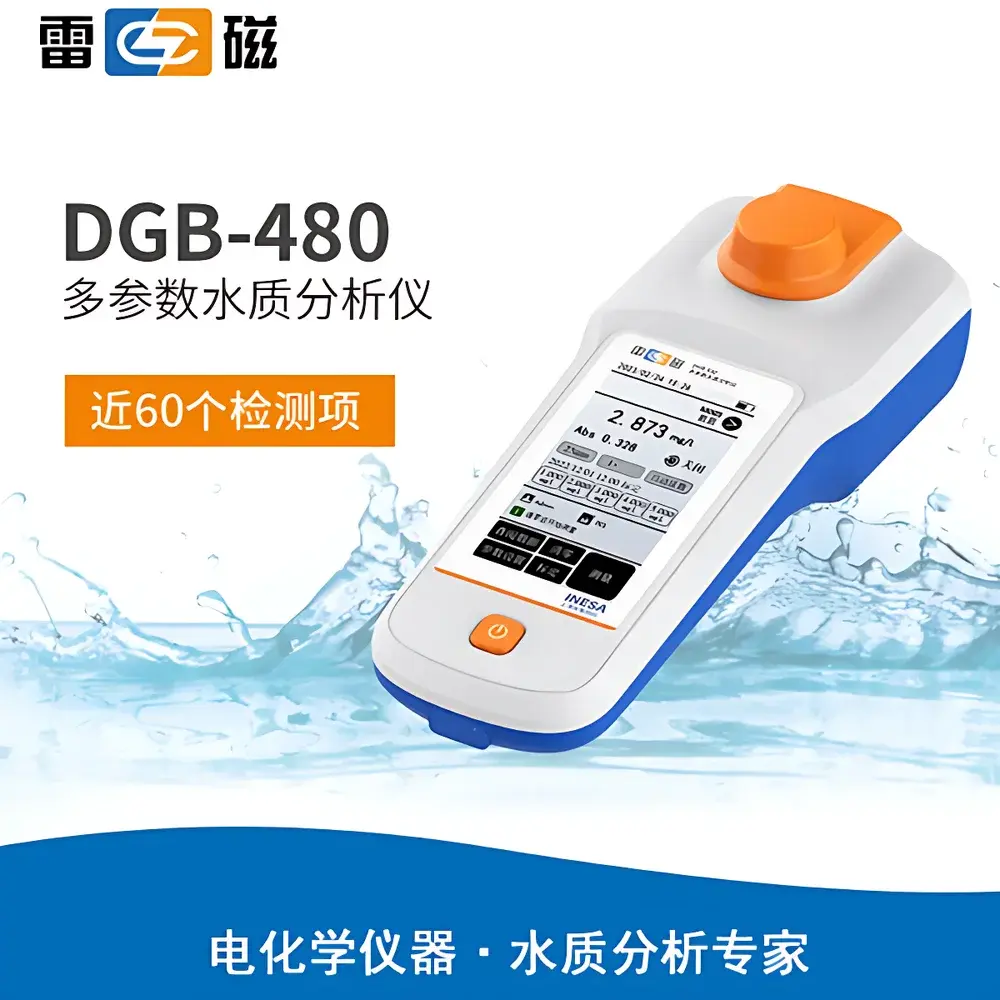
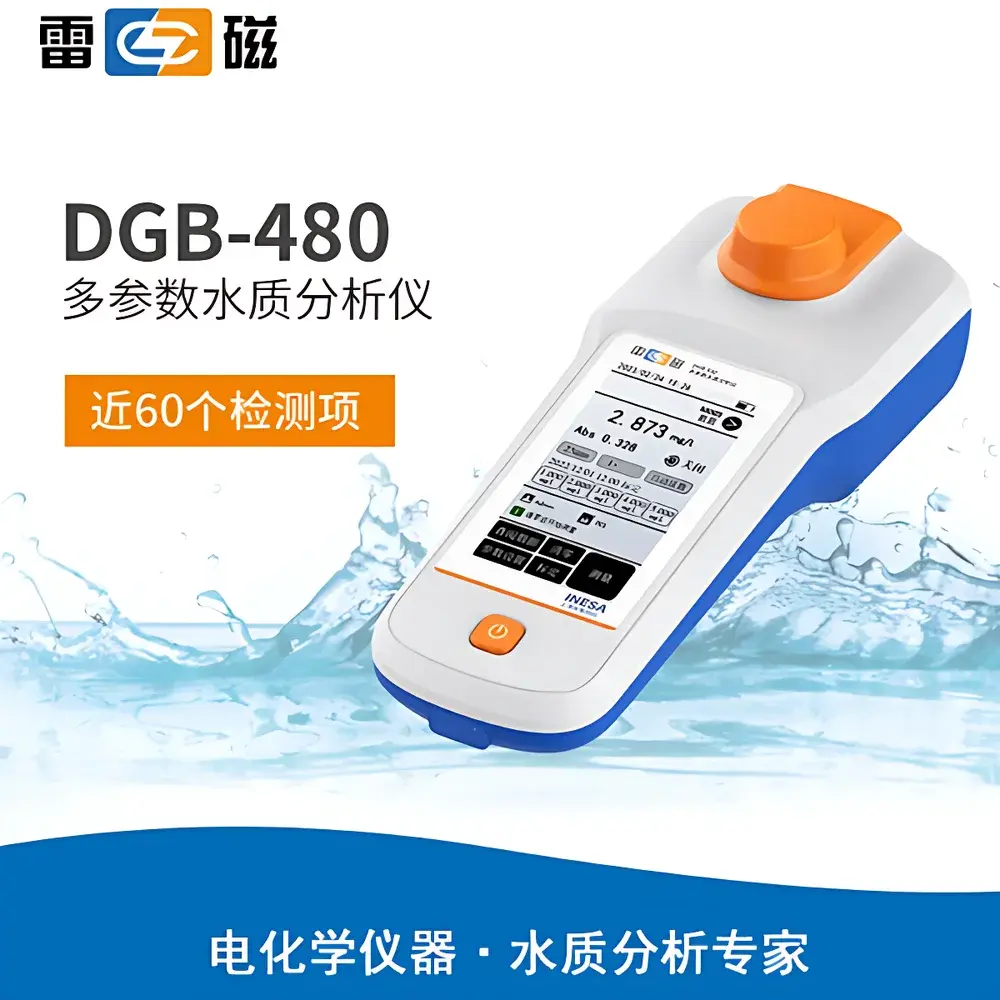
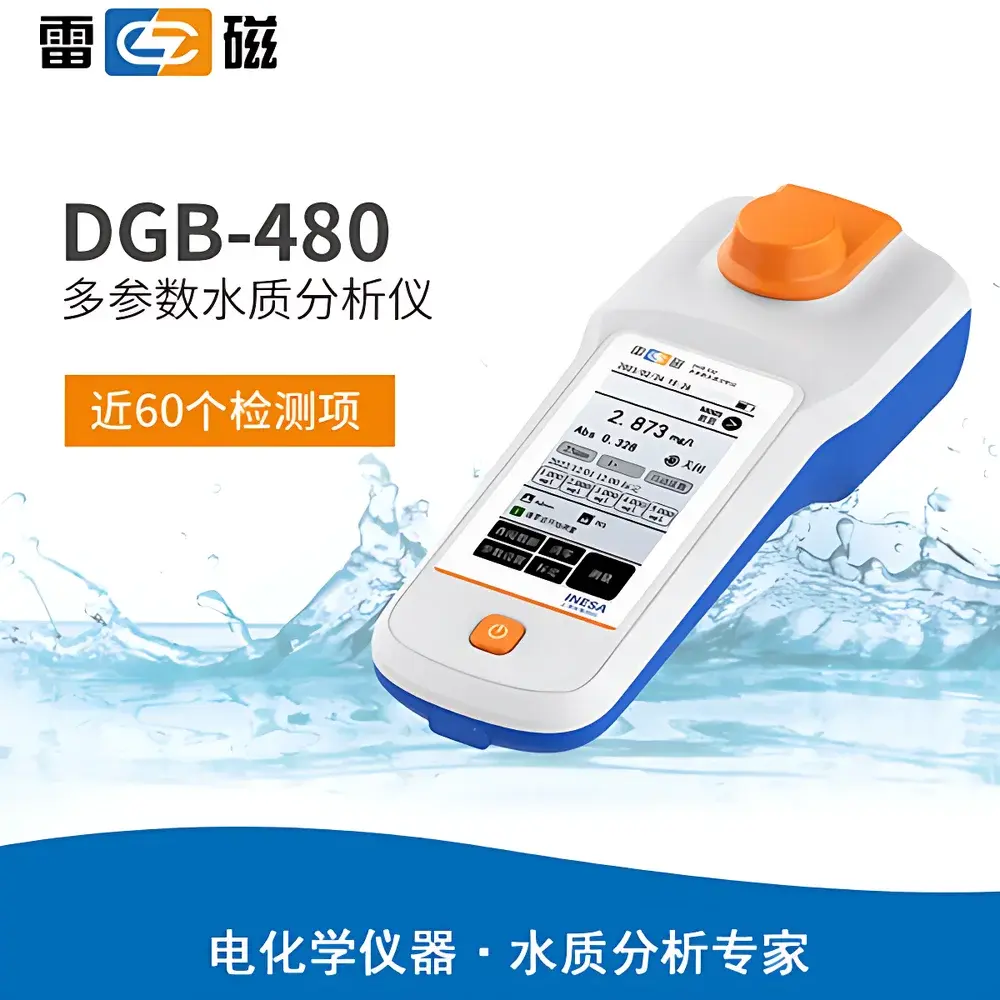
Leici DGB-480 Portable Multi-Parameter Water Quality Analyzer
| Brand | Leici |
|---|---|
| Origin | Shanghai, China |
| Manufacturer Type | Authorized Distributor |
| Country of Origin | China |
| Model | DGB-480 |
| Instrument Type | Portable / Handheld Water Quality Analyzer |
| Detection Principle | Colorimetry |
| Detection Parameters | Turbidity, Color, Transmittance Ratio, Ozone, Nitrite Nitrogen, Urea, Hexavalent Chromium, Manganese, Total Nitrogen, Nitrate Nitrogen, Nitrate, Formaldehyde, Water Hardness, Zinc, Nitrite, Free Chlorine, Total Chlorine, Chlorine Dioxide, Permanganate Index, Low-Concentration COD<sub>Cr</sub>, High-Concentration COD<sub>Cr</sub>, Cadmium, Ammonia Nitrogen, Ammonium Ion, Total Phosphorus, Total Phosphate, Nickel, Ferrous Ion, Iron, Sulfite |
| Measurement Range | Ammonia Nitrogen 0.03–10.00 mg/L |
| Repeatability | ≤0.5% |
Overview
The Leici DGB-480 Portable Multi-Parameter Water Quality Analyzer is an engineered field-deployable instrument designed for rapid, reliable, and standardized colorimetric analysis of water samples in compliance with international methodological frameworks. It operates on the principle of absorbance-based photometry, utilizing discrete-wavelength LED light sources to quantify analyte-specific chromophore formation following chemical reaction with proprietary or user-prepared reagents. The system integrates six fixed-wavelength LEDs (420 nm, 470 nm, 515 nm, 540 nm, 620 nm, and 650 nm) for conventional colorimetric assays, a dedicated 365 nm UV LED for color measurement per APHA/Hazen standards, and an 850 nm infrared LED configured for 90° nephelometric turbidity detection in strict adherence to ISO 7027. This optical architecture ensures high spectral selectivity, minimal interferences, and robust performance across diverse matrix types — including drinking water, swimming pool water, surface water, and wastewater effluents.
Key Features
- Multi-wavelength photometric platform supporting up to 60 pre-programmed and expandable test methods — covering metals (e.g., Cr(VI), Cd, Ni, Fe, Mn, Zn), inorganic ions (e.g., NO3−-N, NO2−-N, NH4+, PO43−, SO42−, Cl−), disinfectants (free/total chlorine, ClO2, O3, H2O2), organic surrogates (formaldehyde, urea, phenol), and integrated indices (CODCr, permanganate index, total nitrogen/phosphorus).
- Flexible reagent compatibility: supports both Leici-certified reagent kits and validated third-party or in-house prepared reagents — enabling method customization without hardware modification.
- Intelligent endpoint detection with auto-read and continuous-read modes; configurable readout units (absorbance, transmittance %, concentration) and automatic dilution factor compensation for direct reporting of original sample concentration.
- Calibration flexibility: built-in standard curves for 20 parameters plus user-defined calibration (1–5 point) with non-linear fitting options; supports custom curve import via USB.
- Robust data governance: GLP-compliant audit trail with time-stamped measurements, operator ID assignment (up to 8 users, 3-tier access control), sample ID tagging, and full traceability for regulatory review.
- Field-optimized power management: rechargeable Li-ion battery (≥12 h typical operation), USB-C direct powering, PC/mobile power bank charging, and real-time battery status indication.
Sample Compatibility & Compliance
The DGB-480 accommodates standard cylindrical cuvettes (Φ16 mm) and larger-volume vials (Φ25 mm), ensuring compatibility with widely adopted sampling protocols and certified reference materials. Its turbidity module meets ISO 7027 for Formazin-based calibration verification, while colorimetric assays align with ASTM D1208 (color), ASTM D511 (calcium/magnesium hardness), ASTM D3370 (nitrate/nitrite), and EPA Method 350.1 (ammonia). The instrument’s firmware and data handling architecture support audit-ready workflows compliant with ISO/IEC 17025, USP , and FDA 21 CFR Part 11 requirements when paired with validated software and procedural controls.
Software & Data Management
Data storage capacity exceeds 2,000 complete measurement records, each retaining full metadata: date/time stamp, operator ID, sample ID, method name, raw absorbance values, calibration curve used, dilution factor, and final concentration. Export is supported via USB mass-storage mode or RS-232 serial interface (compatible with standard thermal printers). Optional Leici PC communication software enables secure bidirectional transfer, statistical summary generation (mean, SD, CV%), trend plotting, and CSV/PDF report export — all traceable to individual user sessions. Firmware updates are delivered via encrypted USB drive to maintain integrity and version control.
Applications
The DGB-480 serves as a primary analytical tool in municipal water quality surveillance, recreational water safety monitoring (swimming pools, spas), environmental field assessment (rivers, lakes, reservoirs), wastewater treatment plant process control, and emergency response screening. Its portability and battery autonomy make it suitable for unpowered remote sites, mobile laboratories, and routine QC checks where benchtop spectrophotometers are impractical. Regulatory applications include verification of compliance with WHO Guidelines for Drinking-water Quality, EU Directive 98/83/EC, and national standards such as GB/T 5750 (China) and EN ISO 10523 (pH), EN ISO 7027 (turbidity).
FAQ
Does the DGB-480 meet ISO 7027 for turbidity measurement?
Yes — its 850 nm infrared 90° scattering configuration and calibration protocol conform to ISO 7027:2016.
Can I use non-Leici reagents with this analyzer?
Yes — the instrument accepts user-developed or third-party reagents provided they generate stable, stoichiometric color reactions at the supported wavelengths.
Is data export compatible with LIMS systems?
Yes — exported CSV files contain structured fields (e.g., Sample_ID, Parameter_Name, Result_Value, Unit, Timestamp) for direct ingestion into most LIMS platforms.
What is the warranty and service coverage outside China?
Leici provides global warranty support through authorized regional distributors; calibration verification and firmware updates are available via certified service centers.
How is measurement repeatability verified during routine use?
Repeatability is assessed using certified reference standards (e.g., NIST-traceable turbidity suspensions, ammonia nitrogen CRM) per internal SOPs aligned with ISO 5725-2 precision criteria.







