
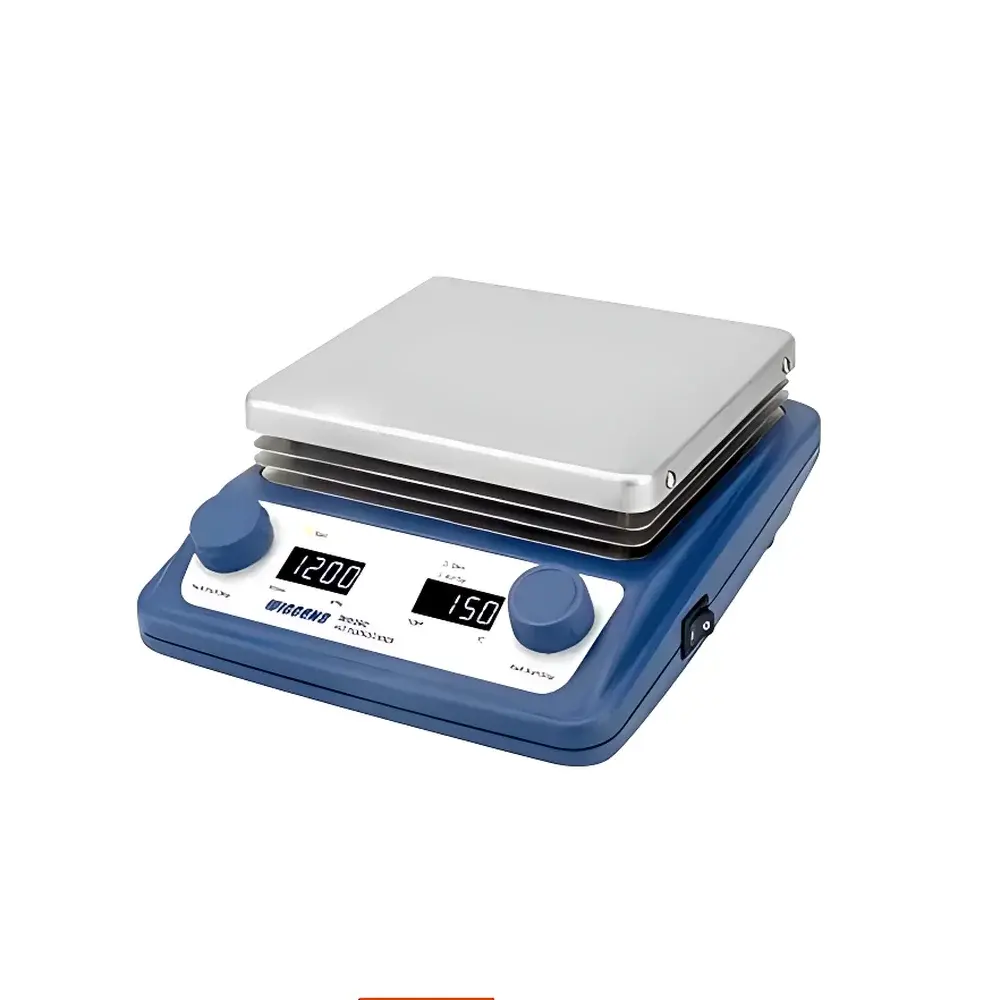
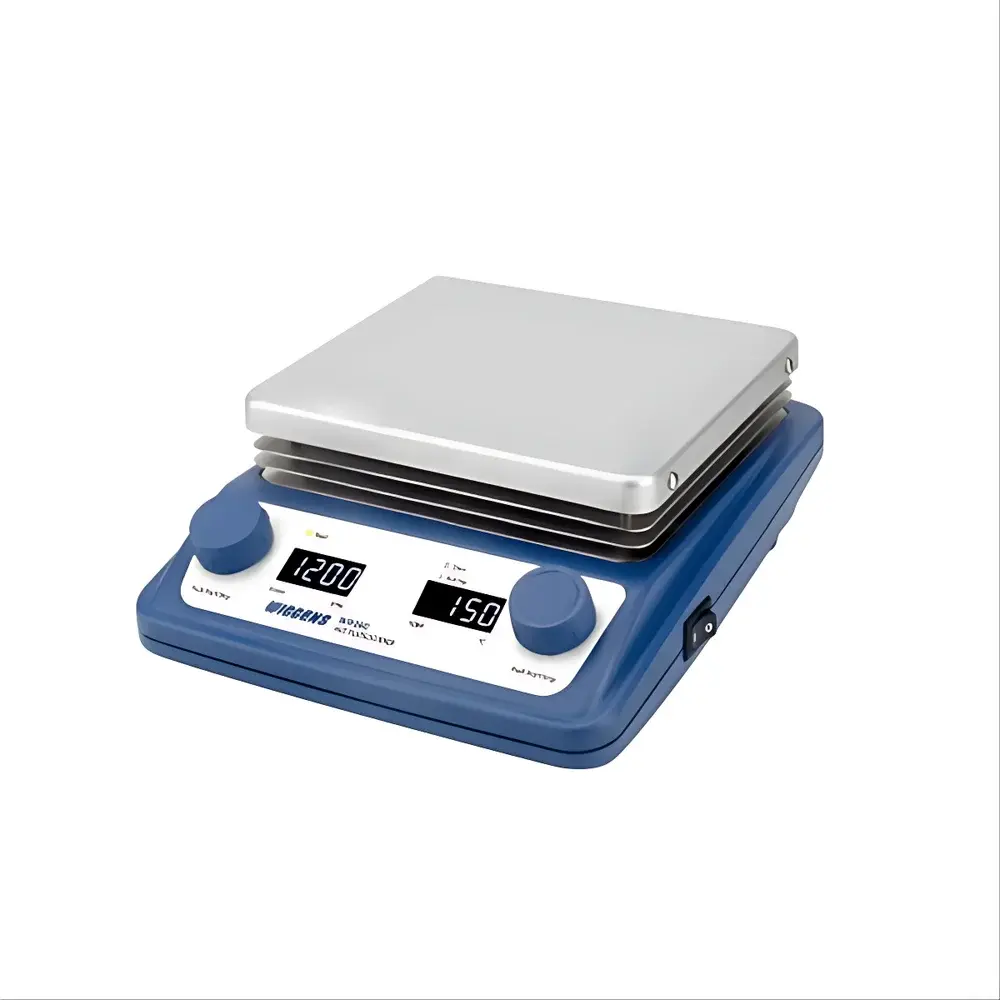
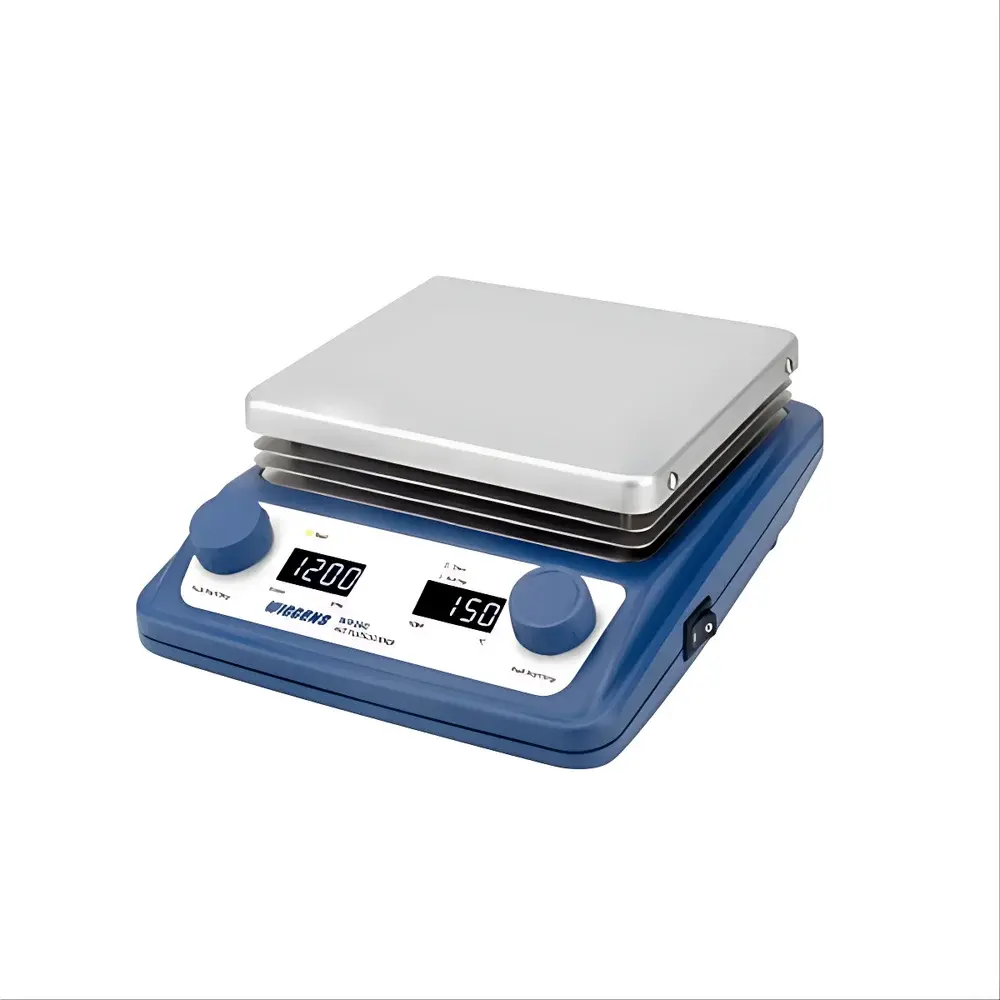
WIGGENS WH200 Heating Magnetic Stirrer
| Brand | WIGGENS |
|---|---|
| Origin | Germany |
| Model | WH200 |
| Stirrer Type | Magnetic Stirrer |
| Max. Stirring Volume | 20 L (in water) |
| Speed Range | 100–2000 rpm |
| Temperature Control Range | Ambient to 280 °C |
| Heating Plate Temp. Limit | ≤250 °C |
| Sample Temp. Control (with thermocouple) | ≤250 °C |
| Temp. Accuracy (with thermocouple) | ±1 °C |
| Safety Cut-off Temp. | 280 °C |
| Heating Power | 300 W |
| Stirring Speed Range (spec. sheet) | 100–1500 rpm |
| Heating Plate Material | Anodized Aluminum |
| Plate Dimensions | 165 × 150 mm |
| External Dimensions (W×D×H) | 230 × 200 × 100 mm |
| Weight | 1.5 kg |
| PID Control | Enabled |
| LED Display | Digital, Dual-Parameter (Temp. & Speed) |
| Safety Features | Overtemperature Alarm (E02), Thermal Runaway Protection, Splash-Resistant Grooved Control Panel, Sealed Enclosure |
Overview
The WIGGENS WH200 Heating Magnetic Stirrer is an engineered laboratory instrument designed for precise, reproducible temperature-controlled mixing of liquid samples in research, quality control, and teaching laboratories. It operates on the principle of magnetic coupling: a rotating permanent magnet beneath the heating plate induces synchronous rotation of a PTFE- or glass-coated stir bar immersed in the sample vessel. Simultaneous resistive heating of the aluminum alloy heating plate enables accurate thermal regulation—critical for applications requiring defined reaction kinetics, solubility studies, or viscosity assessments under controlled thermal conditions. Unlike basic stirrers, the WH200 integrates closed-loop PID temperature control with real-time digital feedback, supporting both plate-surface and sample-core temperature monitoring via optional PT100 or thermocouple sensors. Its robust mechanical architecture, sealed electronics housing, and splash-resistant control panel align with ISO/IEC 17025-compliant lab infrastructure requirements.
Key Features
- Microprocessor-based PID temperature control with dual-setpoint capability: independent adjustment of heating plate temperature and sample temperature (when equipped with external sensor)
- High-contrast LED display showing real-time speed (rpm) and temperature (°C) simultaneously; intuitive rotary encoder interface for parameter entry
- Automatic parameter retention: last-used speed and temperature settings are recalled at power-on, ensuring protocol consistency across repeated experiments
- Integrated safety system including E02 overtemperature alarm (triggered when plate or sample temperature exceeds setpoint by >50 °C), audible alert, and automatic heater shutdown
- Thermally insulated anodized aluminum heating plate (165 × 150 mm) offering uniform heat distribution and corrosion resistance against common solvents and aqueous reagents
- Front-panel liquid guidance groove prevents ingress of spilled liquids into internal circuitry—enhancing long-term reliability in high-throughput environments
- Compact footprint (230 × 200 × 100 mm) and lightweight design (1.5 kg) facilitate integration into fume hoods, biosafety cabinets, or modular benchtop setups
Sample Compatibility & Compliance
The WH200 accommodates standard laboratory glassware—including beakers (up to 2 L nominal volume), Erlenmeyer flasks, and jacketed reactors—when paired with appropriately sized magnetic stir bars (e.g., WIGGENS 001.230.8). Its 20 L maximum stirring capacity (in water) reflects performance under low-viscosity, non-foaming conditions; actual volumetric limits vary with medium density, viscosity, and container geometry. The device complies with IEC 61010-1:2010 for electrical safety in laboratory equipment and meets EMC directive 2014/30/EU. Its sealed enclosure and IP20-rated construction support use in general-purpose labs operating under GLP guidelines. While not certified for hazardous area use (ATEX/IECEx), its thermal cut-off logic and absence of exposed electrical contacts reduce ignition risk during solvent handling.
Software & Data Management
The WH200 operates as a standalone instrument without proprietary software dependency. All operational parameters—including speed, setpoint temperature, elapsed time, and alarm status—are displayed locally and retained in non-volatile memory. For audit-trail compliance in regulated environments (e.g., pharmaceutical QC per USP or FDA 21 CFR Part 11), users may integrate the unit into validated workflows via external data loggers connected to the analog output port (available on select configurations). The included PT100 sensor (model PT100-05) supports traceable temperature calibration against NIST-traceable references. Firmware updates are not field-upgradable; however, factory recalibration services ensure ongoing metrological integrity.
Applications
- Kinetic studies requiring isothermal reaction conditions (e.g., hydrolysis, polymerization, enzymatic assays)
- Solubility and dissolution testing in formulation development (aligned with USP apparatus considerations)
- Buffer and reagent preparation under controlled thermal homogenization
- Pre-heating and equilibration of samples prior to spectroscopic or chromatographic analysis
- Cell culture media warming and gentle suspension maintenance in microbiology workflows
- Calibration verification of temperature probes and secondary reference standards
FAQ
Does the WH200 support external temperature feedback control?
Yes—when used with the supplied PT100 sensor (order code PT100-05) or compatible K-type thermocouples, the WH200 regulates based on actual sample temperature rather than plate surface temperature.
What is the maximum recommended viscosity for stable stirring at 2000 rpm?
For reliable operation at top speed, dynamic viscosity should remain below 500 mPa·s (e.g., 60% glycerol/water at 25 °C); higher viscosities require reduced speed or larger stir bars.
Is the heating plate surface chemically resistant to strong acids or bases?
The anodized aluminum surface resists mild aqueous solutions but is not suitable for prolonged exposure to concentrated HCl, HF, or hot NaOH; use glass or ceramic inserts for aggressive chemistry.
Can the WH200 be operated inside a CO₂ incubator?
No—the unit is rated for ambient operation only (5–40 °C, <80% RH); internal electronics are not designed for elevated humidity or CO₂-rich atmospheres.
How often should the unit undergo metrological verification?
Annual verification against traceable standards is recommended for GxP-regulated use; calibration intervals may be extended to 2 years in non-critical academic settings based on risk assessment.



