
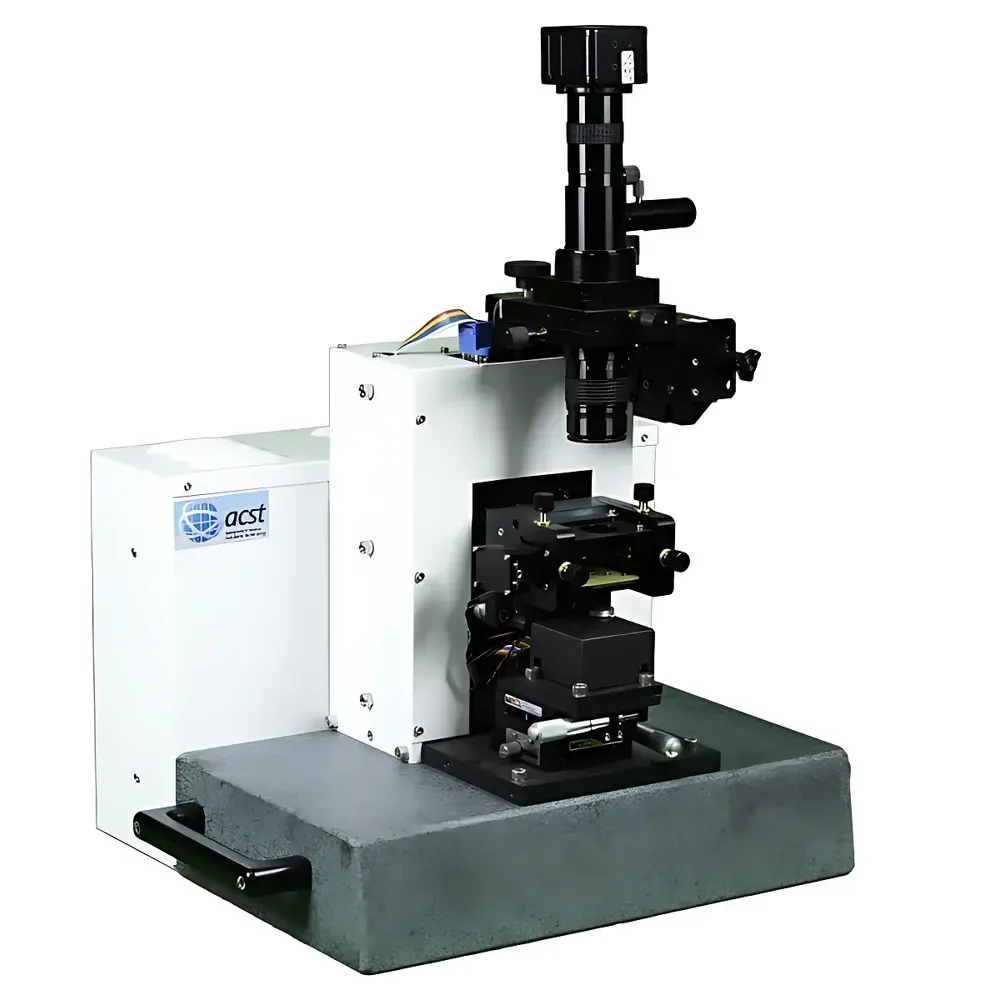
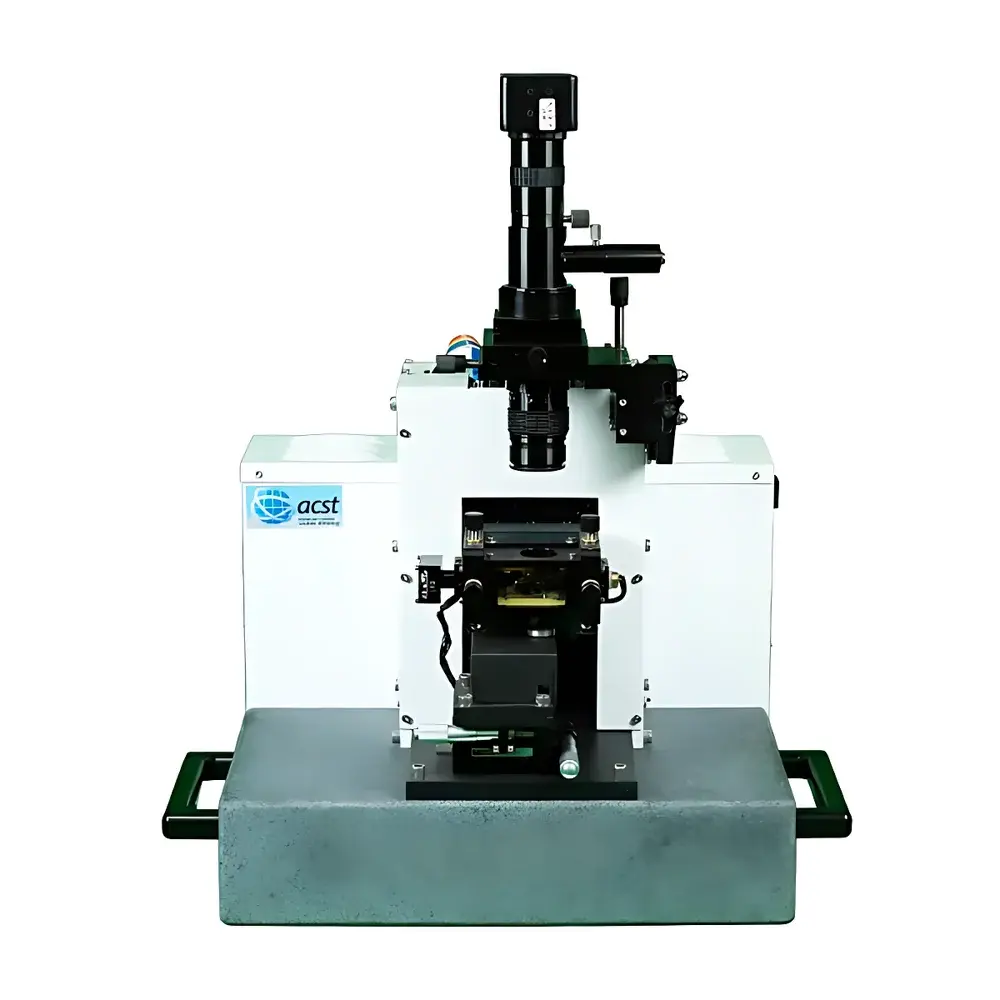
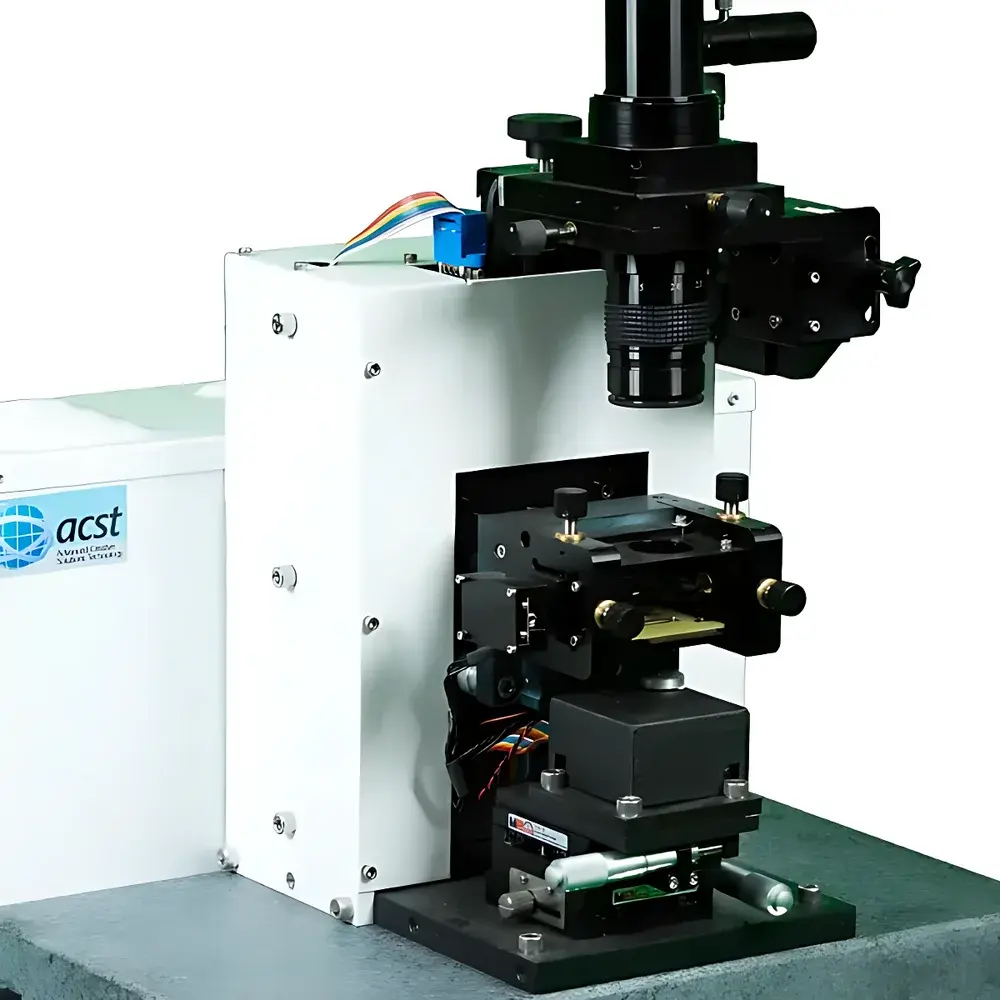
ACST ACST-AFM Desktop Atomic Force Microscope
| Brand | ACST |
|---|---|
| Origin | USA |
| Manufacturer Type | Authorized Distributor |
| Origin Category | Imported |
| Model | ACST-AFM |
| Instrument Type | Biological AFM |
| Position Detection Noise | ≤0.15 nm RMS |
| Maximum Sample Size | 15 mm diameter |
| XY Stage Travel Range | 25 mm × 25 mm |
| Software | Aotu AFM |
| Imaging Modes | Contact, Tapping, Phase, Lateral Force, Advanced Force Spectroscopy, Conductive AFM, Magnetic AFM, Nanolithography |
| XY Scanner Range | >50 µm (closed-loop), <10 nm resolution (closed-loop), <1 nm resolution (open-loop) |
| Z Scanner Range | >16 µm |
| Z Sensor Noise | <5 nm |
| Z Feedback Noise | <0.2 nm |
| Z Actuation | Direct-drive stepper motor, 25 mm travel, 330 nm minimum step, 8 mm/min max speed |
| Optical System | 3 MP CCD camera, 45×–400× real-time magnification |
| Base Material | Solid granite for vibration isolation and mechanical stability |
| Probe Loading | Tool-free, rapid exchange design |
Overview
The ACST ACST-AFM Desktop Atomic Force Microscope is a compact, benchtop-integrated scanning probe microscope engineered for high-resolution topographic imaging and quantitative nanomechanical characterization under ambient or liquid environments. Based on the fundamental principle of dynamic or static cantilever deflection detection via optical beam bounce (OBD), the system measures interatomic forces between a sharp probe tip and sample surface with sub-nanometer spatial resolution in X, Y, and Z axes. Unlike electron microscopy, AFM requires no conductive coating or vacuum conditions—enabling true in situ, label-free observation of hydrated biological specimens, soft polymers, and functionalized surfaces. Its modular architecture supports both qualitative morphological mapping and rigorous quantitative force spectroscopy, making it suitable for GLP-compliant life science labs, university core facilities, and industrial R&D groups requiring traceable, repeatable nanoscale metrology.
Key Features
- Granite-based mechanical platform ensuring thermal and vibrational stability—critical for low-noise, long-duration force curves and high-fidelity topography acquisition
- Sub-0.2 nm Z-feedback noise performance and ≤0.15 nm RMS position detection noise—enabling reliable single-molecule unfolding experiments and polymer chain elasticity measurements
- Multi-mode operational flexibility: contact, tapping, phase imaging, lateral force microscopy (LFM), advanced force spectroscopy (AFS), conductive AFM (C-AFM), magnetic AFM (MFM), and nanolithography
- Integrated 3-megapixel CCD optical microscope with 45×–400× continuous zoom for precise probe alignment, real-time sample navigation, and correlative optical-AFM analysis
- 50 µm closed-loop XY scanner with <1% linearity error and <10 nm closed-loop resolution; open-loop resolution <1 nm—optimized for large-area survey scans and high-speed mapping
- Z-axis direct-drive stepper actuator with 25 mm travel range, 330 nm step resolution, and programmable approach/retract velocity—ideal for thick tissue sections or multi-layered device stacks
- Tool-free probe cartridge system enabling rapid tip exchange without recalibration—reducing setup time and operator dependency
- Magnetic sample holder accommodating samples up to 15 mm diameter and 6.35 mm height—compatible with standard TEM grids, silicon wafers, and custom biochips
Sample Compatibility & Compliance
The ACST-AFM accommodates diverse specimen classes—including live cells, protein monolayers, lipid bilayers, hydrogels, bacterial biofilms, semiconductor thin films, carbon nanotubes, and nanoparticle dispersions—without vacuum dehydration or metal sputtering. Its environmental compatibility extends to aqueous buffers (e.g., PBS, HEPES), cell culture media, and organic solvents (e.g., chloroform, ethanol), supporting ASTM E2539-22 compliant nanomechanical testing protocols. The system meets ISO/IEC 17025:2017 requirements for calibration traceability when used with NIST-traceable reference standards (e.g., Si grating SRM 2053). For regulated environments, Aotu AFM software supports audit trail logging, electronic signatures, and user-access controls aligned with FDA 21 CFR Part 11 and EU Annex 11 principles.
Software & Data Management
Aotu AFM software provides a unified interface for instrument control, real-time data visualization, automated parameter optimization, and post-acquisition analysis. It includes built-in modules for force-distance curve fitting (WLC, Freely-Jointed Chain, Worm-Like Chain models), Young’s modulus mapping (Hertz, Sneddon, Derjaguin-Muller-Toporov models), adhesion quantification, and statistical surface roughness analysis (Ra, Rq, Rz per ISO 4287). All raw data are stored in HDF5 format with embedded metadata (timestamp, user ID, calibration parameters, environmental conditions), ensuring FAIR (Findable, Accessible, Interoperable, Reusable) data management practices. Export options include TIFF, PNG, CSV, and MATLAB-compatible MAT files—facilitating integration with third-party analysis platforms such as ImageJ/Fiji, Gwyddion, and Python-based SciPy workflows.
Applications
- Life Sciences: In situ conformational dynamics of membrane proteins, amyloid fibril growth kinetics, virus capsid stiffness mapping, single-cell mechanophenotyping (Young’s modulus, viscoelastic relaxation), ligand-receptor binding force distributions, and drug-induced cytoskeletal remodeling
- Materials Science: Grain boundary analysis in perovskite solar cells, interfacial adhesion quantification in multilayer OLED stacks, nanoscale phase separation in block copolymers, and defect density mapping in 2D transition metal dichalcogenides (TMDs)
- Nanofabrication: Sub-10 nm lithographic patterning via local oxidation nanolithography (LON), electrochemical etching, and dip-pen nanolithography (DPN)—with real-time feedback for depth-controlled ablation
- Quality Control: Surface finish verification of medical implants (ISO 10993-1), particulate contamination screening on semiconductor wafers (SEMI F20), and coating uniformity assessment of controlled-release pharmaceutical tablets (USP <1058>)
FAQ
What environmental conditions are required for stable operation?
The system operates reliably in standard laboratory environments (20–25°C, 40–60% RH) with minimal acoustic and floor vibration. No external anti-vibration table is required due to its integrated granite base.
Can the ACST-AFM perform force spectroscopy in liquid?
Yes—fully compatible with fluid cells for physiological buffer immersion, enabling quantitative measurement of receptor-ligand unbinding forces, DNA stretching, and polysaccharide elasticity under native conditions.
Is the software validated for regulated biopharmaceutical applications?
Aotu AFM supports 21 CFR Part 11 compliance through configurable audit trails, role-based access control, and electronic signature workflows—validated per IQ/OQ protocols upon installation.
What probe types are supported out-of-the-box?
Standard silicon and silicon nitride cantilevers (Bruker, NanoAndMore, BudgetSensors) with nominal spring constants from 0.01 N/m to 40 N/m; custom probes (conductive, magnetic, high-aspect-ratio) are mechanically and optically compatible.
How is calibration traceability maintained?
Z-sensor calibration uses NIST-traceable piezo response standards; lateral scale calibration employs certified Si grating standards (e.g., NIST SRM 2053); force calibration follows Sader method using thermal noise spectra.




