SENTECH Etchlab 200 Reactive Ion Etching (RIE) System
| Origin | Germany |
|---|---|
| Manufacturer Type | Authorized Distributor |
| Origin Category | Imported |
| Model | Etchlab 200 |
| Etching Principle | Equipped with magnetic-field-enhanced Inductively Coupled Plasma (ICP/ISM) or Non-Linear Discharge (NLD) plasma source |
| Etch Rate | Up to 1 µm/min (material and process dependent) |
| Wafer Size Compatibility | 100–200 mm (standard), upgradable to 300 mm |
| Selectivity | Up to 1:20 (e.g., SiO₂:Si) |
| Uniformity | ±5% across wafer |
| Residue Level | <1% (post-etch residue coverage) |
| Aspect Ratio Capability | Up to 1:20 (depth:width) |
Overview
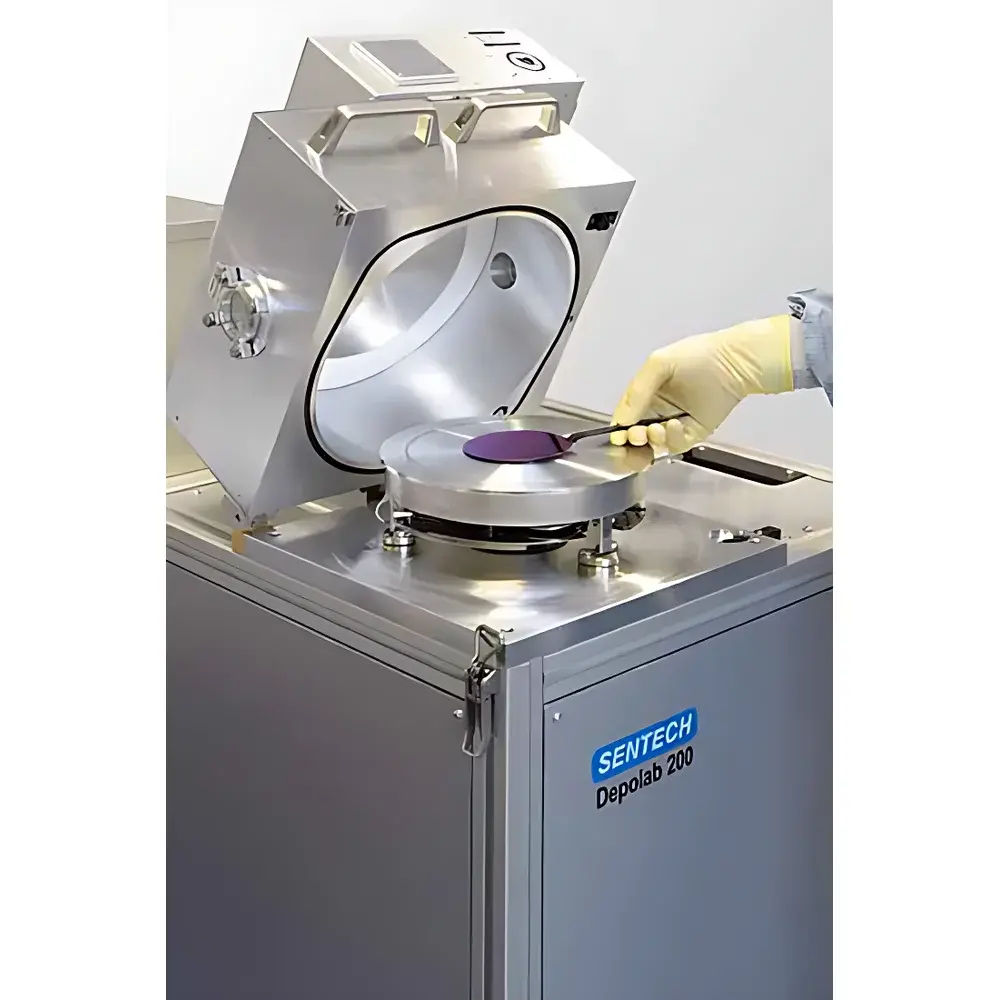
The SENTECH Etchlab 200 is a compact, high-performance Reactive Ion Etching (RIE) system engineered for precision dry etching in semiconductor R&D, MEMS fabrication, and advanced materials processing laboratories. It implements a parallel-plate capacitively coupled plasma (CCP) architecture—optimized for directional ion bombardment—combined with optional magnetic-field-assisted ICP (ISM) or NLD plasma sources to enhance plasma density, dissociation efficiency, and process controllability. Unlike conventional batch-loaded systems, the Etchlab 200 features a top-opening chamber design enabling direct wafer placement onto the grounded electrode or custom carrier, eliminating robotic handling and reducing particulate risk. Its modular vacuum architecture supports seamless integration of auxiliary diagnostics—including optical emission spectroscopy (OES), residual gas analysis (RGA), laser interferometry, and in-situ ellipsometry—making it suitable for real-time plasma characterization and endpoint detection under controlled low-pressure environments (typically 0.1–100 mTorr).
Key Features
- Modular vacuum system: Compatible with standard turbomolecular pumps; optionally upgradeable to high-capacity pumping stations (e.g., 1200 L/s) and load-lock pre-vacuum chambers for improved throughput and contamination control.
- Direct-load electrode configuration: Supports manual loading of wafers up to 200 mm (8″) diameter—or fragmented substrates—onto a temperature-controlled RF-powered lower electrode (13.56 MHz, up to 500 W).
- Dual-source plasma flexibility: Standard CCP RIE mode; field-upgradeable to hybrid ICP/ISM or NLD plasma sources for enhanced ion flux, reduced DC bias, and improved selectivity in challenging chemistries (e.g., Cl₂/BCl₃ for Si, SF₆/O₂ for SiO₂).
- Integrated diagnostic ports: Two quartz viewports (top and side) accommodate SENTECH-compatible OES spectrometers, laser interferometers, and Langmuir probes; dedicated ellipsometry port enables real-time film thickness monitoring during etch.
- Compact footprint (< 1.2 m²): Designed for space-constrained cleanroom environments without compromising process repeatability or maintenance accessibility.
Sample Compatibility & Compliance
The Etchlab 200 processes a broad range of substrate materials including silicon, silicon dioxide, silicon nitride, III–V compounds (GaAs, InP), metals (Al, Ti, Ni), and low-k dielectrics. It operates with industry-standard etchant gases—Cl₂, BCl₃, SF₆, CF₄, CHF₃, O₂, and Ar—and complies with SEMI S2/S8 safety guidelines. Vacuum integrity meets ISO 10110-7 surface quality requirements for optical components, and chamber construction adheres to ASTM F2797 (cleanroom-compatible stainless steel 316L with electropolished interior). All software operations support audit trails and user-level access control per FDA 21 CFR Part 11 and EU Annex 11 requirements when configured with SENTECH’s GLP/GMP-compliant software package.
Software & Data Management
Control is executed via SENTECH’s proprietary SENTECH Control Suite—a Windows-based, fieldbus-integrated platform compliant with EtherCAT and CANopen protocols. The GUI includes real-time plasma parameter visualization (RF forward/reflected power, Vdc, pressure, gas flow), recipe-driven process sequencing, multi-step etch profiles, and timestamped data logging (≥1 kHz sampling rate). Process recipes are exportable in XML format; historical runs are indexed by operator ID, timestamp, and wafer ID. Optional modules include automated endpoint detection (via OES intensity thresholding), statistical process control (SPC) dashboards, and remote web-based monitoring through HTTPS-secured REST API endpoints.
Applications
- R&D-scale patterning of MEMS structures (e.g., deep Si trenches, cantilevers, resonators)
- Prototyping of GaN HEMT gate recesses and AlGaN etch-stop layers
- Low-damage etching of photonic waveguides in SiN and SiO₂
- Maskless microstructuring of metal electrodes for flexible electronics
- Development of atomic-layer etch (ALE) precursors using pulsed RIE modes
- Failure analysis sample preparation requiring minimal redeposition and sidewall taper control
FAQ
What wafer sizes does the Etchlab 200 support natively?
Standard configuration accommodates 100 mm (4″) to 200 mm (8″) wafers; upgrade kits enable 300 mm (12″) compatibility with modified electrode and chamber lid assemblies.
Is the system compatible with chlorine-based chemistries?
Yes—the chamber is constructed from anodized aluminum and stainless steel with Kalrez® seals, rated for continuous exposure to Cl₂, BCl₃, and HBr at process temperatures up to 80 °C.
Can endpoint detection be implemented without external hardware?
Basic optical endpoint detection is supported via integrated OES input channels; full spectral analysis and adaptive thresholding require optional SENTECH SpectraView module.
Does the system meet ISO Class 5 cleanroom requirements?
The Etchlab 200 itself is not classified as a cleanroom device, but its particle generation rate (< 0.1 particles ≥0.5 µm/cm²/min) and outgassing profile (per ASTM E595) permit operation in ISO Class 5 environments when installed with appropriate air showers and exhaust filtration.
What level of technical support is provided post-installation?
SENTECH offers 24-month comprehensive warranty, on-site commissioning, operator training (including plasma physics fundamentals and recipe optimization), and remote diagnostics via secure VPN-linked service portal.
Related Products