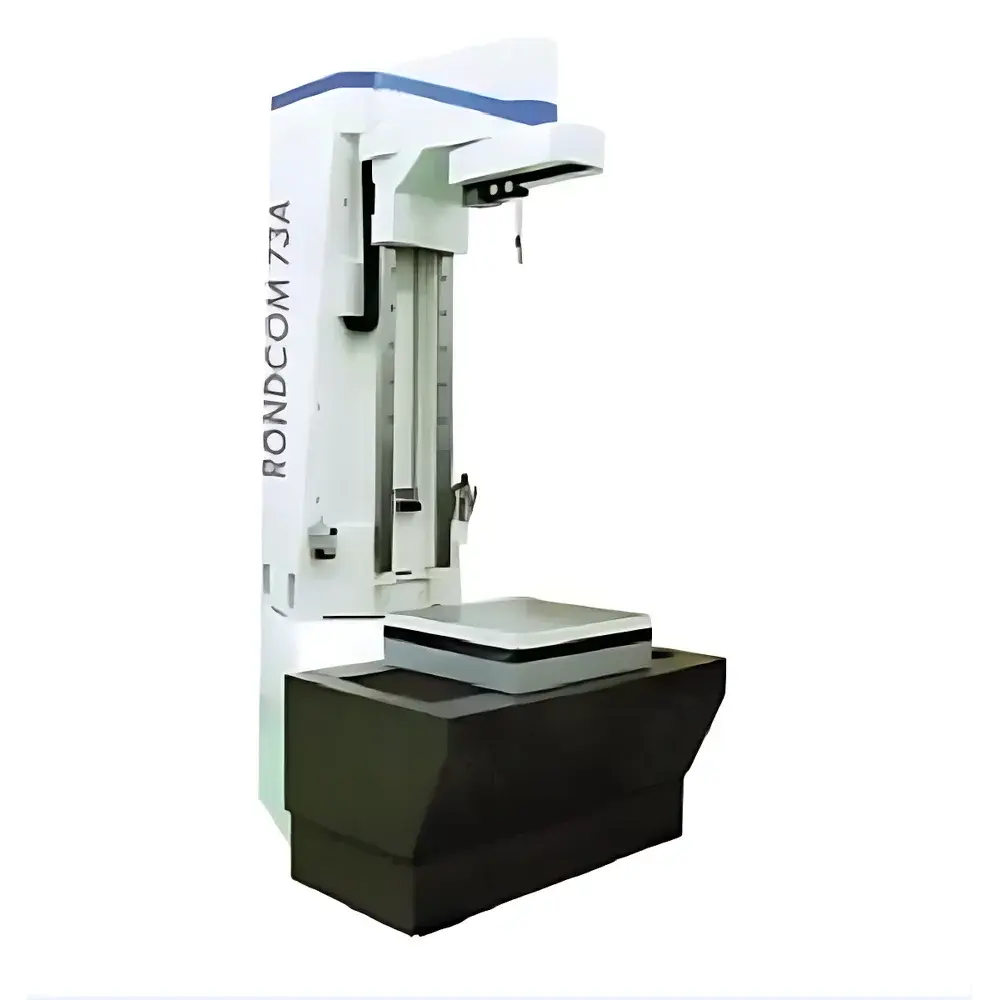
Accretech R73A High-Precision Rotational Roundness and Cylindricity Measuring Instrument
| Brand | Accretech |
|---|---|
| Origin | Japan |
| Model | R73A |
| Bearing Type | Air-bearing spindle |
| Measurement Principle | Radius method with rotating sensor table |
| Z-axis Travel | 1000 mm |
| Radial (R-axis) Auto-zero Function | Yes |
| Tilt & Centering | Fully automated mechanical + software-based correction |
| Air-bearing Pressure Monitoring | Integrated diagnostic circuit |
| Magnification Settings | 8-step selectable (50× to 10,000×) |
| Software Platform | ACCTee Measurement Suite |
| Compliance Framework | Designed for ISO 1101, ISO 12181 (Roundness), ISO 12180 (Cylindricity), and ASTM E1155 (Straightness) |
Overview
The Accretech R73A is a high-accuracy, sensor-rotating roundness and cylindricity measuring instrument engineered for metrology laboratories and precision manufacturing facilities requiring traceable geometric form evaluation. It operates on the radius method—measuring radial deviations of a rotating workpiece relative to a highly stable air-bearing reference axis. Unlike stylus-fixed systems, the R73A rotates the sensor assembly while the workpiece remains stationary, enabling superior dynamic stability and reduced influence from workpiece mass or mounting asymmetry. Its dual-axis architecture integrates a 1000 mm vertical (Z-axis) column with sub-micron straightness performance and a precision radial (R-axis) motion system, supporting comprehensive evaluation of roundness, cylindricity, concentricity, coaxiality, straightness, and parallelism per ISO 1101, ISO 12180, and ISO 12181 standards. The instrument’s air-bearing spindle delivers nanometer-level rotational repeatability (<0.02 µm radial error motion), eliminating mechanical hysteresis and wear-related drift.
Key Features
- Air-bearing spindle with integrated pressure monitoring circuitry—ensures continuous operational integrity and prevents bearing damage due to low-pressure events.
- Fully automated centering and tilt alignment: mechanical adjustment mechanisms coupled with real-time ACCTee software algorithms correct both radial offset and angular misalignment without manual intervention.
- Z-axis and R-axis auto-zero functionality—enables rapid, repeatable positioning of the probe tip at defined datum points, minimizing setup time and safeguarding the stylus during initialization and retraction.
- 1000 mm Z-axis travel with verified straightness ≤0.3 µm over full stroke—supports measurement of large-diameter shafts, bearing housings, turbine casings, and other heavy industrial components.
- Eight-step magnification selection (50× to 10,000×)—allows optimal signal-to-noise ratio tuning for surfaces ranging from coarse-turned to super-finished finishes.
- Optional cross-slide sensor carriage—improves lateral stability and reduces probe overhang errors when measuring small-diameter features (e.g., bearing races, valve stems).
- Dual-axis digital readouts (Z and R)—feed real-time positional data into ACCTee’s tilt compensation engine, eliminating manual coordinate entry and reducing operator-induced error.
Sample Compatibility & Compliance
The R73A accommodates workpieces up to Ø600 mm in diameter and 1000 mm in height, with customizable fixturing for cylindrical, disc-shaped, and stepped geometries. Its non-contact air-bearing design ensures compatibility with delicate, polished, or thermally sensitive components—including ceramic bearing rings, optical lens mounts, and aerospace-grade Inconel housings. All measurement routines adhere to international geometric tolerance standards: roundness per ISO 12181-1, cylindricity per ISO 12180-1, and straightness per ISO 12780-1. The system supports GLP/GMP documentation workflows, including user-access control, electronic signature capability, and audit-trail-enabled report generation compliant with FDA 21 CFR Part 11 requirements when configured with validated ACCTee modules.
Software & Data Management
ACCTee is a modular, Windows-based metrology platform developed specifically for Accretech form-measurement instruments. It provides real-time waveform visualization, harmonic analysis (up to 50th order), filter selection (Gaussian, 2CR-75%, phase-corrected), and GD&T-compliant reporting aligned with ASME Y14.5 and ISO GPS conventions. Data export supports CSV, DXF, XML, and proprietary .ACC formats; raw profile traces are stored with full metadata (date/time, operator ID, calibration certificate ID, environmental logs). Version-controlled software updates maintain backward compatibility with legacy measurement files, and optional network licensing enables centralized administration across multi-station labs.
Applications
The R73A serves critical quality assurance functions in industries where geometric fidelity directly impacts functional performance: automotive powertrain component validation (crankshafts, camshafts, transmission gears), aerospace turbine disk certification, medical device manufacturing (hip joint femoral heads, dental implant abutments), precision bearing production, and semiconductor equipment component inspection. Its high-Z travel and automated alignment make it especially suited for first-article inspection of large-scale machined parts prior to batch release—reducing reliance on coordinate measuring machines for form-specific verification.
FAQ
What standards does the R73A comply with for roundness and cylindricity measurement?
It conforms to ISO 12181-1 (roundness), ISO 12180-1 (cylindricity), ISO 1101 (geometrical tolerancing), and ASTM E1155 (straightness), with traceability to NMIJ/JCSS-accredited calibration artifacts.
Can the R73A measure non-cylindrical parts such as discs or flanges?
Yes—its stationary workpiece configuration and programmable measurement planes support flatness, parallelism, and face-runout evaluation on disc-shaped components using appropriate fixturing.
Is ACCTee software validated for regulated environments?
When deployed with IQ/OQ documentation packages and configured with electronic signatures and audit trail logging, ACCTee meets FDA 21 CFR Part 11 and EU Annex 11 requirements for computerized systems in GxP settings.
How is thermal drift managed during extended measurements?
The granite base structure incorporates temperature gradient compensation algorithms, and the air-bearing supply includes closed-loop pressure/temperature stabilization to minimize thermal-induced axis deviation.
What maintenance is required for the air-bearing spindle?
No lubrication or periodic bearing replacement is needed; routine maintenance consists of compressed air filtration checks, pressure regulator calibration annually, and stylus tip inspection per ISO 14292.