
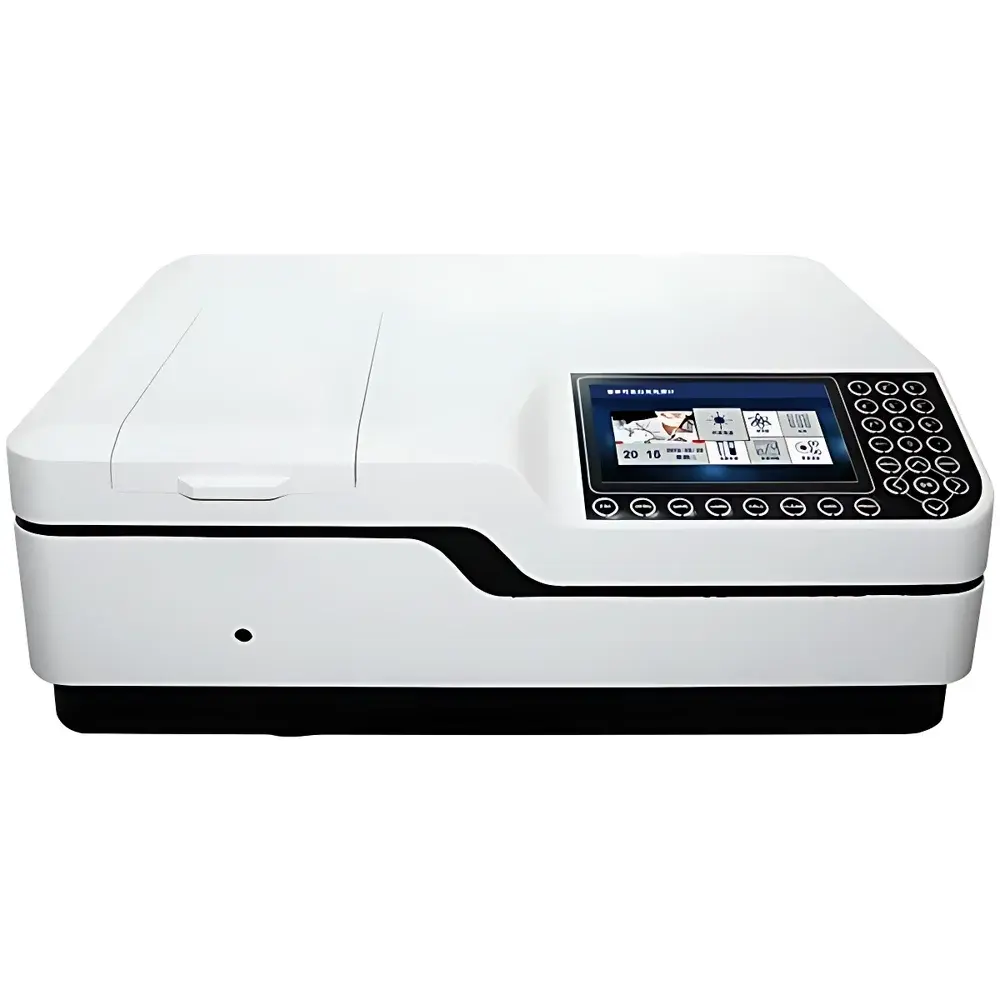
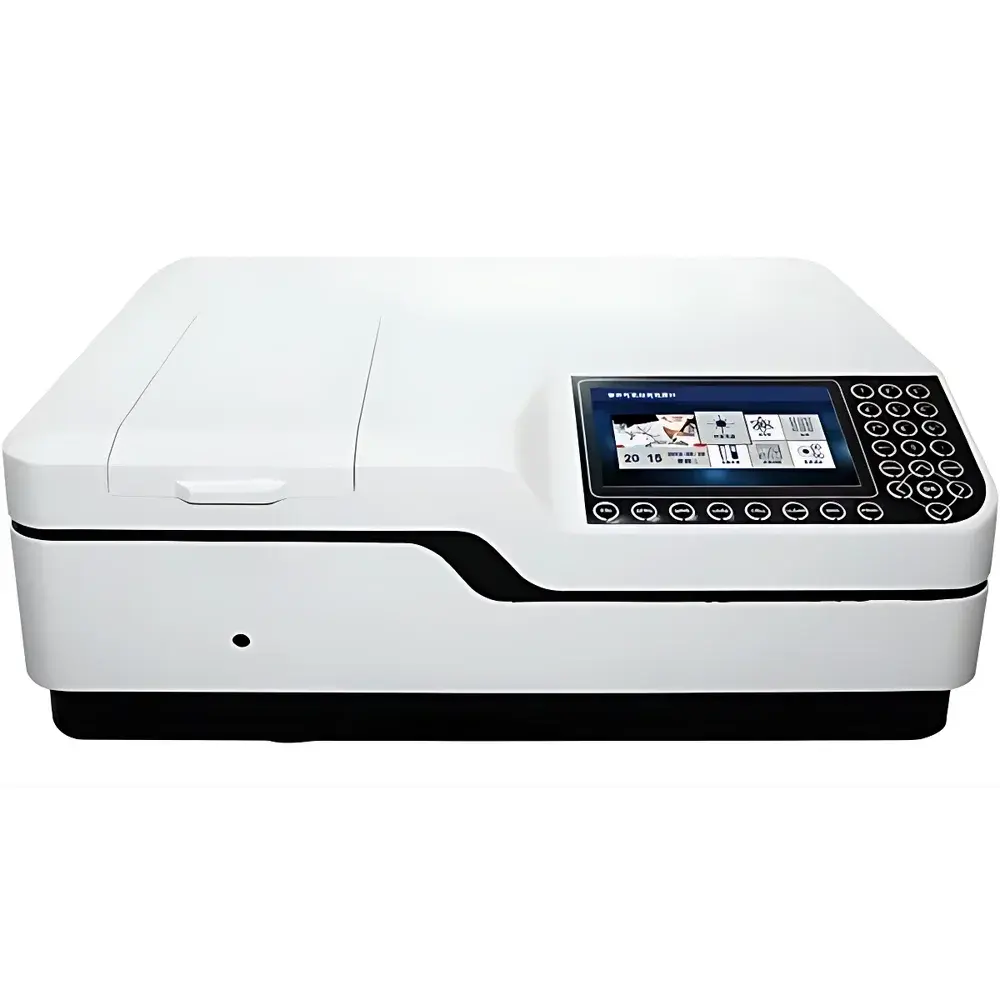
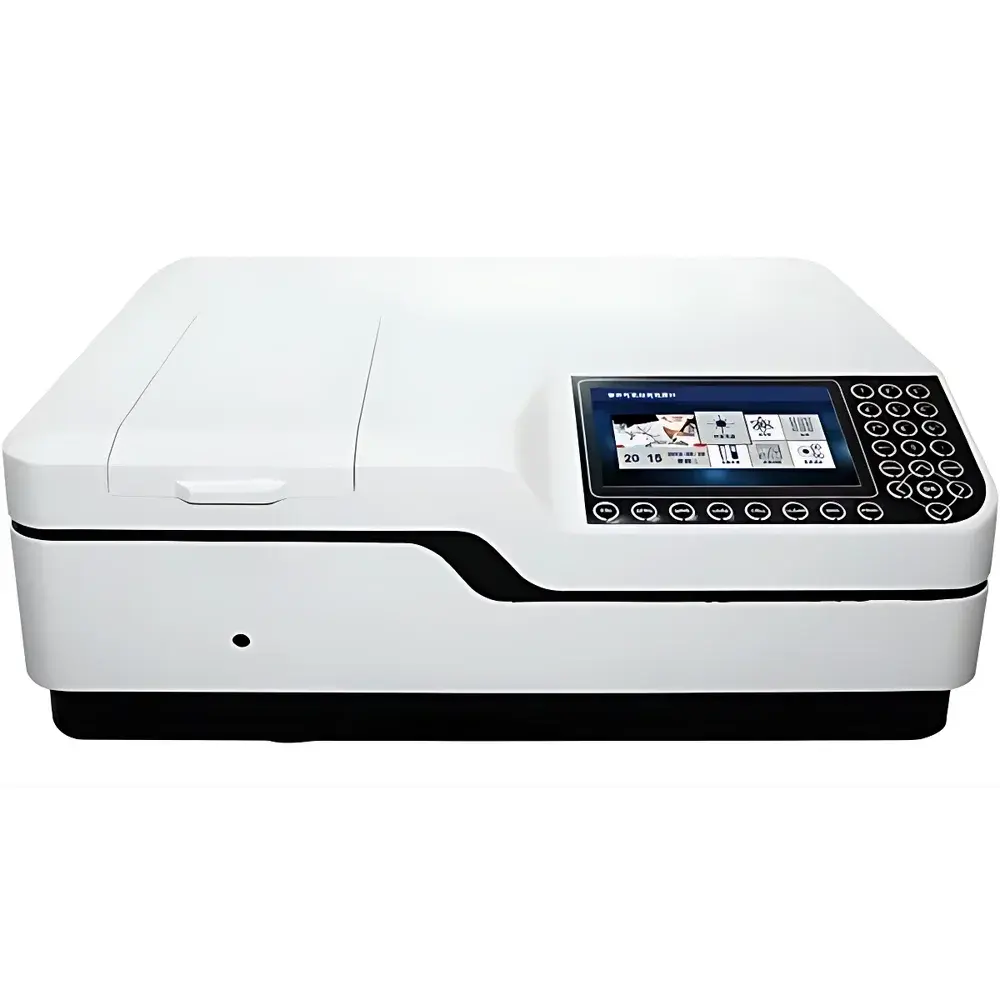
Yoke T2602 Dual-Beam Ultraviolet-Visible Spectrophotometer
| Brand | Yoke |
|---|---|
| Origin | Shanghai, China |
| Model | T2602 |
| Optical System | Dual-beam |
| Detector | Photomultiplier Tube (PMT) |
| Wavelength Range | 190–1100 nm |
| Wavelength Accuracy | ±0.3 nm |
| Wavelength Repeatability | ≤0.1 nm |
| Spectral Bandwidth | 1 nm |
| Stray Light | ≤0.03% T (at 220 nm, using NaI solution) |
| Display | 7-inch TFT color LCD (1024 × 600 resolution) |
| Data Storage | 16 GB internal memory |
| Interfaces | RS-232C, USB Device, USB Host |
| Supported Output Formats | CSV, QUA, TXT, BMP |
| Maximum Data Capacity | 2000 absorbance measurements or 500 calibration curves |
| Light Sources | Imported deuterium lamp and tungsten-halogen lamp |
Overview
The Yoke T2602 Dual-Beam Ultraviolet-Visible Spectrophotometer is an analytical instrument engineered for precision molecular absorption spectroscopy across the ultraviolet (190 nm), visible (400–700 nm), and near-infrared (up to 1100 nm) spectral regions. Its dual-beam optical architecture employs a Czerny-Turner monochromator with real-time beam splitting, enabling continuous reference compensation during measurement—critical for minimizing drift caused by source intensity fluctuation, detector response variation, or environmental thermal effects. The system utilizes a high-stability imported deuterium lamp for UV emission and a tungsten-halogen lamp for visible/NIR output, coupled with a photomultiplier tube (PMT) detector optimized for low-light sensitivity and wide dynamic range. With a nominal spectral bandwidth of 1 nm and wavelength accuracy of ±0.3 nm (verified at primary emission lines such as 656.1 nm), the T2602 meets essential performance criteria outlined in ISO 8579-1:2021 and ASTM E275-22 for spectrophotometric instrumentation validation.
Key Features
- Dual-beam CT monochromator design with suspended optical bench architecture—mounted on a reinforced aluminum baseplate—to suppress mechanical vibration and thermal-induced misalignment.
- 7-inch high-resolution TFT color LCD (1024 × 600) with intuitive graphical interface; supports direct visualization of full-spectrum scans, kinetic time courses, and multi-curve overlays without external software.
- ARM11-based embedded control system enabling local storage of up to 2000 absorbance readings or 500 user-defined calibration curves within integrated 16 GB flash memory.
- Three-tier connectivity: RS-232C for legacy printer integration, USB Device for PC tethering and remote control via optional software, and USB Host for plug-and-play data export to standard USB flash drives.
- Optimized stray light suppression: ≤0.03% T at 220 nm (measured with sodium iodide solution), achieved through precision grating alignment, multi-stage light baffling, and black-anodized internal optics housing.
- Modular expandability: Optional 8-position rotating cuvette changer ensures consistent beam centering across all samples; optional integrated flow cell module enables automated liquid handling for QC batch analysis.
Sample Compatibility & Compliance
The T2602 accommodates standard 10 mm pathlength quartz, glass, or plastic cuvettes (including matched pairs for dual-beam referencing), as well as micro-volume adapters and flow-through cells. It complies with fundamental requirements for laboratory-grade UV-Vis instrumentation under ISO/IEC 17025:2017 for testing laboratories, and its operational parameters align with pharmacopeial methods described in USP and EP 2.2.25. While not pre-certified for FDA 21 CFR Part 11, the instrument’s audit-ready data logging—including timestamped absorbance values, operator ID fields (via optional network login), and immutable file export formats (CSV, QUA)—supports implementation of ALCOA+ principles in GLP/GMP environments.
Software & Data Management
Data acquisition and processing are performed natively on-device, eliminating dependency on proprietary desktop applications. Scan results and quantitative reports can be exported directly to USB storage in four interoperable formats: CSV (for spreadsheet analysis), QUA (compatible with common spectral libraries), TXT (ASCII-readable metadata), and BMP (publication-ready static images). All files retain embedded instrument metadata—including serial number, date/time stamp, wavelength calibration status, and lamp usage hours—facilitating traceability. Internal memory management includes automatic overwrite protection for critical calibration records and configurable auto-save intervals during kinetic experiments.
Applications
The T2602 delivers robust performance in routine and research-level applications requiring quantitative and qualitative spectral analysis. These include: determination of nucleic acid concentration and purity (A260/A280 ratio); enzyme kinetics monitoring (e.g., NADH oxidation at 340 nm); pharmaceutical assay development per ICH Q2(R2) guidelines; heavy metal quantification in environmental water samples using colorimetric reagents; protein quantification via Bradford or BCA assays; and quality control of dyes, pigments, and optical filters. Its extended 1100 nm range further supports characterization of semiconductor materials and NIR-active functional groups in polymer science.
FAQ
What is the maximum scan speed supported by the T2602?
The instrument performs full-range (190–1100 nm) scans at selectable speeds from 100 to 1200 nm/min, with optimal signal-to-noise balance recommended at 300–600 nm/min.
Does the T2602 support method validation protocols required for regulated laboratories?
Yes—the system provides wavelength accuracy verification tools, photometric linearity checks (using neutral density filters), and baseline stability assessment functions aligned with USP and ISO 6329:2020.
Can the T2602 be integrated into a LIMS environment?
Via RS-232C or USB Device mode, it supports ASCII-based command sets compatible with common LIMS middleware; custom API integration requires third-party driver development.
Is the PMT detector thermally stabilized?
The PMT operates in a temperature-compensated housing with active ambient monitoring, though no Peltier cooling is included—sufficient for ambient-lab operation per ISO 17025 clause 5.4.2.
What maintenance is required for long-term wavelength accuracy?
Annual verification using traceable holmium oxide and didymium oxide reference filters is recommended; internal wavelength calibration uses a built-in mercury-argon spectral line source.






