
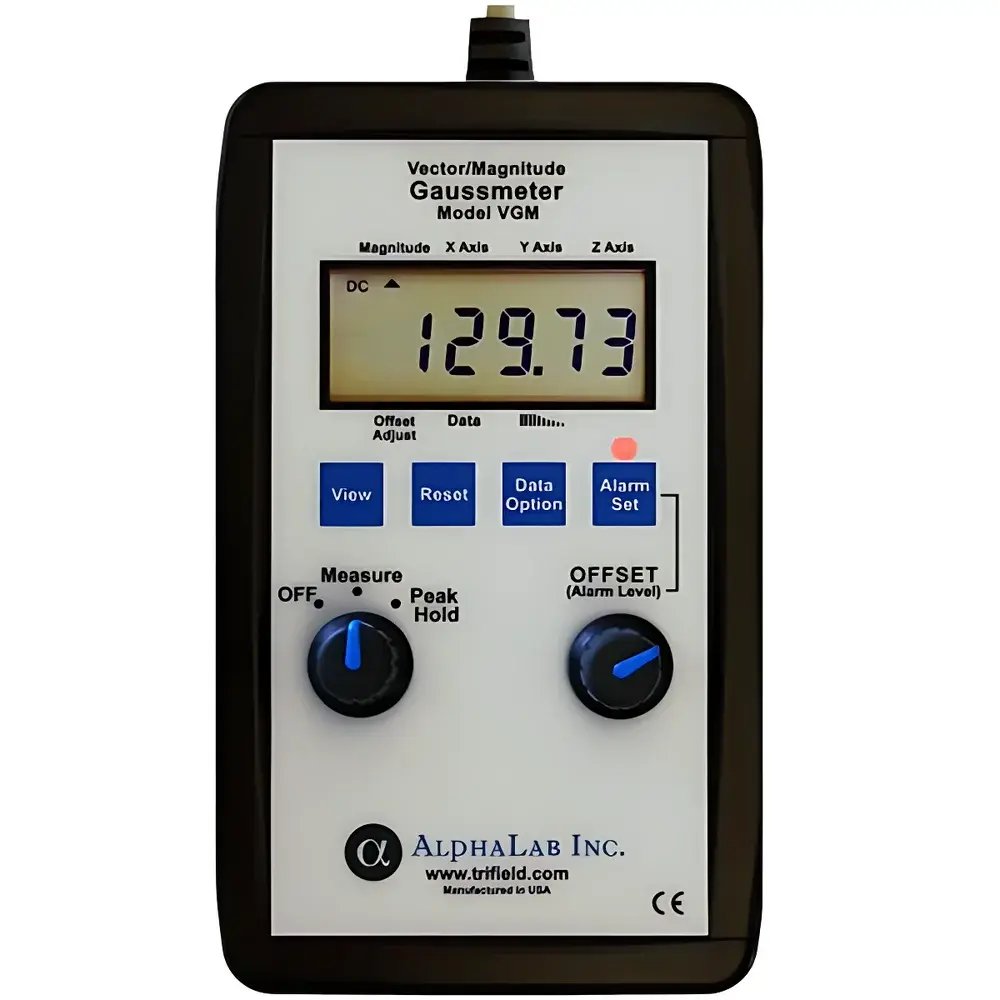
AlphaLab VGM Vector Magnitude Gaussmeter
| Brand | AlphaLab |
|---|---|
| Origin | USA |
| Model | VGM |
| Measurement Range | ±799.99 G |
| Resolution | 0.01 G |
| Accuracy | ±1% of reading (16–29 °C), ±2% (−4–65 °C) |
| Axis Configuration | Triaxial (X, Y, Z) DC magnetic field sensors co-located within 1.5 mm at probe tip |
| Vector Magnitude Calculation | √(X² + Y² + Z²) |
| Peak Hold Time Constant | 5 ms |
| Alarm Response Time | 5 ms |
| Alarm Threshold Range | 1.00–790.00 G (100-step adjustable) |
| Probe Dimensions | 6.3 × 6.3 × 50 mm |
| Display | Real-time magnitude + individual X/Y/Z components (polarity included) + simultaneous peak values |
| Power | 9 V alkaline battery (≈10 h life) or USB adapter (included) |
| Compliance | CE marked |
| Calibration | NIST-traceable certificate included |
| Output Interface | 3.5 mm mono audio jack (active-high 3.5 V alarm signal, 0 V inactive) |
| Environmental Operating Range | −4 to +65 °C |
| Physical Dimensions | 147 × 97 × 51 mm |
| Weight | 332 g |
Overview
The AlphaLab VGM Vector Magnitude Gaussmeter is a precision triaxial DC magnetic field measurement instrument engineered for rapid, orientation-independent characterization of residual magnetism and static field distributions. Unlike conventional single-axis gaussmeters requiring manual probe reorientation to resolve vector components, the VGM integrates three orthogonal Hall-effect sensors—co-located within a 1.5 mm spatial envelope at the probe tip—to simultaneously capture X, Y, and Z field components. This architecture enables real-time computation and display of both instantaneous vector magnitude (√(X² + Y² + Z²)) and directional components with polarity, eliminating rotational ambiguity and significantly reducing measurement cycle time. The instrument operates on fundamental principles of solid-state magnetic transduction and digital signal processing, delivering traceable, repeatable quantification of DC fields up to ±799.99 G with 0.01 G resolution. Its design prioritizes industrial QA/QC workflows where speed, reproducibility, and unambiguous field identification are critical—particularly in aerospace component demagnetization verification, MRI fringe field mapping, and magnetic particle inspection (MPI) process validation.
Key Features
- True vector magnitude measurement: Computes and displays real-time field magnitude independent of probe orientation—no rotation required to locate local maxima.
- Simultaneous 4-channel readout: Shows current magnitude, X, Y, and Z components concurrently, each with signed polarity indication.
- Independent peak-hold functionality: Records and retains peak values for magnitude, X, Y, and Z separately, updated dynamically with a 5 ms time constant—capable of capturing transient spikes as brief as 5 ms.
- Configurable dual-threshold alarm system: Visual (red LED) and audible alert triggers when field magnitude exceeds user-defined threshold (1.00–790.00 G, 100-step resolution); alarm output provides active-high 3.5 V TTL-compatible signal via 3.5 mm mono jack.
- Zero-offset compensation: Supports relative nulling (auto-zero) and infinite manual offset adjustment per axis for baseline subtraction in complex field environments.
- Plug-and-play operation: Factory-calibrated with NIST-traceable certificate; powered by standard 9 V alkaline battery (≈10 h runtime) or included USB adapter—no firmware updates or software installation required.
Sample Compatibility & Compliance
The VGM is optimized for non-contact measurement of ferromagnetic and paramagnetic materials exhibiting residual or induced DC magnetization. Its compact, rigid probe (6.3 × 6.3 × 50 mm) enables access to narrow gaps, curved surfaces, and assembled subcomponents without mechanical interference. While not intended for surface-field characterization of high-coercivity permanent magnets (e.g., NdFeB or SmCo exceeding 800 G), it is highly effective for verifying demagnetization efficacy per ASTM E1444/E709 standards, assessing magnetic contamination in cleanroom tools, and validating shielding integrity in medical imaging facilities. The device complies with CE electromagnetic compatibility (EMC) Directive 2014/30/EU and carries a full NIST-traceable calibration certificate issued prior to shipment. It supports GLP-compliant documentation through its stable analog alarm output and deterministic peak-hold behavior—enabling integration into automated pass/fail test stations without proprietary drivers.
Software & Data Management
The VGM operates as a standalone, embedded-system instrument with no onboard data logging or PC connectivity beyond the alarm output interface. All measurements are displayed in real time on a high-contrast LCD with automatic decimal point positioning. For traceable recordkeeping, users may manually log magnitude and component peaks alongside timestamps using external lab notebooks or LIMS entries. The alarm output (3.5 mm mono jack) provides a robust, galvanically isolated digital trigger signal compatible with programmable logic controllers (PLCs), data acquisition systems (DAQs), or custom microcontroller-based monitoring platforms. Though no proprietary software is provided, the deterministic 5 ms alarm response and TTL-level output ensure seamless integration into FDA 21 CFR Part 11–compliant audit trails when paired with validated third-party DAQ hardware and electronic signature workflows.
Applications
- Rapid screening of machined parts for residual magnetism post-grinding or EDM processes—reducing inspection time by ~10× versus single-axis methods.
- Mapping 5 G safety contours around MRI suites without iterative probe reorientation—accelerating facility commissioning and regulatory compliance checks.
- Verification of demagnetization cycles in aerospace fasteners and turbine blades per AMS 2750 and NADCAP AC7108 requirements.
- Detection of transient magnetic anomalies during electromagnetic compatibility (EMC) testing or power electronics qualification.
- Quantitative assessment of magnetic shielding effectiveness in RF enclosures and electron microscopy sample stages.
- Field uniformity evaluation of Helmholtz coils and permanent magnet assemblies during R&D prototyping.
FAQ
Is the VGM suitable for measuring the surface field of neodymium magnets?
No—the ±799.99 G full-scale range is insufficient for direct surface-field measurement of most sintered NdFeB or SmCo magnets, which commonly exceed 2,000–4,000 G. It is designed for residual field detection and low-to-moderate field mapping.
Does the VGM require periodic recalibration?
While factory calibration is NIST-traceable, users should verify zero stability and sensitivity annually or per internal quality protocols. No user-accessible calibration routine is provided; recalibration must be performed by an ISO/IEC 17025-accredited laboratory.
Can the alarm output drive a relay or PLC input directly?
Yes—the 3.5 mm mono jack delivers a clean 3.5 V (±5%) active-high TTL signal when alarmed, with <1 mA load current capability. A series resistor may be required for direct relay coil driving depending on coil impedance.
What is the temperature coefficient of accuracy?
Specified as ±1% of reading between 16–29 °C (standard lab conditions); performance degrades to ±2% across the full operating range of −4 to +65 °C.
Is the probe replaceable or repairable?
The triaxial probe is permanently integrated and not field-replaceable. Damage to the sensor module requires return to AlphaLab or authorized service center for evaluation and repair.



