
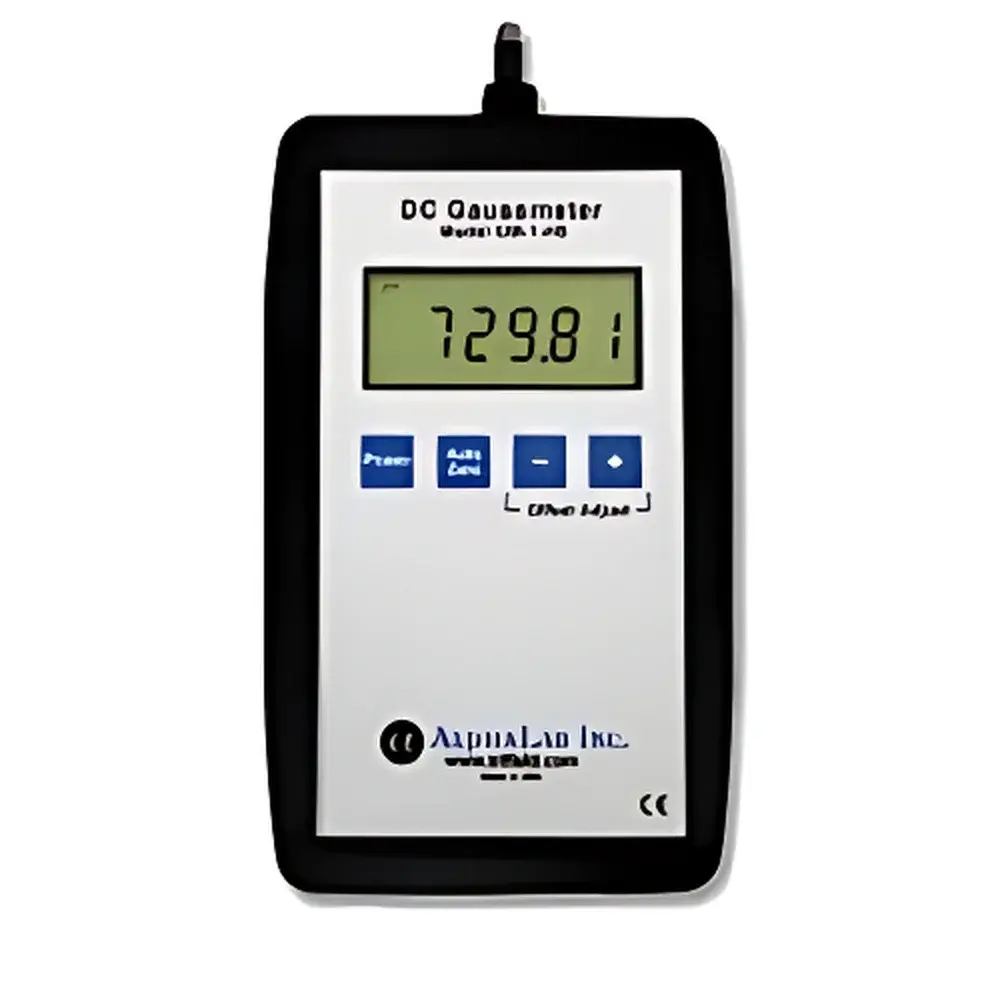
AlphaLab GM1-HS DC Gaussmeter Magnetometer
| Brand | AlphaLab |
|---|---|
| Origin | USA |
| Model | GM1-HS |
| Measurement Range | ±799.99 G |
| Resolution | 0.01 G |
| Accuracy | ±1% of reading (16–29°C), ±2% (-4–65°C) |
| Probe Type | Single-axis Hall-effect sensor with 100 cm flexible cable |
| Probe Dimensions | 2.3 × 4.8 × 24 mm |
| Instrument Dimensions | 132 × 91 × 41 mm |
| Weight | 227 g |
| Power | 9 V alkaline battery (≈20 h operation) |
| Display update rate | 4 Hz |
| Operating temperature | -4°C to +65°C |
| Storage temperature | -20°C to +70°C |
Overview
The AlphaLab GM1-HS is a precision single-axis DC gaussmeter engineered for reliable, real-time measurement of static magnetic fields up to ±799.99 Gauss. Based on a calibrated Hall-effect sensor integrated into a compact, handheld instrument, the GM1-HS delivers high-resolution quantification of field strength and polarity without requiring warm-up time or user calibration. Its measurement principle relies on the linear voltage response of a semiconductor Hall element to orthogonal magnetic flux density—enabling traceable, repeatable readings under ambient laboratory, industrial QA, and field service conditions. Designed specifically for applications involving residual magnetism assessment, magnetic safety zone mapping (e.g., MRI 5-Gauss line verification), and environmental field characterization, the GM1-HS operates across a broad temperature range while maintaining ±1% accuracy within standard lab conditions (16–29°C). The instrument’s immediate power-on functionality and 4 Hz display refresh rate support rapid spatial scanning and dynamic field evaluation without latency or configuration overhead.
Key Features
- High-resolution DC magnetic field measurement: 0.01 G resolution over full ±799.99 G range, including polarity indication
- True plug-and-play operation: No zeroing, calibration, or setup required—functional within seconds of power-on
- Integrated auto-zero function: Subtracts ambient background field from subsequent measurements; supports fine manual offset adjustment in 0.01 G increments across full ±799.99 G span
- Flexible 100 cm probe cable with bendable sensor tip: Enables access to confined geometries (e.g., solenoid interiors, valve housings) and conformal surface contact for remanence inspection on ferrous components
- NIST-traceable calibration certificate supplied with each unit, supporting ISO/IEC 17025-aligned quality systems and audit-ready documentation
- CE-marked design compliant with EMC Directive 2014/30/EU and Low Voltage Directive 2014/35/EU
- Ruggedized housing with removable rubber boot for impact and abrasion resistance during field deployment
Sample Compatibility & Compliance
The GM1-HS is optimized for non-invasive, contact-based measurement of static magnetic fields generated by permanent magnets, electromagnets, ferromagnetic materials, and magnetized mechanical components. It is routinely deployed in aerospace component certification (per ASTM A341/A341M for direct-current magnetic particle testing), medical device manufacturing (MRI site safety surveys per IEC 60601-2-33), and automotive supplier QA protocols for verifying demagnetization efficacy post-machining. The instrument meets general requirements for electromagnetic compatibility and electrical safety in industrial environments. While not explicitly FDA 21 CFR Part 11–validated, its deterministic analog-to-digital architecture, absence of configurable software parameters, and immutable calibration record support GLP/GMP-aligned use where measurement integrity and operator accountability are essential.
Software & Data Management
The GM1-HS operates as a standalone analog-digital hybrid instrument with no embedded firmware updates, network connectivity, or proprietary software dependencies. All measurement data remains local to the display; no internal memory or export interface is provided. This architecture ensures immunity to cybersecurity vulnerabilities, firmware corruption, or driver compatibility issues—making it suitable for regulated environments where deterministic behavior and validation simplicity are prioritized over digital data logging. For users requiring archival or spatial mapping, external recording can be achieved via analog output (available on optional GM1-HS-AN model) or manual transcription from the LCD. The included NIST-traceable certificate documents calibration points, uncertainty budgets, and environmental conditions at time of verification—satisfying metrological traceability requirements under ISO/IEC 17025 Clause 6.6.
Applications
- Residual magnetism verification on machined steel parts, weldments, and bearing assemblies prior to assembly or coating processes
- Mapping magnetic fringe fields around MRI scanners, particle accelerators, and magnetic separation systems to define controlled access zones
- Quality control of permanent magnet assemblies in motors, sensors, and actuators—validating field uniformity and polarity orientation
- Characterizing Earth’s geomagnetic field vector components for geophysical instrumentation alignment and compass calibration
- Verification of degaussing system performance in naval and aerospace maintenance facilities per MIL-STD-1325B
- Education and research labs requiring an affordable, robust tool for foundational magnetostatics experiments
FAQ
Does the GM1-HS measure AC magnetic fields?
No. The GM1-HS is designed exclusively for DC (static or slowly varying) magnetic field measurement. For AC field analysis, consider AlphaLab’s AC-capable models such as the GM2 series.
Can the probe be replaced or recalibrated independently?
The probe is permanently integrated and not user-replaceable. Full-unit recalibration is recommended annually or after physical shock; service must be performed by an AlphaLab-authorized calibration laboratory using NIST-traceable standards.
What is the temperature coefficient of accuracy outside 16–29°C?
Accuracy degrades to ±2% of reading between –4°C and +65°C. For high-precision work outside standard lab conditions, thermal stabilization or correction factors based on published drift curves are advised.
Is the instrument suitable for measuring fields near superconducting magnets?
Yes—provided the field remains within ±799.99 G and the probe is kept outside cryogenic zones. Avoid exposure to temperatures below –4°C or above +65°C, and ensure no ferromagnetic debris contacts the sensor tip.
How is traceability maintained across instrument lifetime?
Each unit ships with a unique NIST-traceable calibration certificate referencing specific reference standards, environmental conditions, and measurement uncertainties. Subsequent calibrations must retain this chain-of-custody documentation to satisfy ISO/IEC 17025 or internal QA requirements.



