
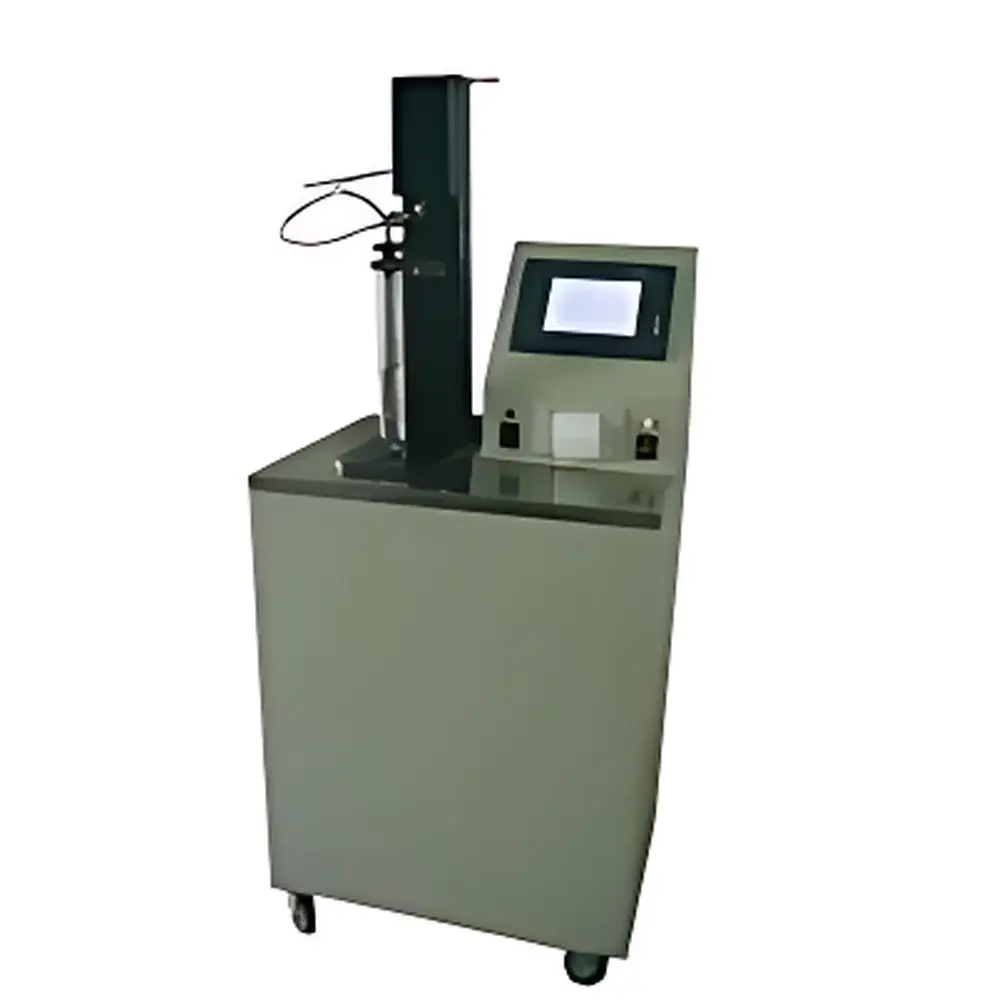
Xufeng XF-5901 ASTM D5901 Automated Aviation Fuel Freezing Point Tester
| Brand | Xufeng |
|---|---|
| Model | XF-5901 |
| Standard Compliance | ASTM D5901 (Automated Optical Method) |
| Temperature Range | 40 °C to −80 °C |
| Temperature Resolution | 0.1 °C |
| Cooling System | Cascade Compressor Refrigeration |
| Detection Method | Fiber-Optic Optical Detection |
| Sensor Type | Calibrated Platinum Resistance Thermometer (Pt100) |
| Power Supply | AC 220 V, 50/60 Hz, 1500 W |
| Dimensions | 550 × 450 × 600 mm (W×D×H) |
| Weight | ~32 kg |
| Data Interface | RS-232C Serial Port |
| Enclosure | Vertical, All-Stainless-Steel Construction |
Overview
The Xufeng XF-5901 Automated Aviation Fuel Freezing Point Tester is a precision-engineered instrument designed specifically for the determination of the freezing point of aviation turbine fuels (e.g., Jet A, Jet A-1, JP-5, JP-8) in strict accordance with ASTM D5901 – “Standard Test Method for Freezing Point of Aviation Fuels (Automated Optical Method)”. This method relies on real-time optical detection of ice crystal formation during controlled cooling, eliminating subjective visual interpretation and enhancing measurement objectivity. The instrument employs a cascade compressor-based refrigeration system capable of stable, reproducible cooling from +40 °C down to −80 °C at a resolution of 0.1 °C. Temperature is monitored continuously via a traceable, high-stability platinum resistance thermometer (Pt100), while phase transition is detected using a fiber-optic optical sensor that captures subtle changes in light transmission through the fuel sample as microcrystals nucleate and grow. The entire test sequence—including thermal ramping, dwell periods, optical monitoring, endpoint validation, and result reporting—is fully automated under microprocessor control, ensuring compliance with laboratory quality management systems requiring audit-ready process documentation.
Key Features
- Fully automated execution of ASTM D5901, minimizing operator intervention and inter-laboratory variability
- Cascade compressor refrigeration architecture delivering robust, low-noise cooling performance across the full −80 °C to +40 °C range
- Fiber-optic optical detection system with high signal-to-noise ratio for reliable, repeatable ice-point identification
- Integrated thermal printer providing immediate hardcopy output of test conditions, cooling curve data, freezing point result, and system status logs
- Large backlit LCD display with intuitive Windows-style interface supporting real-time visualization of temperature profile, cooling rate, detection events, and diagnostic messages
- Self-diagnostic firmware with audible alarm and on-screen fault code display for rapid troubleshooting
- RS-232C serial port enabling bidirectional communication with LIMS or laboratory PCs for data archiving, remote calibration verification, and electronic record retention
- All-stainless-steel vertical enclosure engineered for chemical resistance, mechanical stability, and long-term operation in refinery QC labs or aviation fuel testing facilities
- Automatic fire detection and extinguishing function compliant with safety requirements for hydrocarbon sample handling
- Remote maintenance support capability via secure serial protocol—facilitating firmware updates and configuration diagnostics without on-site service calls
Sample Compatibility & Compliance
The XF-5901 is validated exclusively for aviation fuels meeting specifications such as DEF STAN 91-91, MIL-DTL-83133, ASTM D1655, and ISO 8573-1 (for compressed air used in optical path purging, if applicable). It supports standard 10–15 mL sample volumes in supplied borosilicate glass test tubes. The instrument’s optical detection principle requires samples to be optically clear prior to testing; turbidity or particulate contamination must be removed by filtration per ASTM D2276 or D5508 prior to analysis. Regulatory alignment includes full functional compatibility with GLP and GMP environments: all critical parameters (temperature setpoints, cooling rates, detection thresholds) are software-configurable and logged with timestamps; audit trails are retained in non-volatile memory; and electronic records satisfy FDA 21 CFR Part 11 requirements when paired with validated LIMS integration. The system does not require external dry gas purge but may be optionally interfaced with nitrogen supply for inert atmosphere stabilization during sensitive low-temperature measurements.
Software & Data Management
The embedded control firmware implements deterministic real-time scheduling for temperature regulation and optical sampling at 0.5-second intervals during critical nucleation windows. Data acquisition includes raw Pt100 resistance values, normalized optical transmittance, derivative curves (dT/dt), and user-defined pass/fail flags. All test records are stored internally with unique identifiers, operator ID fields (via optional keypad login), and ISO 8601 timestamps. Export formats include CSV and plain-text reports compatible with Microsoft Excel, LabWare LIMS, and Thermo Fisher SampleManager. The RS-232C interface supports Modbus RTU protocol for integration into industrial SCADA environments. Firmware versioning, calibration certificate upload, and parameter lockdown features are accessible via administrator-level password protection—supporting ISO/IEC 17025 Clause 7.7 traceability requirements.
Applications
- Quality control release testing of jet fuel batches at refineries, blending terminals, and military depots
- Stability assessment of fuel during long-term storage or cold-climate logistics operations
- Investigation of additive effectiveness (e.g., icing inhibitors per ASTM D5006) on freezing point depression
- Validation of fuel handling equipment performance under low-temperature operational envelopes
- Supporting ASTM D7153 (laser-based micro-method) and ASTM D5972 (phase transition) cross-validation studies
- Training and method transfer in accredited aviation fuel testing laboratories seeking ISO/IEC 17025 accreditation
FAQ
What standards does the XF-5901 comply with?
ASTM D5901 is the primary standard; the instrument is also operationally compatible with test protocols referenced in DEF STAN 91-91, MIL-DTL-83133, and IP 163.
Is manual observation required during the test?
No—optical detection is fully automated; no visual inspection or endpoint judgment by the operator is needed.
Can the instrument store historical test data?
Yes, up to 1,000 test records are retained onboard with full metadata including date/time, operator ID, ambient conditions, and raw sensor traces.
What maintenance is required for the refrigeration system?
The sealed cascade compressor unit requires no routine oil changes or refrigerant topping; annual verification of cooling performance against NIST-traceable reference standards is recommended.
Does the system support electronic signature functionality?
When integrated with a validated LIMS or ELN platform, the RS-232C data stream supports electronic signatures per 21 CFR Part 11, provided the host system implements appropriate access controls and audit trail mechanisms.





