
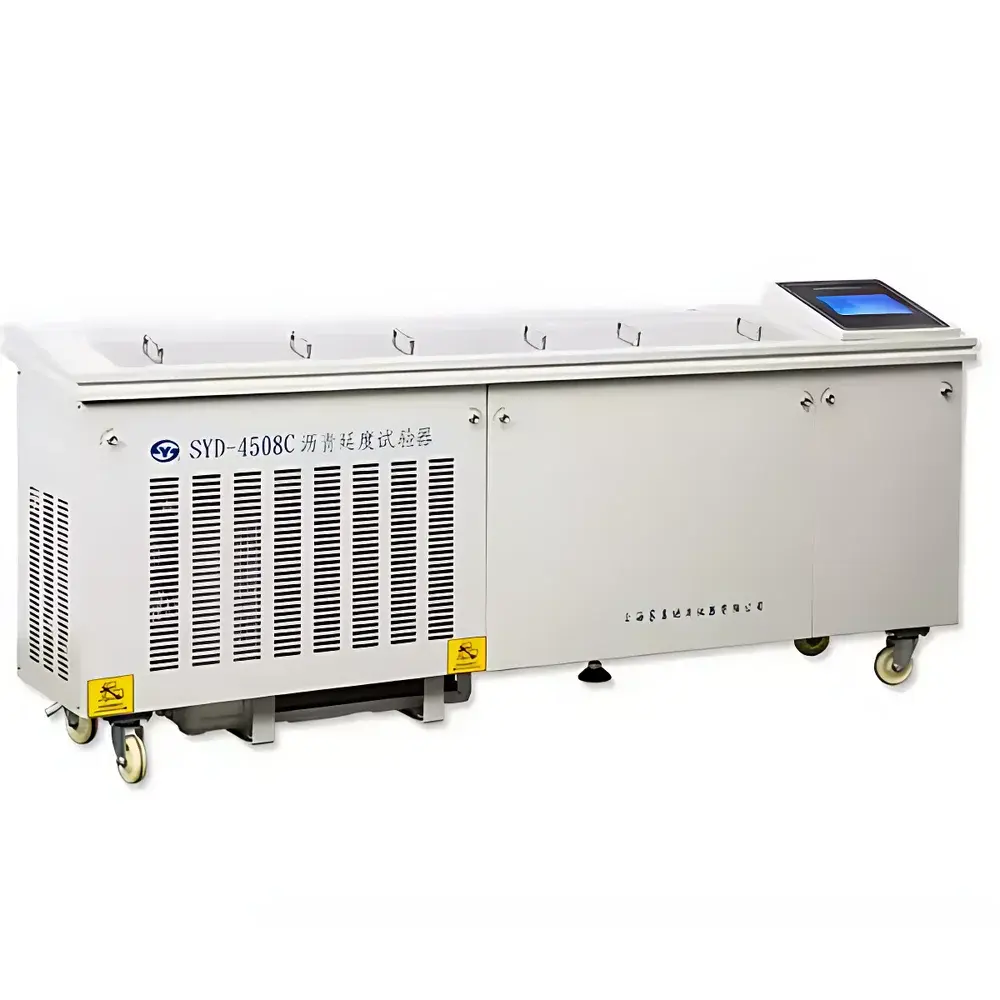
Changji Instruments SYD-4508C Bitumen Ductility Tester
| Brand | Changji Instruments |
|---|---|
| Origin | Shanghai, China |
| Model | SYD-4508C |
| Power Supply | AC (220 ± 10%) V, 50 Hz |
| Measurement Range | 1500 mm (±10 mm) |
| Temperature Control Range | 5 °C to 50 °C (adjustable), resolution 0.01 °C |
| Temperature Stability | ±0.1 °C |
| Pulling Speeds | 1 cm/min and 5 cm/min (dual fixed rates) |
| Measurement Accuracy | ±1 mm |
| Heating Power | 4500 W |
| Refrigeration | Compressor-based cooling |
| Bath Uniformity | Achieved via shielded hot-cold balanced pressurized circulation system |
| Data Processing | 32-bit ARM microcontroller with automatic ductility calculation and real-time display |
| Storage | Internal data logging with touchscreen-triggered record capture |
| Dimensions (L×W×H) | 2370 × 520 × 1000 mm |
| Net Weight | 285 kg |
| Max. Power Consumption | ≤5600 W |
| Operating Environment | 15–35 °C, RH ≤85% |
Overview
The Changji Instruments SYD-4508C Bitumen Ductility Tester is a precision-engineered laboratory instrument designed for the standardized determination of bitumen ductility in accordance with key international and national specifications—including GB/T 4508 (China National Standard), JTG E20-2011 (Chinese Highway Engineering Test Specifications), and aligned methodologies referenced in ASTM D113 and EN 13398. Ductility measurement quantifies the ability of asphalt binders to undergo plastic deformation under tensile stress at controlled temperature and strain rate—serving as a critical quality indicator for binder consistency, low-temperature cracking resistance, and compatibility with polymer modifiers. The SYD-4508C implements a constant-rate tensile extension principle: a standardized asphalt specimen, cast in a figure-eight mold and conditioned in a temperature-controlled water bath, is pulled horizontally at fixed speeds (1 cm/min or 5 cm/min) until fracture. The elongation distance—recorded in centimeters—is reported as the ductility value. This mechanical test reflects molecular chain mobility and cohesive strength within the bituminous matrix, directly informing pavement performance modeling and specification compliance.
Key Features
- High-resolution color touchscreen interface enabling intuitive parameter setup, real-time monitoring, and one-touch data capture—eliminating reliance on external PCs or auxiliary controllers.
- Integrated dual-mode thermal management: high-capacity compressor refrigeration (for sub-ambient operation down to 5 °C) combined with 4500 W electric heating ensures rapid stabilization and tight control across the full 5–50 °C range.
- Shielded hot-cold balanced pressurized circulation system maintains axial and radial temperature uniformity within ±0.1 °C across the entire 1500-mm bath volume—critical for reproducible specimen conditioning per ASTM D113 Annex A1 requirements.
- 32-bit ARM microcontroller architecture provides deterministic timing for motor-driven pulling carriage actuation, synchronized with high-frequency position sensing for ±1 mm measurement repeatability.
- Onboard data handling: automatic averaging of triplicate measurements, timestamped storage of individual ductility values, and export-ready records accessible via touchscreen navigation—supporting traceability in GLP-compliant environments.
- Rugged industrial frame (285 kg net weight) with vibration-damped leveling feet ensures mechanical stability during extended low-speed pulls—minimizing parasitic motion artifacts that compromise measurement fidelity.
Sample Compatibility & Compliance
The SYD-4508C accommodates standard figure-eight molds conforming to GB/T 4508 and ASTM D113 dimensions (typically 10 mm × 10 mm cross-section, 80 mm central width). Specimens may include unmodified penetration-grade asphalts (e.g., 60/70, 40/50), polymer-modified bitumens (SBS, EVA), crumb rubber modified binders, and bio-based asphalt alternatives—provided they meet minimum fluidity criteria for mold filling at specified pouring temperatures. The instrument satisfies technical requirements outlined in GB/T 4508, JTG E20-2011 T 0605, and provides measurement traceability consistent with ISO/IEC 17025 calibration frameworks. Its temperature control accuracy (±0.1 °C) and speed regulation tolerance align with the uncertainty budgets defined in EURAMET cg-19 and NIST SP 250-95 for materials testing instrumentation.
Software & Data Management
All operational logic and data processing are embedded within the instrument’s firmware—no external software installation or license dependencies required. The touchscreen OS supports user-defined test protocols (temperature setpoint, pull speed, soak duration), stores up to 1000 test records with date/time stamps, and displays real-time elongation curves alongside final ductility values. Data export is supported via USB flash drive in CSV format for integration into LIMS or statistical process control platforms. Audit trails—including operator ID (via optional login module), parameter changes, and calibration events—are retained internally and comply with documentation expectations under GLP and GMP Annex 11 for regulated laboratories conducting asphalt binder qualification.
Applications
- Quality assurance testing of incoming asphalt binders against contractual specifications (e.g., SHRP PG grading, EN 14023).
- Research evaluation of aging effects (RTFOT, PAV) on ductility retention—key for predicting long-term pavement fatigue life.
- Formulation development of polymer-modified bitumens where ductility serves as a proxy for elastomeric network integrity.
- Verification of temperature susceptibility profiles by conducting tests at multiple conditioning points (e.g., 5 °C, 10 °C, 15 °C).
- Third-party certification testing for road construction projects requiring compliance with MoHURD or provincial transportation bureau standards.
FAQ
What standards does the SYD-4508C comply with?
It is fully compliant with GB/T 4508, JTG E20-2011 T 0605, and technically aligned with ASTM D113 and EN 13398 for ductility measurement procedures and apparatus requirements.
Can the instrument operate continuously at 5 °C?
Yes—the compressor-based refrigeration system, combined with the shielded circulation loop, enables stable 24-hour operation at the minimum setpoint without thermal drift exceeding ±0.1 °C.
Is calibration documentation provided with the unit?
Each unit ships with a factory verification report covering temperature uniformity mapping, speed verification at both 1 cm/min and 5 cm/min, and dimensional validation of the pulling mechanism—traceable to national metrology institutes.
How is data integrity ensured during power interruption?
The embedded controller features non-volatile memory; all active test data and configuration settings are preserved during brief outages (<30 seconds); extended interruptions trigger automatic resumption from last valid state upon reboot.
Does the system support remote monitoring or network connectivity?
No Ethernet or Wi-Fi interface is integrated; however, USB-host functionality allows direct connection to laboratory networks via intermediary gateways for centralized data aggregation.
Related Products



