
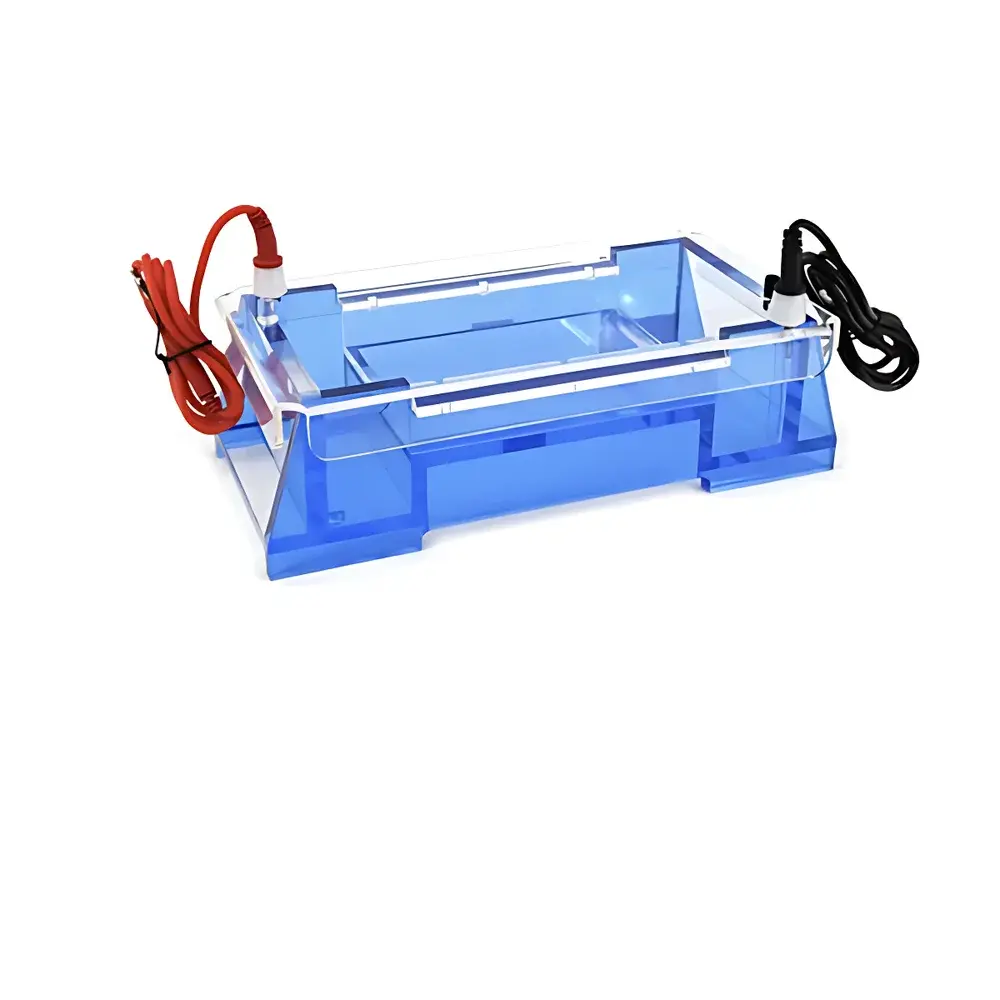
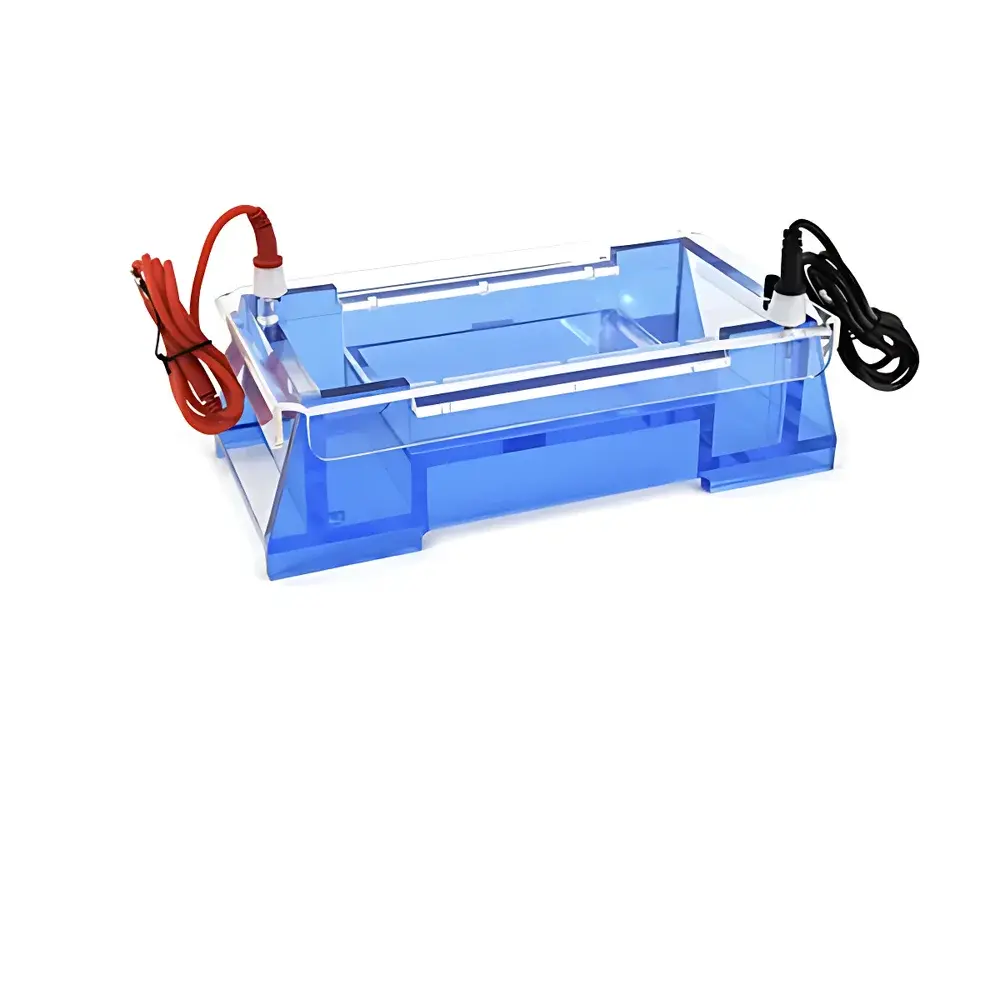
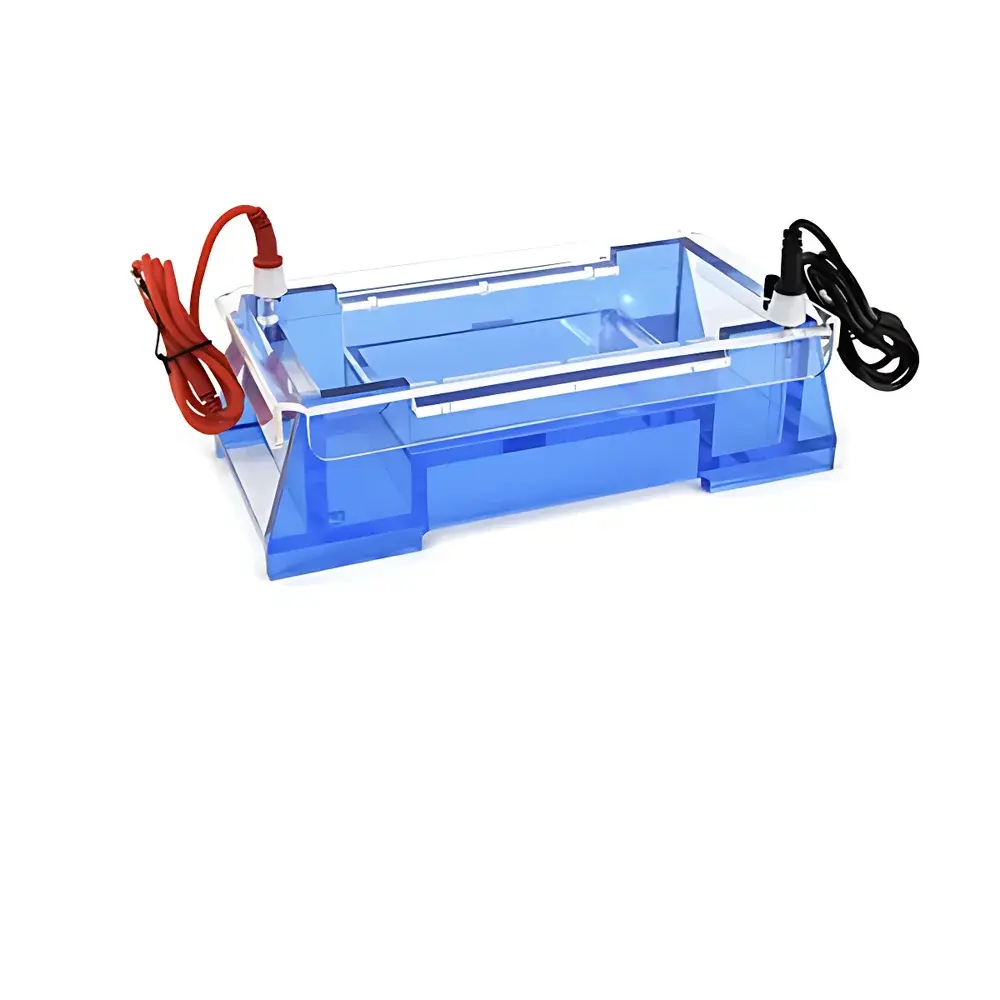
Beijing Liuyi DYCP-32A Agarose Horizontal Electrophoresis System
| Brand | Beijing Liuyi (LY) |
|---|---|
| Origin | Beijing, China |
| Model | DYCP-32A |
| Instrument Type | Nucleic Acid Electrophoresis Apparatus |
| Gel Tray Dimensions (L × W) | 160 × 100 mm |
| Overall Dimensions (L × W × H) | 300 × 162 × 110 mm |
| Buffer Capacity | 650 mL |
| Weight | 2 kg |
| Comb Options | 12-, 16-, and 22-well combs |
| Compliance | Designed for standard molecular biology laboratory workflows under GLP-aligned practices |
Overview
The Beijing Liuyi DYCP-32A Agarose Horizontal Electrophoresis System is an engineered platform for routine nucleic acid separation, identification, and molecular weight estimation in academic, clinical, and industrial molecular biology laboratories. Based on the principle of electrophoretic mobility—where DNA fragments migrate through a porous agarose matrix under a uniform DC electric field—the system delivers reproducible resolution of fragments ranging from ~100 bp to >20 kbp. Its horizontal configuration enables straightforward gel casting, loading, and post-run visualization under UV transillumination or blue-light excitation systems. The unit operates without integrated power supply (requires external DC power source, typically 0–300 V / 0–500 mA), maintaining compatibility with widely deployed laboratory electrophoresis power supplies and ensuring flexibility across varying voltage and current requirements.
Key Features
- Bridge-style buffer chamber design minimizes electrolyte volume while maintaining uniform field distribution across the full gel surface—reducing buffer consumption by up to 40% compared to conventional rectangular tanks.
- Heat-resistant acrylic construction ensures dimensional stability during extended runs (up to 2 hours at 120 V), preventing warping or leakage even at elevated current densities.
- Integrated comb positioning limiters guarantee repeatable well depth and alignment—critical for consistent sample loading volume and inter-gel comparability.
- High-flexibility silicone-insulated electrodes and leads resist fatigue and mechanical abrasion, supporting >5,000 insertion/removal cycles without insulation breach or contact resistance drift.
- Modular comb system includes six comb variants (12-, 16-, and 22-well configurations in both 1.0 mm and 2.0 mm thicknesses), enabling optimization of resolution vs. sample throughput for diverse applications—from PCR product screening to plasmid restriction digests.
- Gel tray features precision-machined alignment grooves and dual-level leveling indicators to ensure flat, bubble-free casting—a prerequisite for high-resolution band separation.
Sample Compatibility & Compliance
The DYCP-32A supports standard agarose concentrations (0.7–2.0% w/v) and compatible low-melting-point (LMP) agarose formulations. It accommodates ethidium bromide, SYBR Safe, GelRed, and other common nucleic acid stains. While not certified to IEC 61010-1 or UL 61010B as a standalone powered device, its passive architecture complies with general laboratory safety guidelines when used with CE/UL-marked power supplies. The system aligns with core procedural standards referenced in ISO/IEC 17025-accredited labs—including ASTM D4327 (electrophoresis method validation), USP (electrophoretic analysis of biologics), and CLSI MM19-A (nucleic acid electrophoresis quality control). All components are autoclavable (121°C, 20 min) except for electrode leads and combs, which are cleaned via ethanol immersion and air drying.
Software & Data Management
As a benchtop electrophoresis apparatus, the DYCP-32A operates independently of proprietary software. However, it is fully interoperable with third-party gel documentation systems—including Bio-Rad GelDoc™, Azure Sapphire™, and UVP ChemStudio™—enabling digital capture, lane profiling, molecular weight calibration, and export of TIFF/PNG/CSV files. When integrated into GLP/GMP environments, users may apply audit-trail-enabled imaging software compliant with FDA 21 CFR Part 11 (e.g., TotalLab Quant, ImageLab™ with secure user authentication) to meet traceability requirements for regulatory submissions.
Applications
- Routine verification of PCR amplification products and cloning constructs
- Restriction enzyme digestion analysis and plasmid mapping
- Quality control of extracted genomic DNA and RNA integrity assessment (via ribosomal RNA banding patterns)
- Preparative isolation of DNA fragments for downstream enzymatic manipulation (e.g., ligation, sequencing library prep)
- Teaching laboratories requiring robust, intuitive electrophoresis platforms for undergraduate molecular biology instruction
- Field-deployable diagnostics support where minimal infrastructure and buffer economy are critical
FAQ
Does the DYCP-32A include a built-in power supply?
No. It is a passive electrophoresis tank requiring connection to an external DC power supply capable of delivering 0–300 V and 0–500 mA.
Can I use this system for polyacrylamide gels?
Not recommended. The DYCP-32A is optimized for agarose-based matrices; polyacrylamide gel electrophoresis requires higher voltage tolerance, tighter thermal management, and vertical orientation for optimal resolution.
What is the maximum recommended run time at 100 V?
Up to 90 minutes under continuous operation with adequate buffer circulation or periodic buffer replenishment to maintain pH and ionic strength.
Are replacement combs available separately?
Yes. All comb types (141-3210 series) and gel trays (143-3210/143-3212) are stocked as individual SKUs with documented lot traceability.
Is the unit compatible with UV transilluminators having standard 254 nm emission?
Yes. The transparent acrylic body exhibits >92% transmission at 254 nm, permitting direct placement on UV platforms without signal attenuation or fluorescence quenching.
Related Products





