
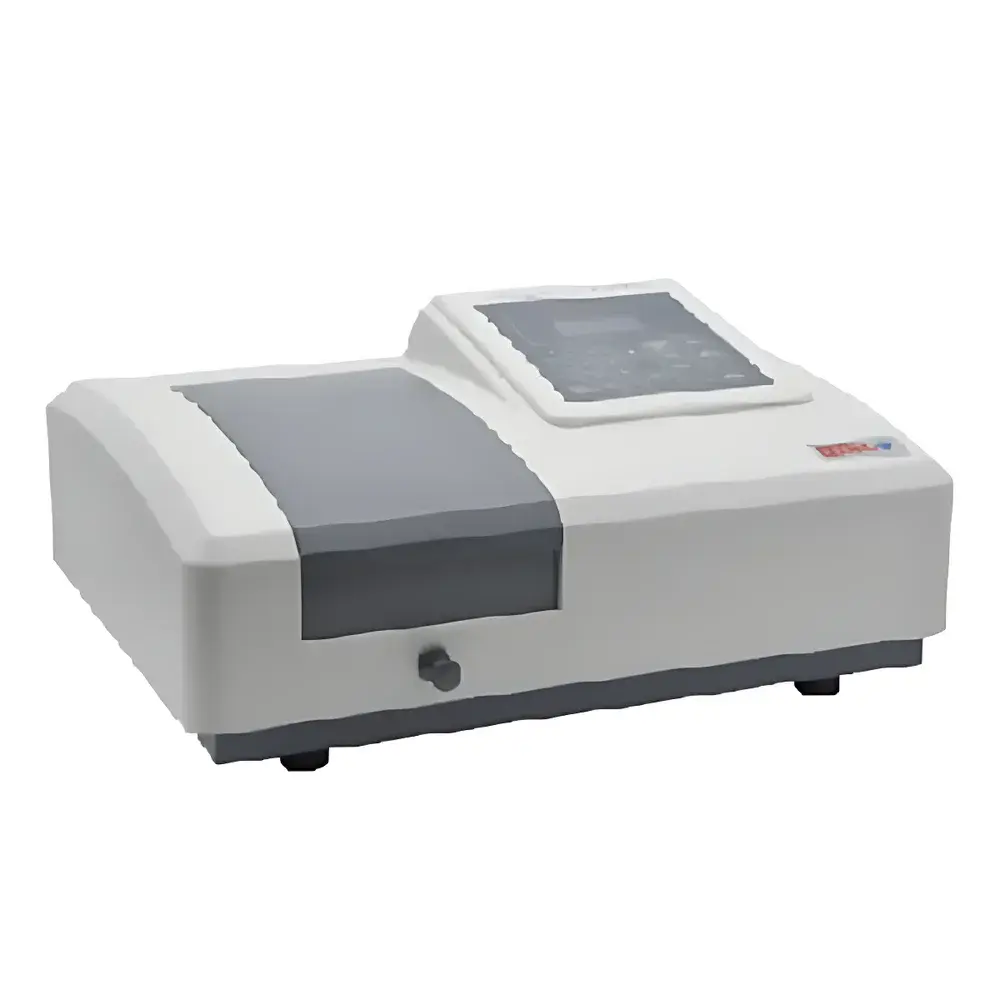
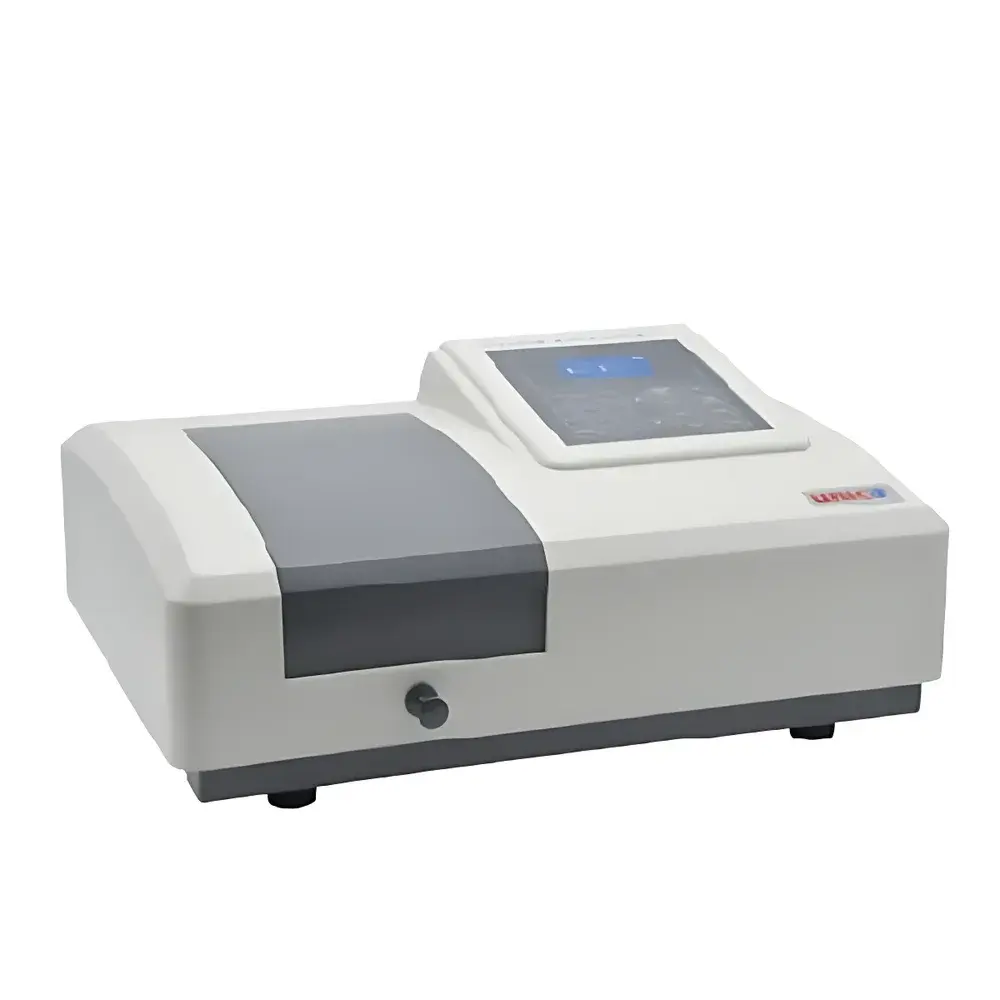
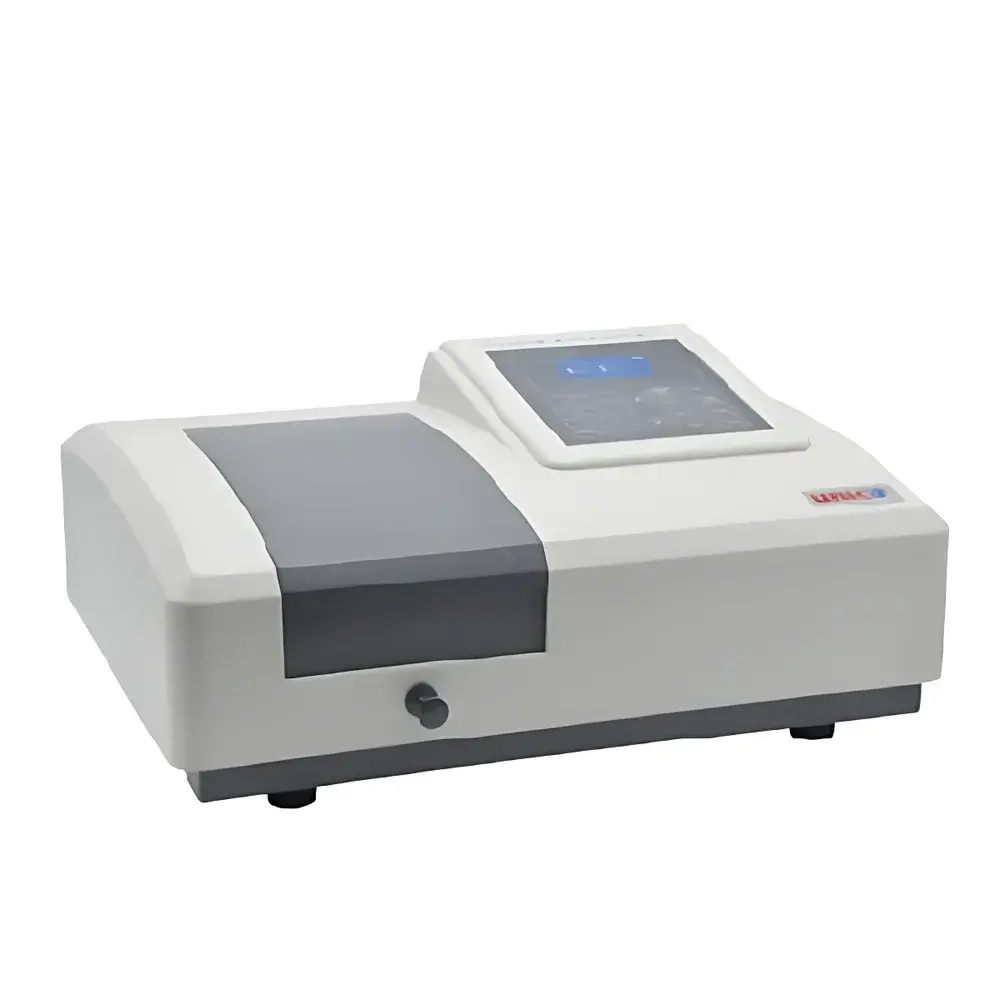
UniCo V1800 Visible Spectrophotometer
| Brand | UniCo |
|---|---|
| Origin | Shanghai, China |
| Model | V1800 |
| Optical System | Single-beam with 1200 lines/mm holographic grating |
| Wavelength Range | 325–1000 nm |
| Spectral Bandwidth | 2 nm |
| Wavelength Accuracy | ±0.8 nm |
| Wavelength Repeatability | ±0.2 nm |
| Stray Light | ≤0.2% T at 360 nm |
| Photometric Accuracy | ±0.002 Abs (0–0.5 Abs), ±0.005 Abs (0.5–1.0 Abs), ±0.3% T |
| Photometric Repeatability | ±0.001 Abs (0–0.5 Abs), ±0.002 Abs (0.5–1.0 Abs), ±0.2% T |
| Baseline Linearity | ±0.002 A |
| Stability | ±0.002 A/h at 500 nm (after warm-up) |
| Display | 126 × 64 dot-matrix LCD |
| Data Interface | USB and Centronics |
| Dimensions (W×D×H) | 485 × 365 × 220 mm |
| Weight | 13.5 kg |
Overview
The UniCo V1800 Visible Spectrophotometer is a precision single-beam optical instrument engineered for routine quantitative analysis in educational laboratories, quality control environments, and industrial R&D settings where visible-range absorbance and transmittance measurements are required. Operating on the principle of Beer–Lambert law-based absorption spectroscopy, the V1800 employs a high-stability tungsten-halogen light source and a 1200 lines/mm holographic diffraction grating to deliver consistent spectral dispersion across its full 325–1000 nm wavelength range. Its fixed 2 nm spectral bandwidth ensures adequate resolution for most colorimetric assays—including those standardized by ASTM E308 (computing CIE tristimulus values) and ISO 7724 (color measurement in paints and plastics)—while maintaining robust signal-to-noise performance. Designed for operational simplicity without compromising metrological integrity, the V1800 integrates microprocessor-controlled wavelength scanning, automatic zeroing (0%T) and full-scale calibration (100%T), and real-time photometric calculation in absorbance (A), transmittance (%T), and concentration (C) modes.
Key Features
- Single-beam optical architecture with optimized thermal and mechanical stability for long-term baseline consistency
- High-efficiency 1200 lines/mm holographic grating enabling precise wavelength selection with ±0.8 nm accuracy and ±0.2 nm repeatability
- Integrated 126 × 64 dot-matrix graphical LCD display supporting simultaneous multi-parameter readout (wavelength, A/%T/C, status indicators)
- Touch-sensitive membrane keypad with tactile feedback for intuitive navigation and rapid method recall
- Onboard memory storing up to 200 user-defined measurement protocols, including multi-point standard curves and fixed-wavelength kinetic sequences
- Dual data output interface: USB 2.0 for direct connection to Windows-based PCs and Centronics parallel port for legacy printer compatibility
- Pre-aligned 1 cm quartz/glass cuvette holder with spring-loaded mechanism ensuring repeatable optical path positioning
Sample Compatibility & Compliance
The V1800 accepts standard 10 mm square-path cuvettes—compatible with both glass and UV-transparent quartz cells—enabling seamless transition between aqueous, organic, and mildly acidic/alkaline sample matrices. Its optical design excludes deep-UV wavelengths (<325 nm), making it unsuitable for nucleic acid or aromatic compound quantification requiring 260/280 nm measurements, but highly suitable for dye analysis, enzyme kinetics (e.g., pNPP hydrolysis at 405 nm), nutrient assays (e.g., phosphate via molybdenum blue at 880 nm), and pigment concentration determination per AOAC 971.13 or APHA Standard Methods 4500-P E. The instrument meets general requirements for laboratory-grade photometric instrumentation under ISO/IEC 17025:2017 clause 5.5.2 (equipment verification), and supports GLP-compliant operation when paired with validated software workflows and documented calibration records (including NIST-traceable neutral density filters for photometric verification).
Software & Data Management
While the V1800 operates autonomously via front-panel controls, its USB interface enables integration with UniCo’s optional PC-based SpectraLink v3.x software suite. This application provides enhanced data handling capabilities including automated standard curve generation (linear, quadratic, and cubic regression), batch report export in CSV and PDF formats, audit trail logging (user ID, timestamp, parameter changes), and basic compliance features aligned with FDA 21 CFR Part 11 principles—such as electronic signature prompts and immutable result archiving when deployed on validated Windows systems. All raw absorbance/time or %T/wavelength datasets are exportable without proprietary format restrictions, facilitating secondary analysis in MATLAB, Python (NumPy/Pandas), or Excel.
Applications
- Quantitative analysis of dyes, pigments, and food colorants (e.g., tartrazine, sunset yellow) per ISO 10392
- Enzyme activity assays (e.g., ALP, LDH, GOT) using chromogenic substrates within visible detection windows
- Water and wastewater testing for iron (1,10-phenanthroline method at 510 nm), nitrate (brucine method at 410 nm), and sulfate (turbidimetry at 420 nm)
- Educational experiments in analytical chemistry, including Beer’s law validation, equilibrium constant determination, and ligand-binding stoichiometry
- Pharmaceutical excipient qualification (e.g., lactose, starch) via UV-Vis impurity screening above 325 nm
- Quality assurance of inks, coatings, and cosmetic emulsions where hue and strength must be monitored against master standards
FAQ
What is the minimum detectable absorbance change the V1800 can resolve?
The photometric repeatability specification of ±0.001 Abs (0–0.5 A range) indicates reliable discrimination of sub-millioptical-density differences under controlled conditions—sufficient for most routine QC applications but not intended for ultra-low-concentration trace analysis.
Can the V1800 perform time-scan or wavelength-scan kinetics?
Yes—the instrument supports manual or programmed wavelength stepping and fixed-wavelength time-course acquisition, though continuous spectral scanning requires external software control via USB.
Is the V1800 compliant with pharmacopeial methods such as USP <857>?
It satisfies the core instrumental requirements for visible-range spectrophotometers outlined in USP <857> (system suitability, wavelength accuracy, photometric linearity), provided users implement documented calibration procedures and verify performance using certified reference materials.
Does the V1800 support RS-232 or Ethernet connectivity?
No—only USB 2.0 and Centronics parallel interfaces are provided. Networked data transfer requires intermediary PC hosting and appropriate driver configuration.
What maintenance is recommended for long-term wavelength accuracy?
Annual verification using holmium oxide or didymium glass filters (traceable to NIST SRM 2034 or equivalent) is advised; optical alignment is factory-set and not field-adjustable.





