
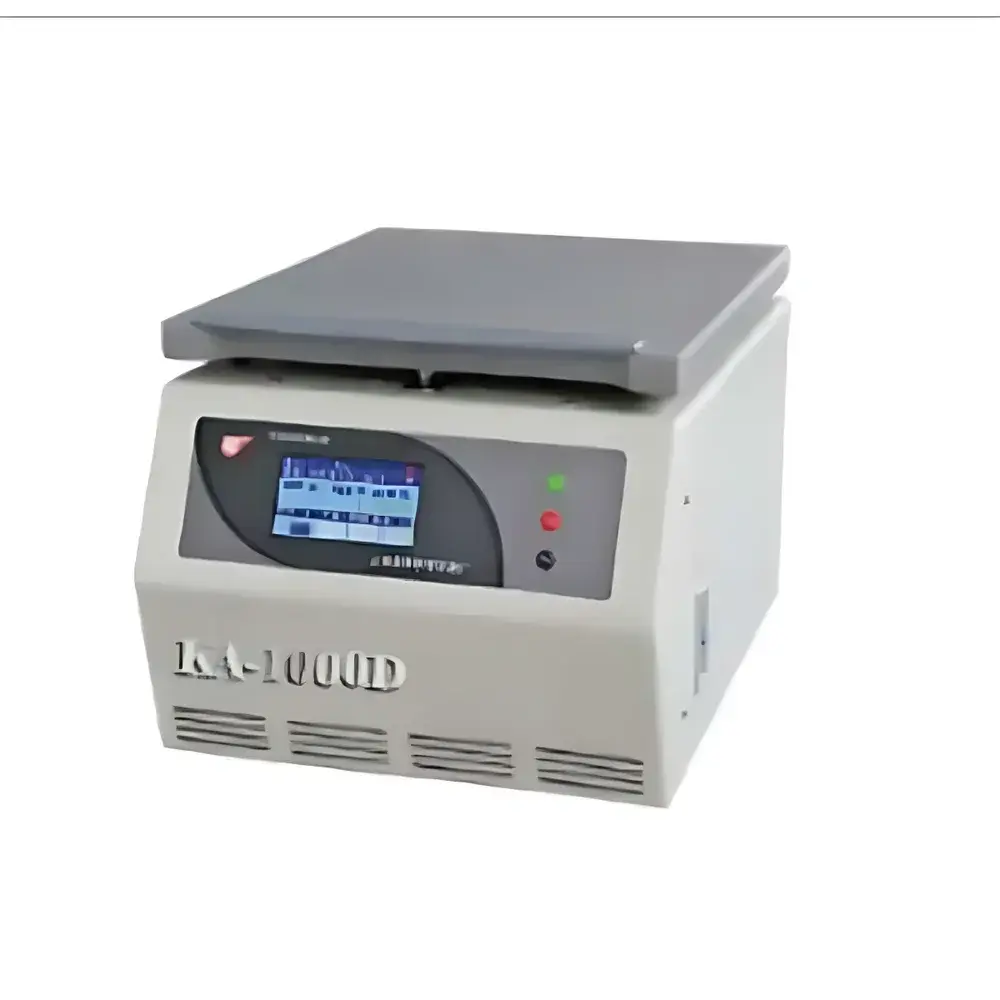
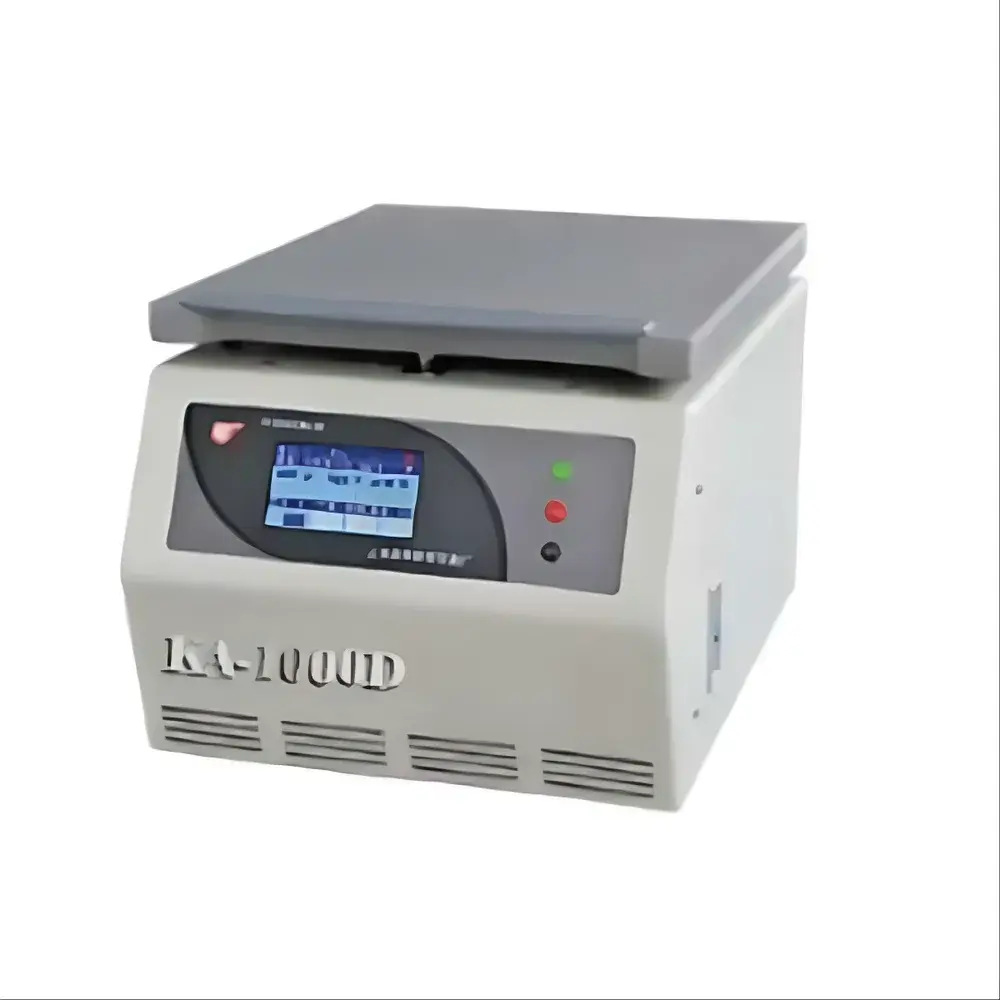
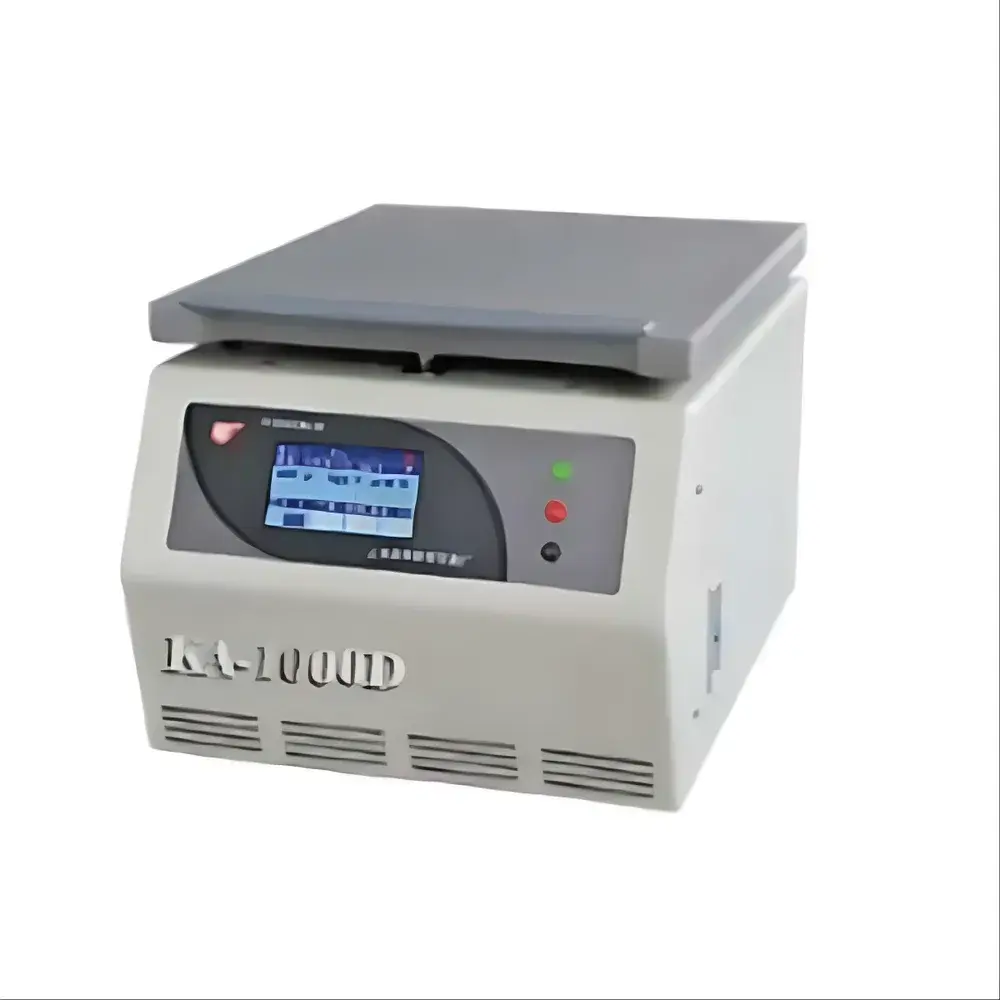
AnTing KA-1000D Benchtop Low-Speed Centrifuge
| Brand | AnTing |
|---|---|
| Origin | Shanghai, China |
| Model | KA-1000D |
| Type | Benchtop Centrifuge |
| Speed Range | 0–4000 rpm |
| Max RCF | 2220 ×g |
| Rotor Type | Fixed-Angle |
| Rotor Capacity | 15 mL × 8 |
| Timer Range | 0–99 min |
| Power Supply | 220 V, 50 Hz, 180 W |
| Dimensions (L×W×H) | 520 × 375 × 335 mm |
| Weight | 45 kg |
| Construction | Reinforced polymer housing with electronic safety door lock |
| Control System | Frequency-converter motor with capacitive touch panel interface |
| Compliance | Designed for GLP-compliant routine separation tasks in academic and QC laboratories |
Overview
The AnTing KA-1000D is a benchtop low-speed centrifuge engineered for reliable, repeatable sedimentation of biological, chemical, and clinical samples under controlled rotational conditions. It operates on the principle of sedimentation acceleration via radial force generation—where sample components separate based on differences in density, size, and shape when subjected to centrifugal acceleration (RCF). With a maximum speed of 4000 rpm and a corresponding RCF of 2220 ×g, the KA-1000D is optimized for applications requiring gentle yet effective phase separation—such as cell pelleting, serum/plasma preparation, precipitate recovery, and routine particulate clarification. Its compact footprint and reinforced polymer chassis ensure mechanical stability during extended operation while minimizing vibration transmission to adjacent instrumentation. The unit integrates a frequency-converter motor for precise speed regulation and stepless acceleration/deceleration profiles—critical for preserving fragile cellular structures or preventing resuspension of settled material.
Key Features
- Capacitive touch-panel interface with intuitive icon-based navigation and real-time parameter display (speed, time, RCF, remaining time)
- Electronic safety door lock system that automatically inhibits rotor rotation when the lid is open or improperly secured—compliant with IEC 61010-2-020 safety standards for laboratory centrifuges
- Frequency-converter motor enabling smooth ramp-up/down control, reduced mechanical stress on bearings, and extended service life
- Fixed-angle rotor configuration (15 mL × 8) designed for high reproducibility across consecutive runs; rotor balance tolerance ±0.5 g per tube position
- Thermally insulated housing minimizes ambient heat transfer, supporting stable operation in non-climate-controlled lab environments
- Low-noise design (<65 dB(A) at 4000 rpm) suitable for shared laboratory spaces without acoustic enclosures
Sample Compatibility & Compliance
The KA-1000D accommodates standard polypropylene or glass centrifuge tubes (10–15 mL) and is routinely deployed for blood fractionation, microbial pellet collection, polymer suspension clarification, and buffer exchange workflows. It supports protocols aligned with ISO 15189 and CLSI GP40-A4 guidelines for pre-analytical sample handling. While not a refrigerated unit, its thermal management allows uninterrupted operation for ≤30 min at maximum speed without measurable internal temperature rise (>2°C)—making it suitable for short-duration separations where thermal sensitivity is moderate. All electrical components conform to CE marking requirements (EMC Directive 2014/30/EU and LVD Directive 2014/35/EU), and the device is documented for traceable calibration using NIST-traceable tachometers.
Software & Data Management
The KA-1000D operates as a standalone instrument with no external software dependency. All operational parameters—including speed setpoint, run time, acceleration/deceleration profile, and rotor identification—are stored locally in non-volatile memory and retained after power cycling. The touch interface logs the last 20 run cycles (timestamp, speed, duration, RCF), accessible for internal audit purposes. Though lacking FDA 21 CFR Part 11-compliant electronic signatures or network connectivity, the unit meets essential data integrity criteria for GLP environments when used with manual logbook documentation and periodic verification of timer accuracy (±1 sec over 60 min, verified annually per internal SOP).
Applications
- Routine blood banking: separation of whole blood into packed red cells, leukocyte-poor plasma, and platelet-rich plasma
- Microbiology labs: harvesting bacterial or yeast cultures prior to DNA extraction or protein expression analysis
- Environmental testing: solid-liquid separation of suspended solids from aqueous effluent samples (e.g., EPA Method 160.1)
- Pharmaceutical QA: clarification of excipient suspensions and active ingredient slurries during formulation development
- Educational settings: demonstration of sedimentation kinetics and Stokes’ law validation experiments
FAQ
Is the KA-1000D compatible with swing-bucket rotors?
No—the KA-1000D is configured exclusively with a fixed-angle rotor (15 mL × 8). It does not support horizontal or swinging-bucket rotor interchangeability.
What maintenance intervals are recommended for long-term reliability?
Rotor inspection and cleaning every 6 months; full bearing lubrication and drive belt tension check annually by certified technician.
Can the timer be paused mid-run?
No—once initiated, the countdown proceeds continuously. Interrupted runs require manual stop and reset.
Does the unit include rotor imbalance detection?
Yes—a dynamic imbalance sensor triggers automatic shutdown if vibration exceeds ISO 1940-1 G6.3 threshold during acceleration or steady-state operation.
Is calibration certification provided with shipment?
A factory-issued calibration report (speed and timer accuracy) is included; users may request UKAS-accredited third-party verification at additional cost.



