
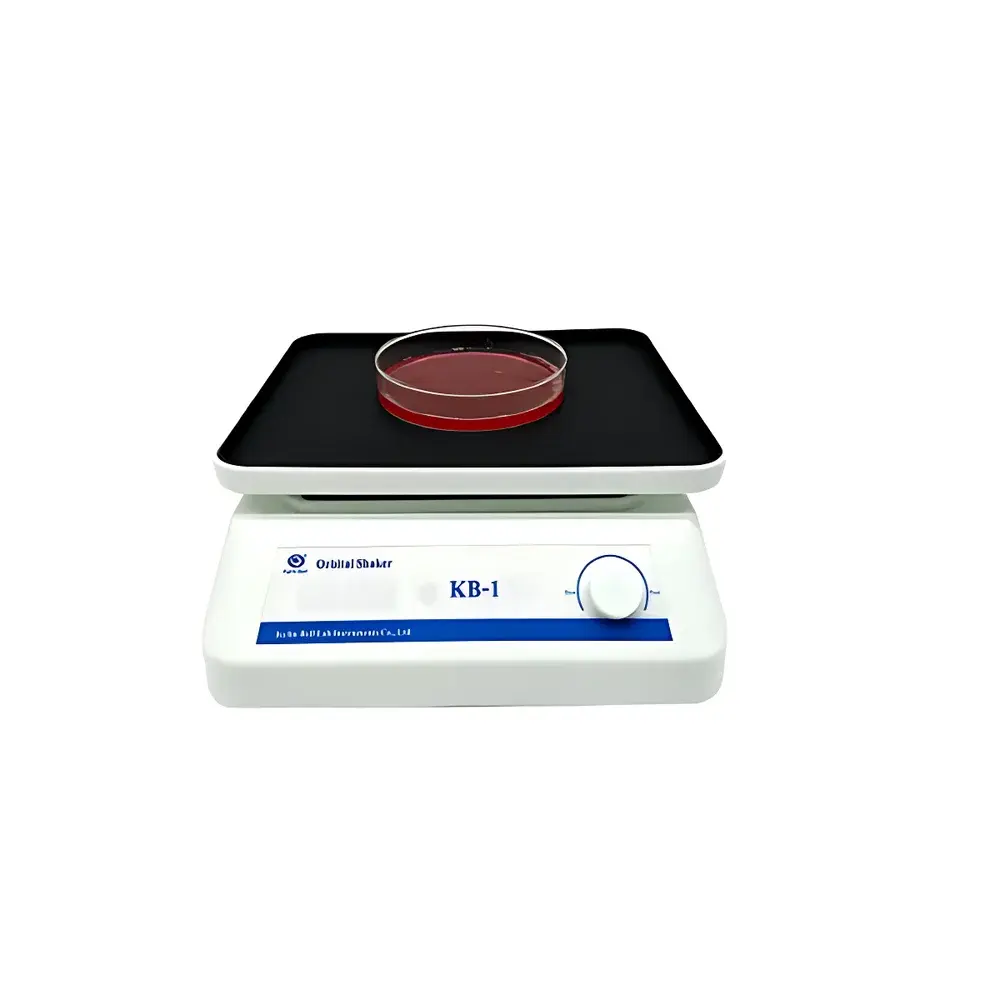
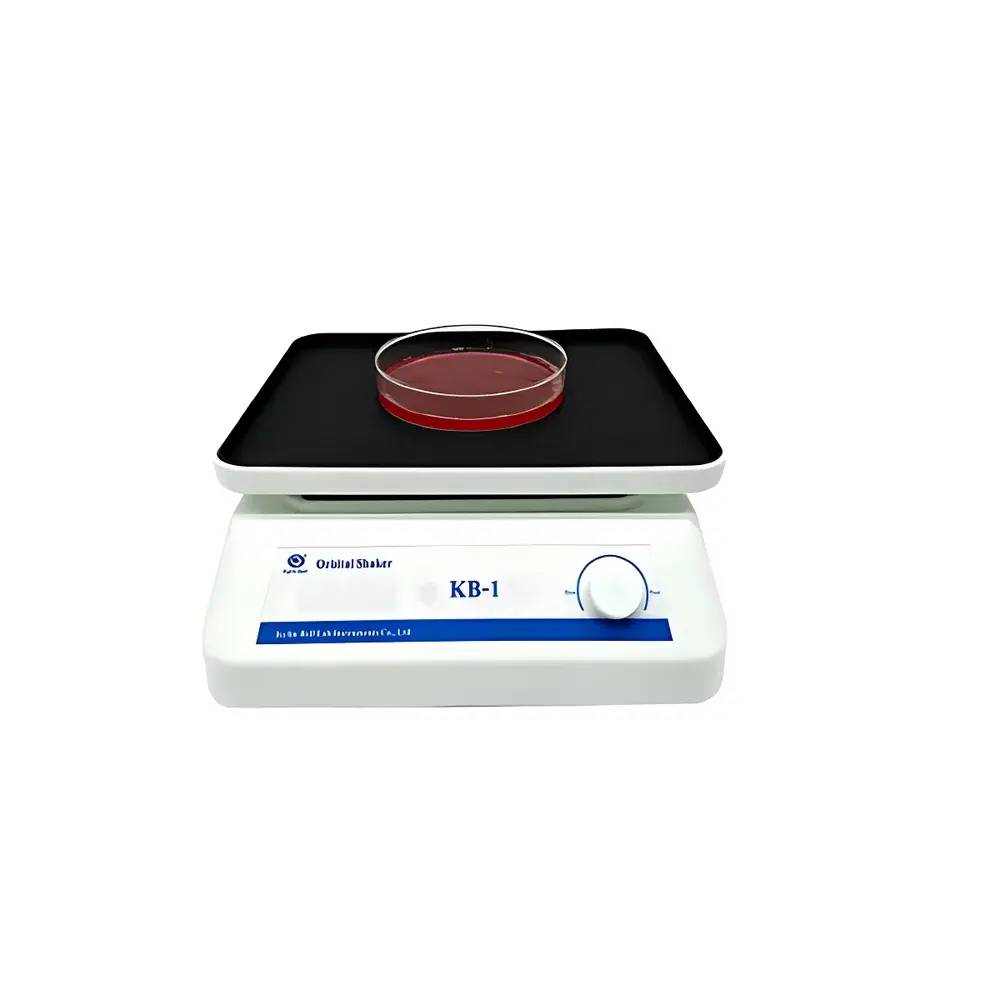
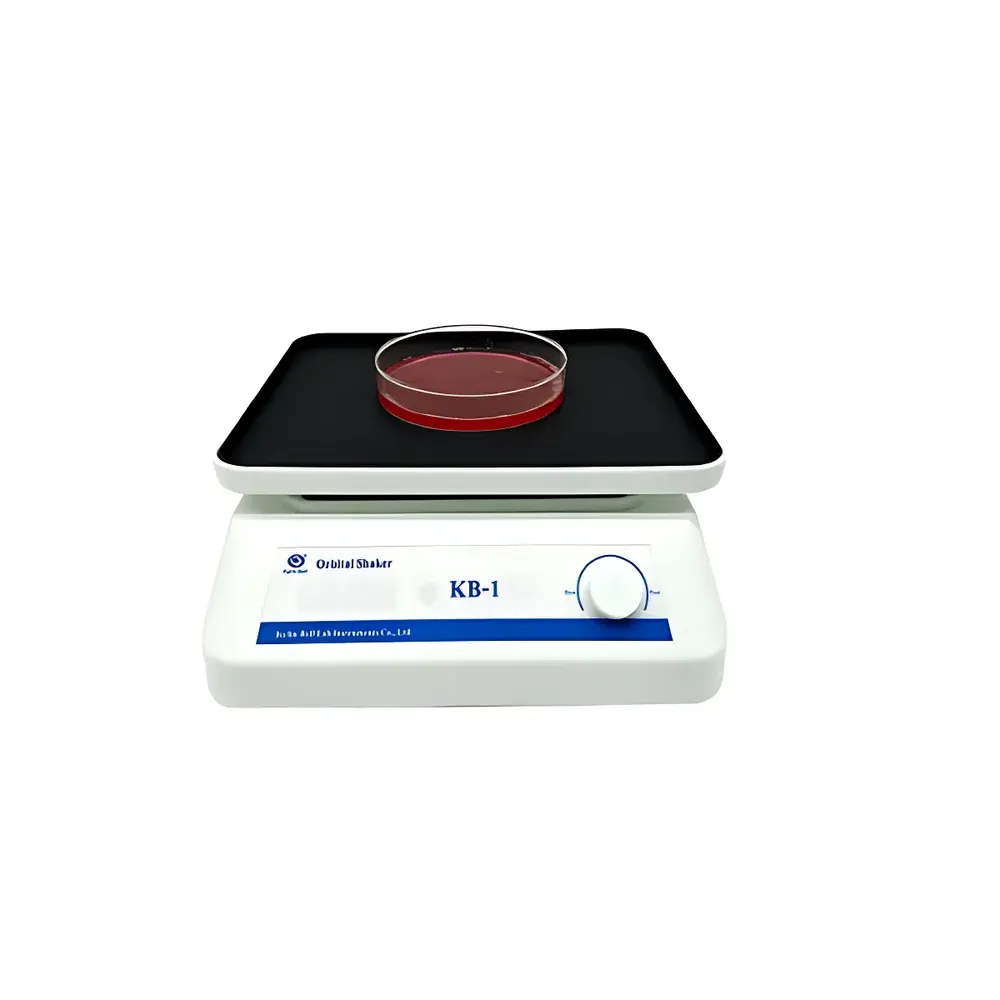
Kylin-Bell KB-1 Decolorization Shaker
| Brand | Kylin-Bell |
|---|---|
| Origin | Jiangsu, China |
| Manufacturer Type | Authorized Distributor |
| Product Category | Domestic |
| Model | KB-1 |
| Instrument Type | Decolorization & Transfer Shaker |
| Oscillation Frequency | 40–240 rpm (adjustable, continuous) |
| Temperature Compatibility | Non-thermostatic — designed for use inside external incubators, cold rooms, or environmental chambers |
| Number of Platforms | 1 |
| Power Supply | 110–220 V AC (default 220 V) |
| Drive Mechanism | DC motor with nylon 1010 shaft core and brass eccentric sleeve |
| Transmission | Silicone timing belt |
| Platform Material | Molded natural rubber (acid/alkali resistant) |
| Platform Dimensions | 265 × 330 mm |
| Overall Dimensions (W×D×H) | 330 × 330 × 135 mm |
| Weight | 5 kg |
| Rated Power | 30 W |
| Motion Type | Horizontal orbital shaking |
| Speed Control | Stepless (analog knob) |
Overview
The Kylin-Bell KB-1 Decolorization Shaker is an entry-level, high-reliability orbital shaker engineered specifically for low-shear, uniform agitation in post-electrophoretic workflows. It operates on the principle of horizontal circular motion—generating consistent, gentle orbital displacement (typically 20–25 mm diameter)—optimized to accelerate diffusion-controlled processes such as dye removal from polyacrylamide or agarose gels, antibody binding during membrane-based immunoassays, and hybridization kinetics in nucleic acid blotting. Unlike thermostatic shakers, the KB-1 features a passive thermal design: it contains no internal heating or cooling elements, enabling safe, stable operation inside externally controlled environments—including refrigerated cabinets (4 °C), CO₂ incubators (37 °C), or humidity-regulated chambers—without risk of condensation, electromagnetic interference, or thermal drift affecting sensitive biomolecular interactions.
Key Features
- Robust mechanical architecture: DC motor coupled with a brass eccentric sleeve and nylon 1010 shaft core ensures long-term rotational stability and minimal runout across the full speed range (40–240 rpm).
- Chemically inert platform: Molded natural rubber deck resists degradation from common laboratory reagents—including acetic acid, methanol, ethanol, SDS, and sodium hydroxide—facilitating rapid decontamination and reducing cross-contamination risk.
- Low-noise, low-vibration operation: Silicone timing belt drive eliminates gear backlash and metal-on-metal contact, delivering smooth motion even at maximum speed—critical for preserving fragile gels and blotted membranes.
- Stepless analog speed control: Precision potentiometer enables fine-grained adjustment without discrete steps, supporting method optimization for protocols requiring specific agitation intensities (e.g., stringent washes vs. gentle hybridization).
- Compact footprint and lightweight design (5 kg): Fits seamlessly into standard benchtop hoods, cold rooms, and stacked incubator configurations; compatible with ISO Class 5 laminar flow cabinets when used with appropriate containment.
Sample Compatibility & Compliance
The KB-1 accommodates standard electrophoresis trays (up to 20 × 20 cm), mini-gel cassettes, hybridization bottles (50–250 mL), and multi-well membrane frames (e.g., 96-well dot-blot supports). Its non-thermostatic construction aligns with GLP-compliant lab practices where temperature is independently monitored and logged via external calibrated sensors (e.g., NIST-traceable thermistors or data loggers). While not certified to IEC 61000-6-3 (EMC) or UL 61010-1 out-of-the-box, the unit meets basic electrical safety requirements for laboratory equipment per GB 4793.1–2007 (China’s equivalent to IEC 61010-1), and its material composition complies with RoHS Directive 2011/65/EU restrictions on hazardous substances.
Software & Data Management
The KB-1 is a standalone analog instrument with no embedded firmware, digital interface, or data logging capability. This design prioritizes operational simplicity, electromagnetic compatibility in sensitive detection environments (e.g., phosphorimagers, scintillation counters), and regulatory flexibility: absence of software eliminates validation burdens under FDA 21 CFR Part 11 or EU Annex 11 for routine decolorization or transfer steps. Users maintain full procedural traceability through manual logbook entries or integration with LIMS via external timers or programmable power controllers (e.g., smart outlets with event-triggered scheduling).
Applications
- Gel processing: Coomassie Blue or silver stain destaining, fixation, and washing of SDS-PAGE and native PAGE gels.
- Membrane-based assays: Pre-hybridization blocking, probe hybridization, stringency washes, and chemiluminescent substrate incubation on nitrocellulose or PVDF membranes.
- Radiographic film development: Uniform agitation during X-ray film developer, stop bath, and fixer immersion in autoradiography workflows.
- Cellular applications: Gentle suspension of adherent cells during detachment (with enzymatic buffers), post-transfection mixing, and low-speed resuspension of pelleted primary cultures.
- Environmental adaptability: Validated performance at temperatures ranging from 4 °C (cold-room gel storage) to 45 °C (high-stringency hybridization), provided ambient humidity remains below 80% RH to prevent belt slippage.
FAQ
Can the KB-1 be operated inside a CO₂ incubator?
Yes—its passive thermal design, sealed motor housing, and silicone belt make it suitable for continuous operation in humidified 5% CO₂ incubators up to 37 °C. Ensure adequate airflow around the unit to prevent localized heat buildup.
Is the rubber platform autoclavable?
No. The molded natural rubber deck is not autoclave-rated. Clean with 70% ethanol, 0.5% SDS, or mild detergent; avoid prolonged exposure to oxidizing agents (e.g., hydrogen peroxide >3%).
What is the minimum load required for stable operation?
The shaker achieves optimal balance with ≥300 g distributed load (e.g., one filled gel tray or two 50-mL conical tubes). Light loads (<100 g) may induce slight resonance at mid-range speeds (120–180 rpm); adding mass or reducing speed resolves this.
Does the KB-1 support external speed control via TTL or 0–10 V signal?
No. It features only manual analog speed adjustment. For automated integration, consider using a programmable AC relay controller synchronized with lab workflow software.
Are replacement platforms available separately?
Yes. Kylin-Bell supplies OEM-compatible rubber decks (P/N KB-RUB-PLT) and optional stainless-steel mesh inserts for enhanced durability in high-throughput labs.





