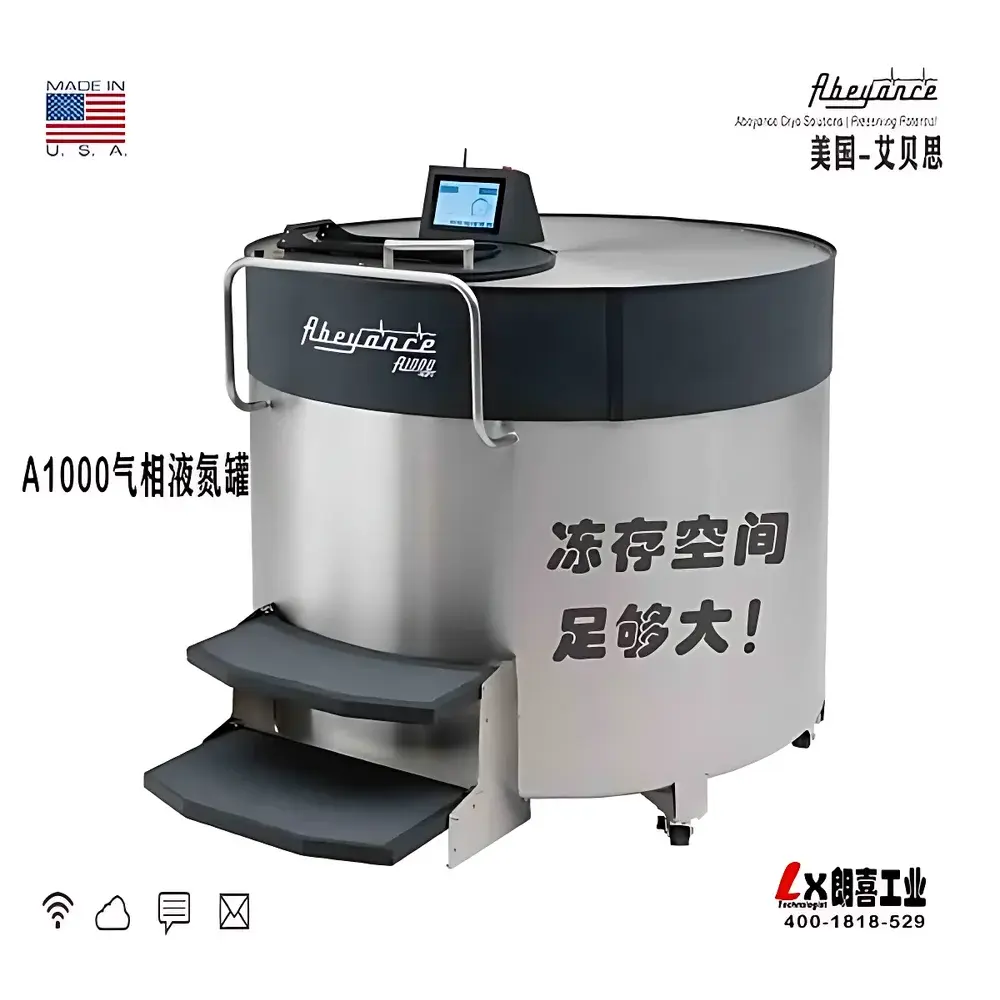
Abeyance A1000 Ultra-High-Capacity Vapor-Phase Liquid Nitrogen Storage Tank
| Brand | Abeyance |
|---|---|
| Origin | USA |
| Model | A1000 |
| Capacity | Up to 1,000 L (liquid nitrogen hold time ≥ 120 days) |
| Operating Temperature Range | −190 °C to −150 °C (vapor-phase zone) |
| Construction | Dual-walled stainless steel with high-vacuum insulation |
| Control System | Microprocessor-based touchscreen interface with Wi-Fi/Ethernet connectivity |
| Compliance | Designed per ISO 13485 principles for medical device storage environments |
| Alarm Options | SMS, email, and cloud-based notifications via secure TLS-encrypted API |
Overview
The Abeyance A1000 is an ultra-high-capacity vapor-phase liquid nitrogen (LN₂) storage system engineered for long-term, ultra-low-temperature preservation of sensitive biological specimens—including cryopreserved cells, stem cell lines, oocytes, embryos, tissue fragments, and genomic materials. Unlike traditional liquid-phase storage, the A1000 maintains samples exclusively in the stable, contamination-free vapor phase above the LN₂ reservoir—eliminating direct contact with liquid while ensuring uniform thermal distribution across the entire storage chamber. Its dual-walled, vacuum-insulated stainless steel architecture minimizes heat ingress and reduces LN₂ boil-off rates to ≤0.8 L/day under standard ambient conditions (25 °C, 50% RH), enabling hold times exceeding 120 days between refills. The system operates within a tightly controlled temperature range of −190 °C to −150 °C in the vapor zone, validated through continuous multi-point thermocouple mapping per ASTM F2626-22 guidelines for cryogenic storage integrity.
Key Features
- Vapor-phase storage architecture with thermally optimized internal geometry—ensures ±0.5 °C temperature uniformity across all storage positions (validated per ISO/IEC 17025-accredited calibration protocols)
- High-efficiency vacuum insulation layer maintained at ≤1×10⁻⁴ Pa residual pressure, coupled with multi-layer reflective shielding for minimized radiative heat transfer
- Integrated microprocessor control panel featuring a 7-inch capacitive touchscreen with real-time graphical display of LN₂ level, internal temperature gradients, vacuum status, and alarm history
- Ergonomic access design: wide-diameter top opening (Ø520 mm), hinged lift-top lid with gas-assisted dampening, rotating central canister carousel (360° manual rotation with indexed positioning), and foldable stainless steel footstep with non-slip tread
- LED cold-resistant illumination system with anti-fog optics—provides full visual clarity during sample retrieval without thermal perturbation or condensation buildup
- Embedded dual-network interface (Wi-Fi 802.11n + 10/100 Mbps Ethernet) supporting TLS 1.2–secured data transmission to enterprise LIMS or cloud-hosted monitoring platforms
Sample Compatibility & Compliance
The A1000 accommodates standardized cryogenic storage formats including 1.2 mL, 2.0 mL, and 5.0 mL externally threaded vials; 25 mm and 30 mm cryoboxes (up to 20 boxes per canister); and custom racks for IVF straws or cryobags. All internal components comply with USP extractables profiling and are certified non-pyrogenic per EP 2.6.14. The system supports audit-ready operation under GLP and GMP frameworks: event logs include timestamped user ID, parameter changes, door-open duration, and alarm acknowledgments—all retained for ≥18 months with write-protection and cryptographic hashing. Remote alerting conforms to ICH E6(R3) Annex 11 requirements for electronic records and signatures when integrated with validated middleware.
Software & Data Management
The Abeyance A1000 runs firmware version 4.2.x with embedded data logging at 1-minute intervals for up to 3 years (circular buffer). Raw telemetry—including 12-channel temperature traces, vacuum sensor output, LN₂ level ultrasonic readings, and door status—is exportable in CSV or HL7-compliant formats. Optional Abeyance CloudLink™ subscription enables role-based web dashboard access, automated backup to AWS S3 (SOC 2 Type II compliant), and configurable escalation trees for critical alarms. All remote communications adhere to FDA 21 CFR Part 11 Annex B specifications, including electronic signature capture, audit trail immutability, and system validation documentation packages (IQ/OQ/PQ templates available upon request).
Applications
- Long-term biobanking of human biospecimens in academic, clinical, and contract research organization (CRO) settings
- Embryo and gamete storage in assisted reproductive technology (ART) laboratories compliant with CAP/CLIA and ESHRE standards
- Stem cell banking infrastructure requiring ISO 20387:2018 conformance for biobank accreditation
- Pharmaceutical stability studies involving cryopreserved reference standards and potency assay materials
- Government and defense-sector biodata repositories requiring NIST-traceable temperature assurance and chain-of-custody reporting
FAQ
What is the maximum validated storage capacity for 2 mL vials?
The A1000 supports up to 32,000 individually barcoded 2 mL vials using standard 10×10 cryoboxes across 16 canisters.
Does the system support integration with existing LIMS or ELN platforms?
Yes—via RESTful API or HL7 v2.5 message exchange; Abeyance provides documented interface specifications and pre-validated connectors for Thermo Fisher SampleManager, LabVantage, and Benchling.
How is vacuum integrity monitored over time?
A built-in Pirani gauge continuously measures interstitial pressure; deviation beyond 5×10⁻⁴ Pa triggers maintenance alerts and disables auto-refill functions until service verification.
Is the touchscreen interface compatible with glove use in cleanroom environments?
The capacitive screen responds reliably to nitrile and latex gloves rated ISO Class 5 or higher; optional stylus mode is enabled via firmware toggle.
Can temperature mapping be performed without interrupting active storage?
Yes—using the optional A1000-TM Kit, which deploys 16 calibrated PT100 sensors on a removable grid; mapping reports conform to ASTM E2874-21 Annex A1 for cryogenic chambers.
Related Products