
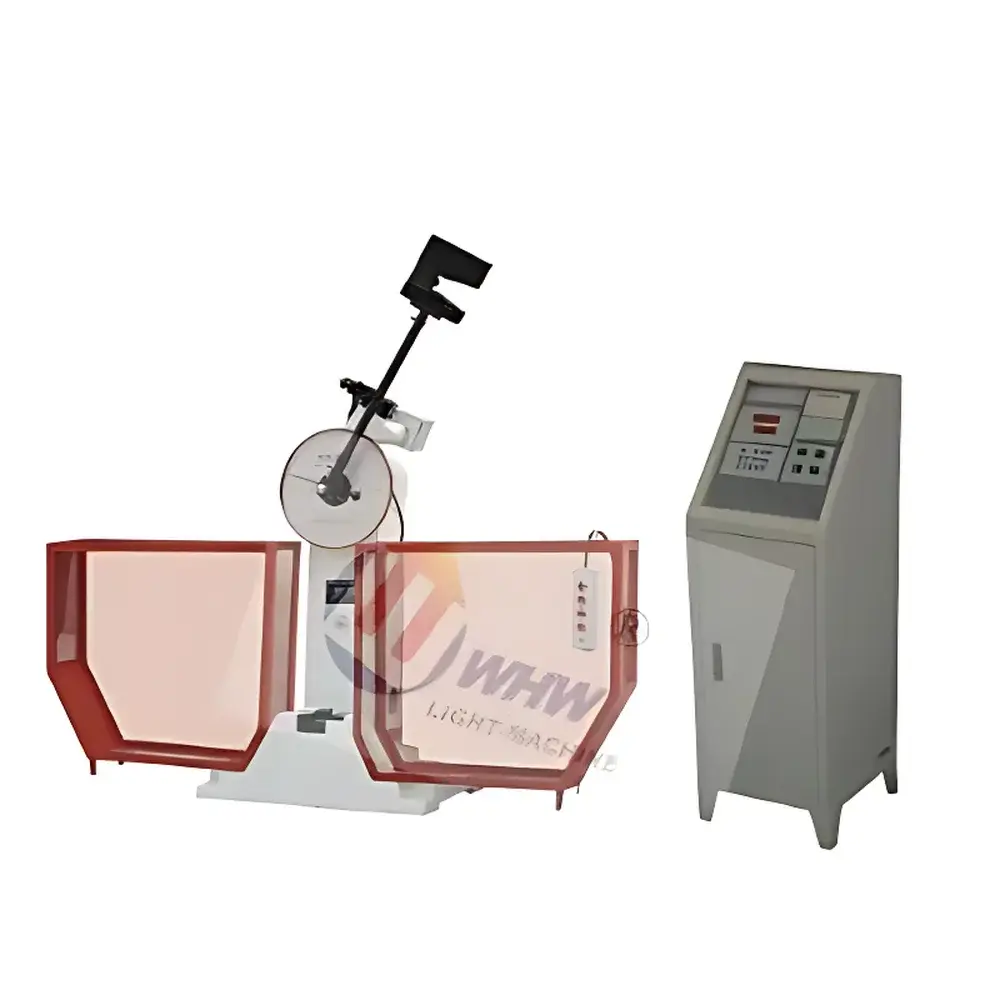
MC009-JB-300S/500S Digital Semi-Automatic Charpy Impact Testing Machine
| Origin | Shanghai, China |
|---|---|
| Manufacturer Type | Authorized Distributor |
| Origin Category | Domestic (China) |
| Model | MC009-JB-300S / MC009-JB-500S |
| Price | Upon Request |
| Impact Energy | 150/300 J (JB-300S) / 250/500 J (JB-500S) |
| Pendulum Pivot-to-Impact Point Distance | 750 mm (JB-300S) / 800 mm (JB-500S) |
| Impact Velocity | 5.2 m/s (JB-300S) / 5.4 m/s (JB-500S) |
| Pre-lift Angle | 150° |
| Support Span | 40 mm |
| Anvil Radius | R1–R1.5 mm |
| Striking Edge Radius | R2–R2.5 mm and R8 ± 0.05 mm |
| Specimen Dimensions | 10 (or 7.5, 5, 2.5) × 10 × 55 mm |
Overview
The MC009-JB-300S and MC009-JB-500S Digital Semi-Automatic Charpy Impact Testing Machines are precision-engineered instruments designed to evaluate the impact toughness of metallic materials under dynamic loading conditions. Based on the standardized Charpy V-notch (CVN) or Charpy U-notch test principle, these machines measure the energy absorbed during fracture—expressed in joules (J)—when a pendulum-driven striker impacts a notched specimen supported as a simply supported beam. The system complies with ISO 148-1:2016, ASTM E23-23, and GB/T 229–2007 for specimen geometry, testing procedure, and result interpretation. Each model employs a single-pivot pendulum mechanism with calibrated rotational inertia and defined impact velocity, ensuring high reproducibility across repeated tests. The semi-automatic operation—covering pendulum lifting, latching, release, and post-fracture automatic re-lift—is implemented via embedded microcontroller logic, minimizing operator intervention while maintaining full traceability of mechanical actuation sequences.
Key Features
- Robust single-column frame architecture with cantilevered pendulum suspension, optimized for rigidity and minimal energy loss during impact;
- Interchangeable pendulums with dual-range energy calibration (150/300 J for JB-300S; 250/500 J for JB-500S), each certified per GB/T 3803–2002 verification requirements;
- Quick-release impact blade mounted via precision-threaded fasteners, enabling tool-free replacement and alignment verification using included centering plates;
- Standardized 40 mm support span with hardened anvil surfaces and controlled radii (R1–R1.5 mm) to ensure consistent stress distribution per ISO 148-2;
- Integrated safety interlock system featuring mechanical safety pins and full-height protective mesh enclosure, compliant with EN ISO 13857 and OSHA 1910.212;
- Digital measurement and display unit with real-time calculation of absorbed energy, pendulum lift angle, and batch-averaged results; supports thermal-printed output of raw data and statistical summaries.
Sample Compatibility & Compliance
These testers accommodate standard Charpy specimens per GB/T 229–2007 and ISO 148–1:2016, including 10 × 10 × 55 mm nominal cross-sections with optional sub-size geometries (7.5, 5.0, and 2.5 mm thickness). Notch types supported include V-notch (45°, 2 mm depth, 0.25 mm root radius) and U-notch (5 mm depth, 1 mm root radius), both machined to tolerance limits specified in ASTM E23 Annex A1. All mechanical components—including pivot bearings, knife edges (R8 ± 0.05 mm), and specimen supports—undergo metrological validation prior to shipment. The system meets national verification standards GB/T 3803–2002 for machine classification (Class 2 accuracy), and its operational repeatability is validated against reference specimens traceable to NIM (National Institute of Metrology, China) or equivalent national metrology institutes.
Software & Data Management
The integrated digital control cabinet features an industrial-grade 8-bit microcontroller with non-volatile memory storage for up to 500 test records. Each record includes timestamp, specimen ID, energy value (J), calculated absorbed energy per unit area (J/cm²), lift angle (°), and pass/fail flag based on user-defined thresholds. Data export is available via RS-232 serial interface to external PCs running Windows-compatible lab management software. While the base system does not include FDA 21 CFR Part 11-compliant audit trail functionality, it supports GLP-aligned documentation practices through printed reports containing operator ID, calibration date, and environmental notes. Optional firmware upgrades enable CSV file generation and basic statistical analysis (mean, SD, CV%) directly on the display interface.
Applications
These instruments serve critical roles in quality assurance laboratories across metallurgical production facilities, heavy equipment manufacturing, aerospace component suppliers, and third-party certification bodies. Typical use cases include incoming material inspection of structural steels (e.g., ASTM A36, A572, Q345), heat-treatment process validation (quenching & tempering response), low-temperature toughness assessment for cryogenic service alloys (e.g., ASTM A333 Gr.6), and failure analysis of fractured components. In R&D environments, they support comparative studies of alloy modifications, weld metal characterization, and aging behavior evaluation of pressure vessel steels under simulated service temperatures (–40 °C to +60 °C).
FAQ
What standards does this machine comply with?
It conforms to GB/T 229–2007, GB/T 3803–2002, ISO 148-1:2016, and ASTM E23–23 for test methodology, machine verification, and reporting requirements.
Can the machine test sub-size specimens?
Yes—it accepts specimens with thicknesses of 10, 7.5, 5.0, and 2.5 mm, provided notch geometry and support span adjustments follow ISO 148-1 Annex B guidelines.
Is calibration certificate included?
Each unit ships with a factory calibration report referencing standard impact specimens verified against national metrological standards; optional NIST-traceable calibration services are available upon request.
What maintenance is required for long-term accuracy?
Recommended quarterly verification of pendulum pivot friction, knife-edge wear (using optical profilometry), and support span alignment; annual recalibration of energy scale using certified reference pendulums.
Does the system support networked data transfer?
Native RS-232 connectivity enables point-to-point data logging; Ethernet or Wi-Fi integration requires external protocol converters compatible with Modbus RTU or ASCII serial framing.



