
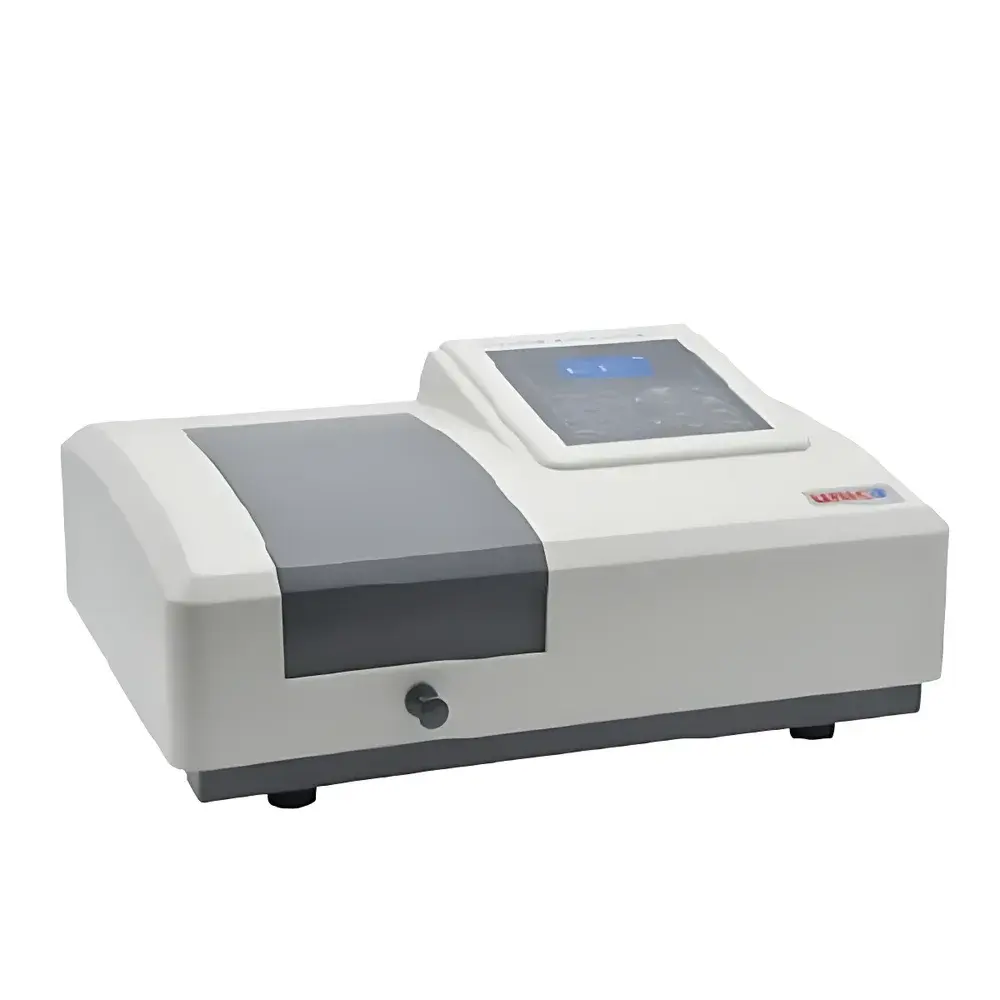
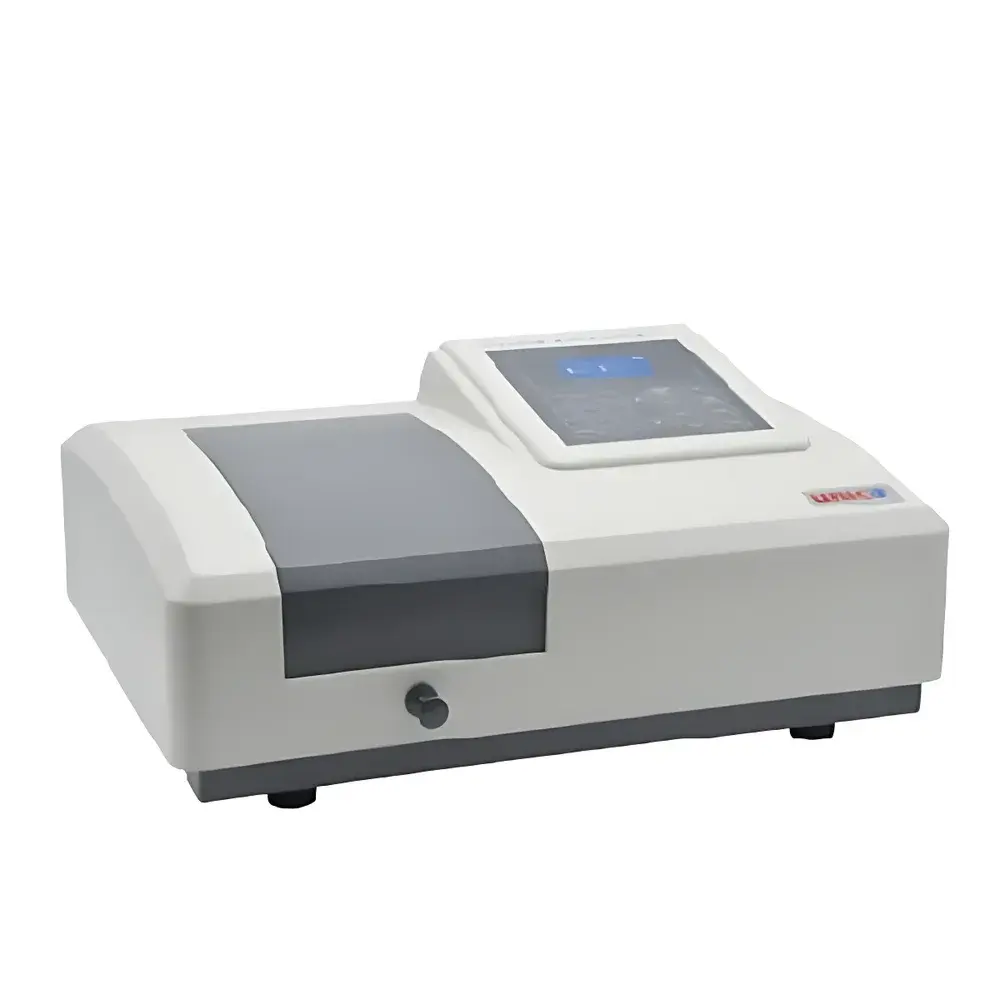
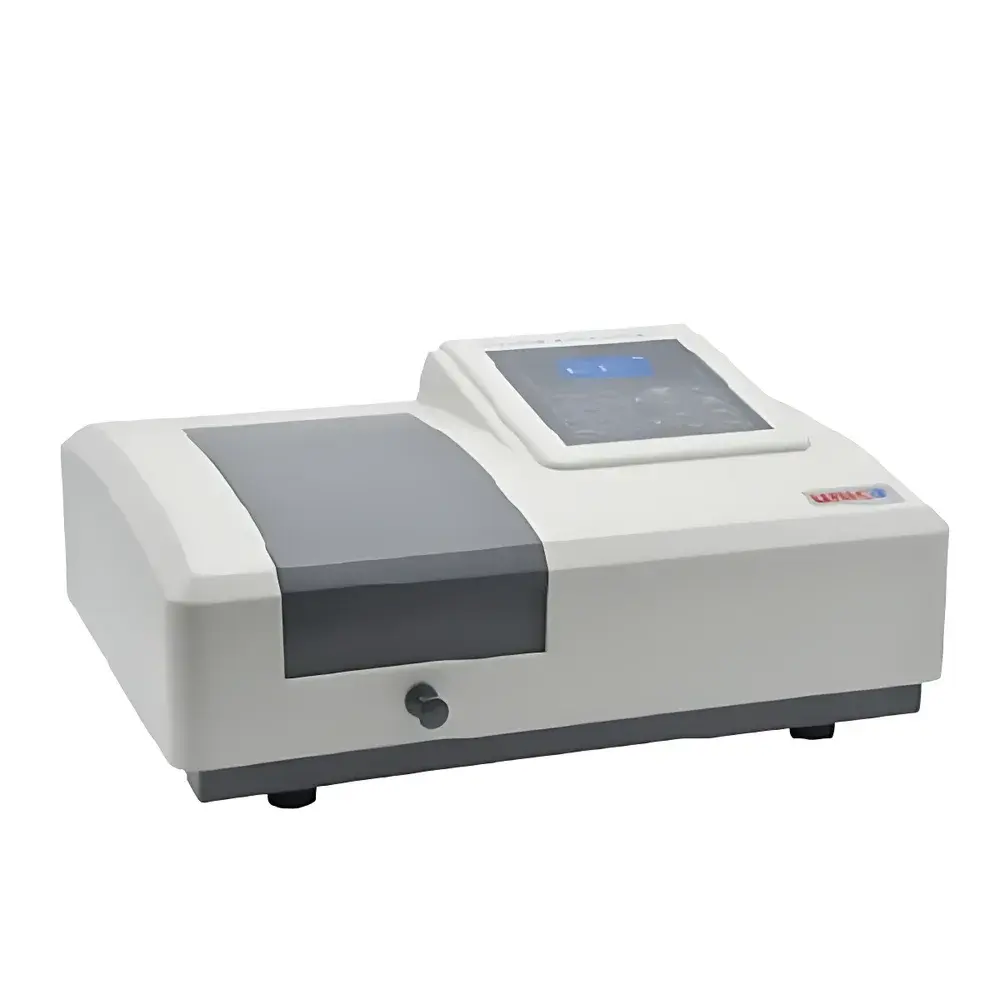
UniCo UV-2350 Single-Beam Ultraviolet-Visible Spectrophotometer
| Brand | UniCo |
|---|---|
| Origin | Shanghai, China |
| Model | UV-2350 |
| Optical System | Single-beam with 1200 lines/mm holographic grating |
| Wavelength Range | 200–1000 nm |
| Spectral Bandwidth | 2 nm |
| Wavelength Accuracy | ±0.8 nm |
| Wavelength Repeatability | ±0.2 nm |
| Stray Light | ≤0.2% T at 220 nm and 340 nm |
| Photometric Accuracy | ±0.002 Abs (0–0.5 Abs), ±0.005 Abs (0.5–1.0 Abs), ±0.3% T |
| Photometric Repeatability | ±0.001 Abs (0–0.5 Abs), ±0.002 Abs (0.5–1.0 Abs), ±0.2% T |
| Baseline Linearity | ±0.002 A |
| Stability | ±0.002 A/h at 500 nm (after warm-up) |
| Display | 126 × 64 dot-matrix LCD |
| Interface | USB and Centronics |
| Dimensions (W × D × H) | 485 × 365 × 220 mm |
| Weight | 14 kg |
Overview
The UniCo UV-2350 is a precision-engineered single-beam ultraviolet-visible (UV-Vis) spectrophotometer designed for routine quantitative analysis, spectral scanning, and method validation in academic laboratories, quality control environments, and industrial R&D settings. Operating on the principle of Beer-Lambert law-based absorbance measurement, the instrument employs a high-stability tungsten-halogen lamp for visible wavelengths and a deuterium arc lamp for UV output, coupled with a 1200 lines/mm holographic diffraction grating to deliver consistent spectral resolution across its full 200–1000 nm range. Its single-beam architecture—optimized for cost-effective operation and robust optical alignment—ensures long-term photometric stability and minimal maintenance requirements. The system is calibrated against NIST-traceable standards and supports compliance with fundamental analytical guidelines including ASTM E275, ISO 6425, and USP for spectrophotometric performance verification.
Key Features
- Automated wavelength scanning and zero/100% transmittance calibration via microprocessor-controlled optics
- High-contrast 126 × 64 dot-matrix graphical LCD with 0.1 nm wavelength resolution display
- Dual-lamp source switching (deuterium + tungsten-halogen) managed automatically based on selected wavelength region
- Integrated memory storage supporting up to 200 user-defined methods, including standard curve templates, concentration calculations (C), and nucleic acid quantification protocols (DNA/RNA at 260/280 nm)
- Tactile membrane keypad with ergonomic layout for rapid parameter entry and menu navigation
- USB and Centronics parallel interfaces enabling direct data export to external PCs or printers without proprietary drivers
- Optical bench engineered for thermal and mechanical stability, minimizing drift during extended measurements (±0.002 A/h at 500 nm post-warm-up)
Sample Compatibility & Compliance
The UV-2350 accommodates standard 10 mm pathlength cuvettes—including supplied quartz (for UV applications below 350 nm) and optical glass variants—enabling compatibility with aqueous, organic, and mildly corrosive solutions. Its optical design meets ICH Q2(R2) expectations for specificity and linearity in pharmaceutical assay development. While not pre-certified for 21 CFR Part 11, the instrument’s deterministic calibration routines, non-volatile method storage, and audit-ready parameter logging support GLP/GMP-aligned workflows when paired with validated laboratory information management systems (LIMS). Stray light performance (≤0.2% T at 220 nm and 340 nm) satisfies ISO 9001-compliant QC thresholds for low-absorbance trace analysis.
Software & Data Management
No proprietary software is bundled; raw spectral and quantitative data are exported in ASCII-compatible formats via USB or parallel port, facilitating seamless integration with third-party analysis platforms such as OriginLab, MATLAB, or Microsoft Excel. All instrument parameters—including wavelength setpoints, slit width equivalents (fixed at 2 nm), photometric mode selection (A/T/C/F), and calibration timestamps—are embedded in exported files. Internal memory retains method configurations with timestamped versioning, allowing reproducible recall of historical test conditions. For regulated environments, users may implement external electronic lab notebooks (ELN) to capture full audit trails—including operator ID, sample ID, and environmental metadata—consistent with ALCOA+ principles.
Applications
- Quantitative determination of analytes via single- or multi-point calibration curves (e.g., nitrate in water per EPA Method 353.2)
- Nucleic acid purity assessment using A260/A280 and A260/A230 ratios
- Enzyme kinetics monitoring through time-resolved absorbance at fixed wavelengths
- Colorimetric assays (e.g., Bradford, Lowry, BCA) in protein quantification workflows
- Quality assurance of dyes, pigments, and UV filters in chemical manufacturing
- Educational instruction in analytical chemistry, emphasizing Beer’s law fundamentals and instrumental error sources
FAQ
Is the UV-2350 compliant with FDA 21 CFR Part 11?
No—the instrument does not include built-in electronic signature, role-based access control, or automated audit trail generation required for Part 11 compliance. However, its deterministic operation and export capabilities enable integration into validated Part 11–compliant systems when deployed with appropriate procedural controls and external software.
What cuvette materials are supported?
Standard 10 mm square cuvettes: fused silica/quartz (200–350 nm), optical glass (350–1000 nm), and disposable plastic (visible range only, ≥340 nm).
Can the instrument perform kinetic measurements?
Yes—via manual time-point acquisition or external trigger synchronization using the Centronics port; however, it lacks onboard time-scan mode or automated interval programming.
What is the recommended warm-up time before calibration?
Minimum 30 minutes for optimal thermal equilibrium; baseline stability specification (±0.002 A/h) assumes operation after this period at constant ambient temperature (20–25 °C).
How is wavelength accuracy verified?
Using certified holmium oxide or didymium oxide reference filters traceable to NIST SRM 2034, following procedures outlined in ASTM E275 Section 7.3.




