
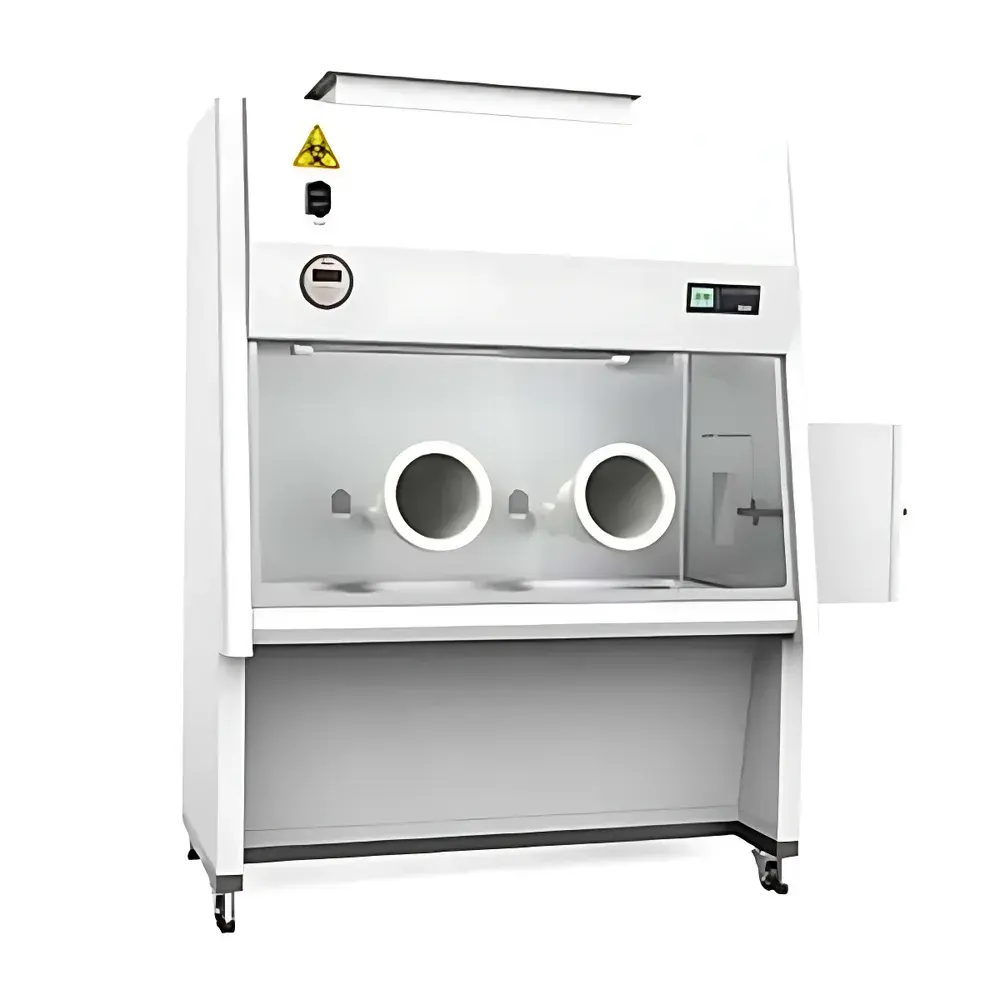
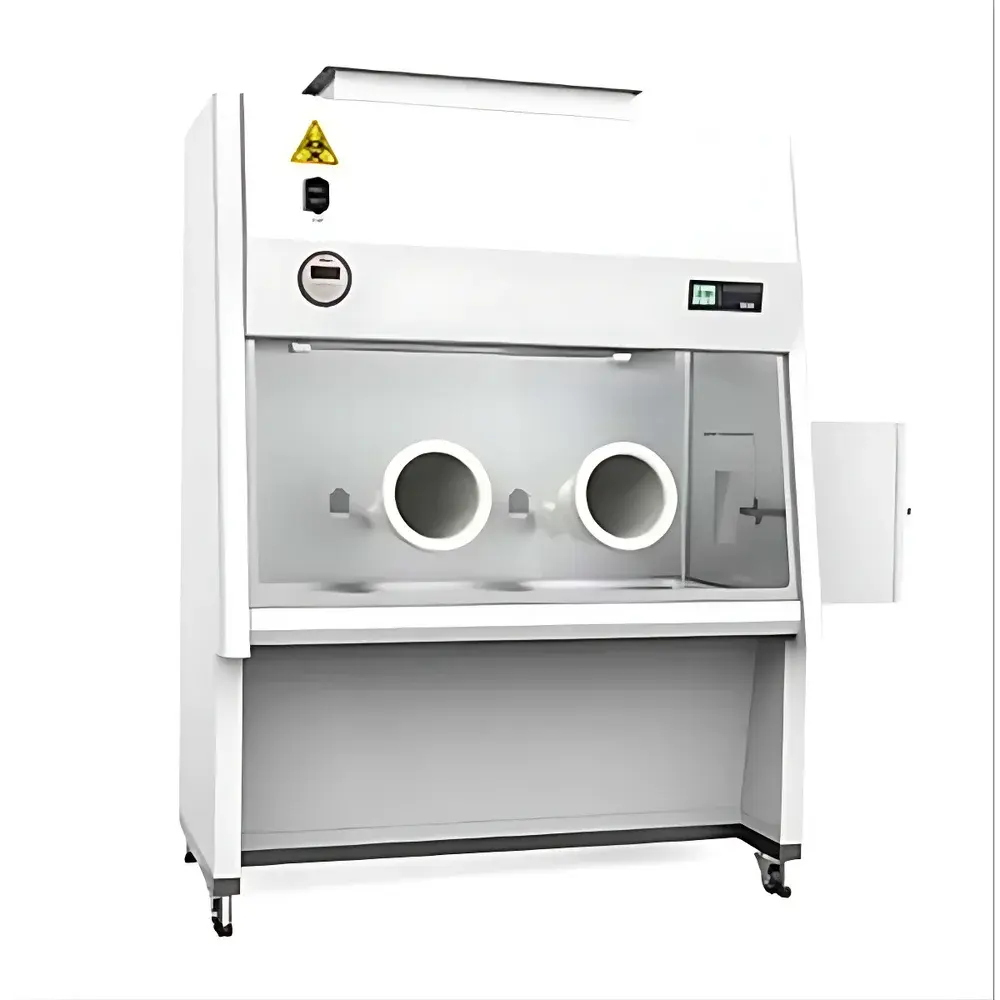
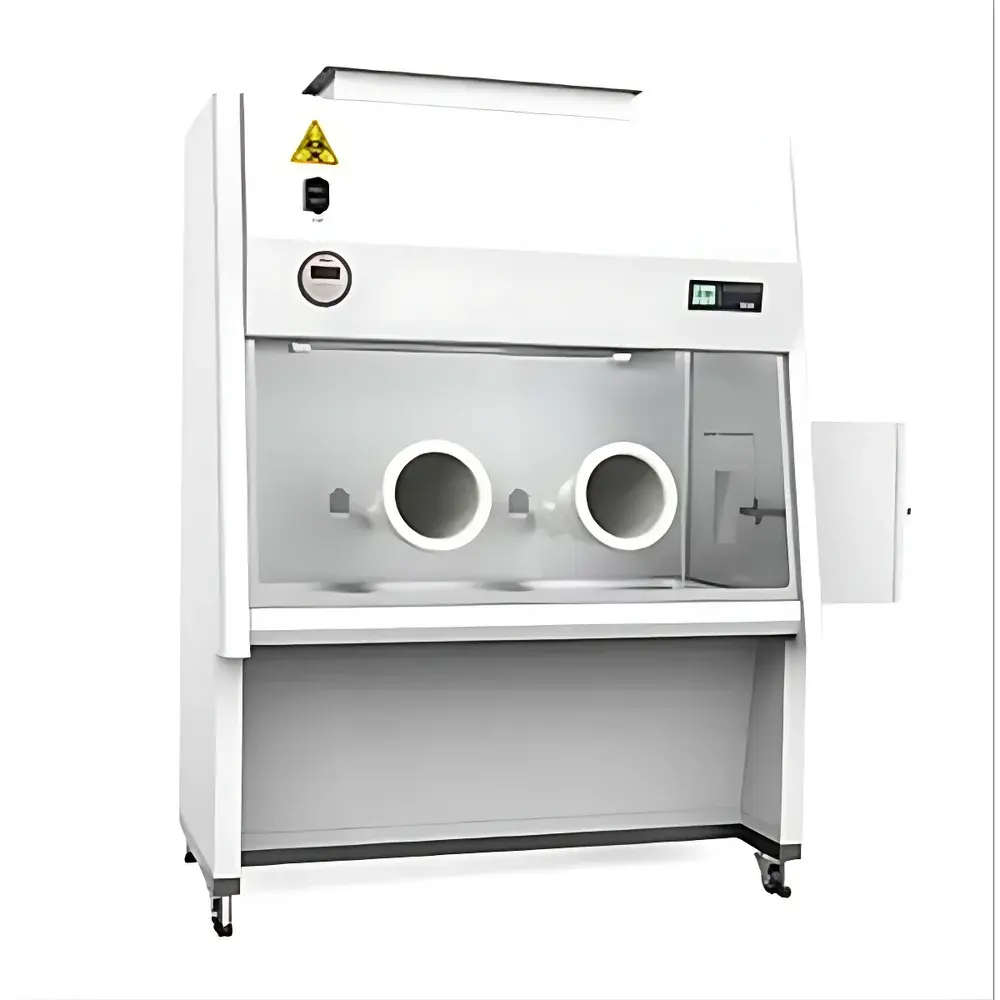
AIRTECH BSC-1000III Class III Biological Safety Cabinet
| Brand | AIRTECH |
|---|---|
| Origin | Jiangsu, China |
| Manufacturer Type | Authorized Distributor |
| Product Category | Domestic |
| Model | BSC-1000III |
| Instrument Type | Class III Biological Safety Cabinet |
| External Dimensions (L×W×H, mm) | 1200×750×2200 |
| Internal Dimensions (L×W×H, mm) | 800×600×650 |
| Filter Efficiency | ≥99.999% at 0.3 µm (HEPA/ULPA dual-stage filtration) |
| Compliance Standard | NSF/ANSI 49-2016 |
| Work Chamber Negative Pressure | ≥120 Pa |
| Airflow Rate | ≥0.05 m³/s |
| Noise Level | ≤65 dB(A) |
| Power Supply | AC 220–240 V, 1φ, 50 Hz |
| Rated Power (excl. outlet) | 1.0 kVA |
| Net Weight | 350 kg |
| Glove Quantity | 2 pairs |
| Lighting | LED, 24.5 W × 1, Illuminance ≥650 lx |
| UV Lamp | 18 W × 1 + 8 W × 1 |
| Cabinet Material | Powder-coated cold-rolled steel (ivory white) |
| Work Area | Seamless 304 stainless steel |
| Exhaust Configuration | Top discharge |
| Cleanliness Class | ISO 5 (Class 100) |
Overview
The AIRTECH BSC-1000III is a fully enclosed, gas-tight Class III biological safety cabinet engineered for maximum personnel, environmental, and product protection when handling Risk Group 4 (RG4) pathogens, select agents, or highly toxic compounds requiring absolute containment. Operating under sustained negative pressure (≥120 Pa), it employs a dual-stage filtration system—comprising pre-filters, HEPA (≥99.999% @ 0.3 µm), and optional ULPA-grade exhaust filtration—to ensure 100% recirculation-free exhaust and zero leakage into the laboratory environment. Its aerodynamic design sustains unidirectional vertical airflow within the work area, eliminating dead zones and guaranteeing ISO 5 (Class 100) cleanroom-equivalent conditions. The cabinet complies strictly with NSF/ANSI 49-2016, the internationally recognized benchmark for biosafety cabinet performance, validation, and certification protocols.
Key Features
- Integrated touch-sensitive color LCD interface with icon-based navigation, enabling real-time monitoring of chamber pressure, airflow velocity, filter differential pressure, and fan operational status.
- Multi-level acoustic and visual alarm system: alerts for low airflow, high filter resistance, glove integrity loss, door position deviation, and power interruption—with configurable thresholds per institutional SOPs.
- Intelligent filter life estimation algorithm based on cumulative runtime, static pressure drop, and ambient particulate load; supports predictive maintenance scheduling and GLP-compliant log generation.
- Ergonomically optimized 10° inclined front sash with reinforced laminated safety glass and certified butyl rubber isolation gloves (2 pairs standard), tested to ASTM D1200 for chemical resistance and EN 374-3 for permeation resistance.
- Seamless 304 stainless-steel work surface and sidewalls fabricated via robotic TIG welding—electropolished and passivated to ISO 10993-1 biocompatibility standards—ensuring corrosion resistance and ease of decontamination.
- Dual-chamber transfer airlock with interlocked UV-C (18 W + 8 W) and LED lighting, supporting validated vaporized hydrogen peroxide (VHP®) or formaldehyde decontamination cycles without manual intervention.
Sample Compatibility & Compliance
The BSC-1000III accommodates a broad range of manipulations including centrifugation (with compatible sealed rotors), pipetting, lyophilization, and small-scale synthesis—all while maintaining full containment. It is routinely validated for use with BSL-4 agents such as Ebola virus, Marburg virus, and variola virus under institutional biosafety committee oversight. All structural welds, glove ports, and cable penetrations undergo helium leak testing per ASTM E499. Electrical safety conforms to IEC 61010-1; electromagnetic compatibility meets IEC 61326-1. Documentation includes Factory Acceptance Test (FAT) reports, filter certification (EN 1822-3), and NSF 49-certified airflow mapping data—fully traceable to NIST-traceable anemometers and manometers.
Software & Data Management
The embedded control system logs all critical parameters—including time-stamped pressure differentials, fan RPM, UV exposure duration, and alarm events—at 1-second resolution. Data export is supported via USB 2.0 (CSV format) and optional RS-485 Modbus RTU integration for LIMS or SCADA systems. Audit trails comply with FDA 21 CFR Part 11 requirements when paired with user-authenticated login (PIN + optional RFID badge). Historical logs are retained for ≥12 months onboard and support automated backup to network drives. Firmware updates are digitally signed and verified prior to installation to prevent unauthorized modification.
Applications
- High-containment virology and bacteriology research involving RG4 organisms under BSL-4 equivalent conditions.
- Production and quality control of viral vectors (e.g., AAV, lentivirus) in GMP-aligned cell and gene therapy facilities.
- Handling of potent cytotoxic compounds (e.g., antibody-drug conjugates) where operator exposure must be reduced to <1 ng/m³ per OEL guidance.
- Radioisotope manipulation (e.g., ¹⁷⁷Lu, ²²⁵Ac) with integrated lead-shielded glove ports and alpha-particle-rated filtration.
- Forensic analysis of hazardous biological evidence under chain-of-custody protocols requiring tamper-evident logging.
FAQ
What certification documentation is provided with the BSC-1000III?
NSF/ANSI 49-2016 compliance certificate, HEPA/ULPA filter test reports (EN 1822), factory-calibrated airflow validation data, electrical safety test report (IEC 61010-1), and helium leak test summary.
Can the cabinet be integrated into a building’s BMS or central alarm system?
Yes—via optional Modbus RTU or BACnet MS/TP interface; dry-contact alarm outputs are standard for hardwired integration.
Is glove replacement possible without compromising containment integrity?
Yes—gloves are replaced using the integrated airlock and positive-pressure purge cycle; integrity is verified automatically post-installation via pressure decay test.
Does the unit support remote firmware updates and diagnostics?
Remote diagnostics are available via secure SSH tunnel; firmware updates require local physical authentication and digital signature verification.
What decontamination methods are validated for this model?
Formaldehyde fumigation (per CDC/NIH guidelines), vaporized hydrogen peroxide (VHP®), and chlorine dioxide gas—each with protocol-specific cycle validation templates included.




