
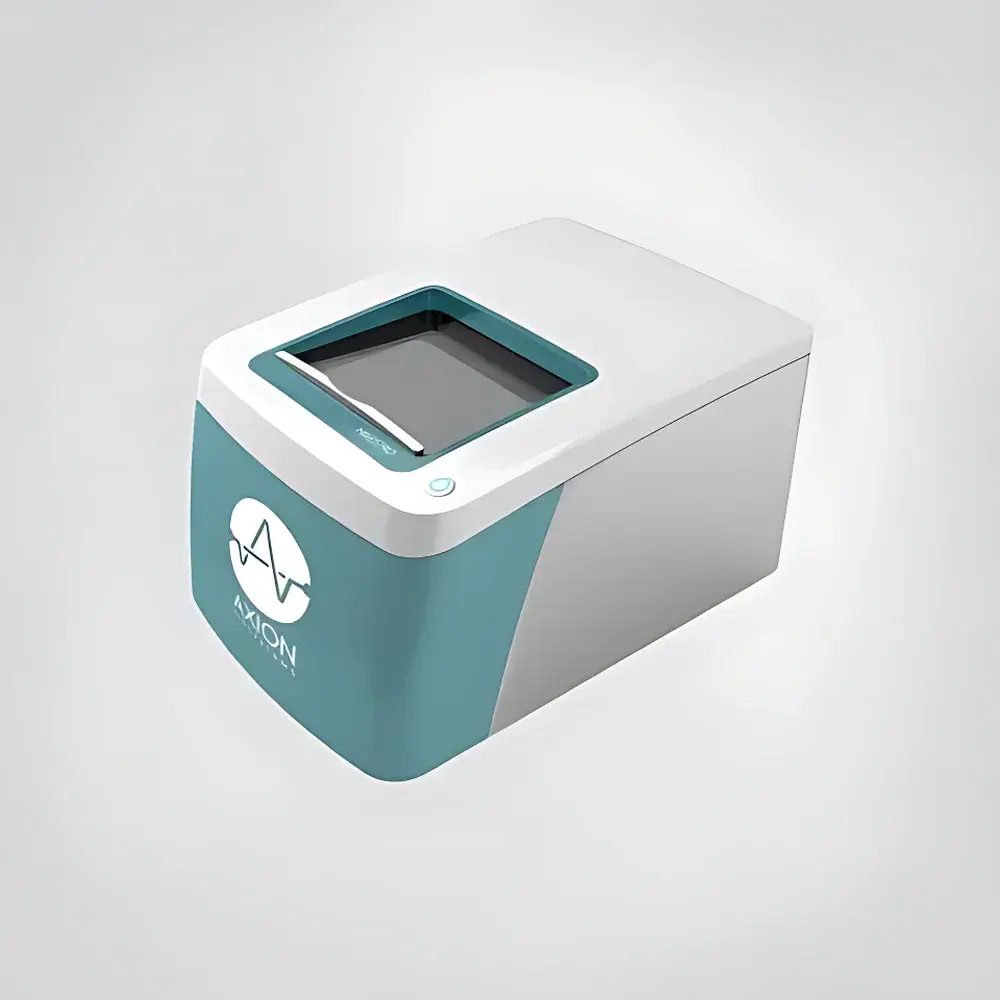
Maestro Z Label-Free Cell Migration and Invasion Analyzer for Wound Healing Assay
| Brand | Axion BioSystems |
|---|---|
| Model | Maestro Z / ZHT |
| Origin | USA |
| Manufacturer | Axion BioSystems, Inc. |
| Category | Imported |
| Pricing | Available Upon Request |
Overview
The Maestro Z is a label-free, real-time impedance-based cell analysis platform engineered for quantitative, non-invasive monitoring of dynamic cellular behaviors—including migration, invasion, proliferation, cytotoxicity, barrier integrity (e.g., TEER), and GPCR-mediated signaling—without requiring fluorescent dyes, antibodies, or genetic modification. At its core, the system employs true impedance spectroscopy: applying low-amplitude alternating current (AC) across a range of frequencies (typically 10 Hz to 50 kHz) through microelectrode arrays embedded in standard tissue-culture plates (e.g., 96-well E-plates). As adherent cells attach, spread, migrate, or detach, they modulate the local ionic current path—altering both magnitude and phase of the measured impedance. Unlike single-frequency resistance systems, Maestro Z’s multi-frequency capability enables discrimination between bulk confluence changes (low-frequency dominance) and subcellular morphological or junctional events (high-frequency sensitivity), delivering physiologically relevant functional readouts with high temporal resolution (up to one measurement per minute).
Key Features
- True impedance spectroscopy platform with multi-frequency AC excitation (10 Hz–50 kHz) for simultaneous detection of cell number, morphology, adhesion strength, and membrane integrity.
- Integrated incubator-compatible design: compact footprint fits inside standard CO2 incubators; thermally stabilized sample chamber minimizes thermal drift and mechanical vibration artifacts during long-term assays (e.g., 72-h wound healing).
- No external hardware dependencies: all signal acquisition, digitization, and real-time processing occur onboard—eliminating reliance on host PC uptime for data continuity.
- FDA 21 CFR Part 11-compliant software (AxIS Software v3.x+) with electronic signatures, audit trails, role-based access control, and automated report generation—validated for GLP/GMP environments.
- Background subtraction, normalization (e.g., to t = 0 post-scratch), kinetic curve fitting (e.g., linear, exponential, sigmoidal), and comparative statistical analysis (ANOVA, t-test) built into the analysis engine.
Sample Compatibility & Compliance
The Maestro Z supports diverse biological models: adherent monolayers (e.g., MCF-7, HCC1806, MDCK), suspension cells (with optional adherence priming), 3D spheroids, organoids, and co-cultures (e.g., endothelial–tumor barriers for transmigration studies). Its impedance-based detection is inherently compatible with standard culture media, serum-containing formulations, and common pharmacological agents—including modified citrus pectin (MCP)—without optical interference or phototoxicity concerns. The system complies with ISO 13485:2016 (medical device quality management) and supports regulatory submissions requiring traceable, ALCOA+ (Attributable, Legible, Contemporaneous, Original, Accurate, Complete, Consistent, Enduring, Available) data integrity.
Software & Data Management
AxIS Software provides a unified interface for assay setup, real-time visualization, and post-acquisition analysis. All raw impedance data (magnitude and phase at each frequency) are stored locally on the instrument’s encrypted internal SSD—ensuring continuity during network outages or host computer failure. Data export options include CSV, Excel, and HDF5 formats for integration with MATLAB, Python (via axionbio-tools), or enterprise LIMS. Audit trails log every user action—including parameter edits, data exports, and report generation—with timestamps and operator IDs. Validation packages—including IQ/OQ documentation and risk assessments—are available for regulated laboratories.
Applications
- Wound healing/scratch assay: Quantitative tracking of migration kinetics (e.g., time-to-50% closure, velocity, persistence) under pharmacological modulation (e.g., MCP dose-response).
- Invasion assessment: Combined with Matrigel-coated electrodes to model basement membrane penetration.
- Immunooncology: Real-time monitoring of T-cell–mediated tumor lysis or NK-cell cytotoxicity.
- Barrier function: Trans-endothelial/epithelial electrical resistance (TEER) profiling in BBB or gut-on-chip models.
- GPCR & kinase pathway profiling: Impedance-based detection of label-free receptor activation dynamics (e.g., β-arrestin recruitment surrogates).
- Toxicology: High-content cytotoxicity screening with temporal resolution distinguishing acute necrosis from delayed apoptosis.
FAQ
How does Maestro Z differentiate between migration and proliferation effects in wound healing assays?
By combining pre-scratch baseline impedance (establishing confluence), immediate post-scratch drop (defining wound area), and subsequent recovery kinetics, the system isolates migration-driven re-colonization from proliferation-dominated regrowth—especially when paired with mitomycin C treatment.
Can Maestro Z be used for suspension cell migration (e.g., leukocytes)?
Yes—using specialized E-plates with fibronectin or ICAM-1 coating to induce transient adhesion, enabling impedance-based tracking of chemotactic responses.
Is calibration required before each experiment?
No routine recalibration is needed; the system performs automatic electrode self-test and background impedance compensation at startup and between wells.
What plate formats are supported?
Standard 96-well E-plates (catalog #MEA-96-1000) only; no compatibility with 24- or 384-well formats.
Does the system support remote monitoring?
Yes—via secure HTTPS web interface; users can view live impedance traces and receive email alerts upon assay completion or anomaly detection.




