
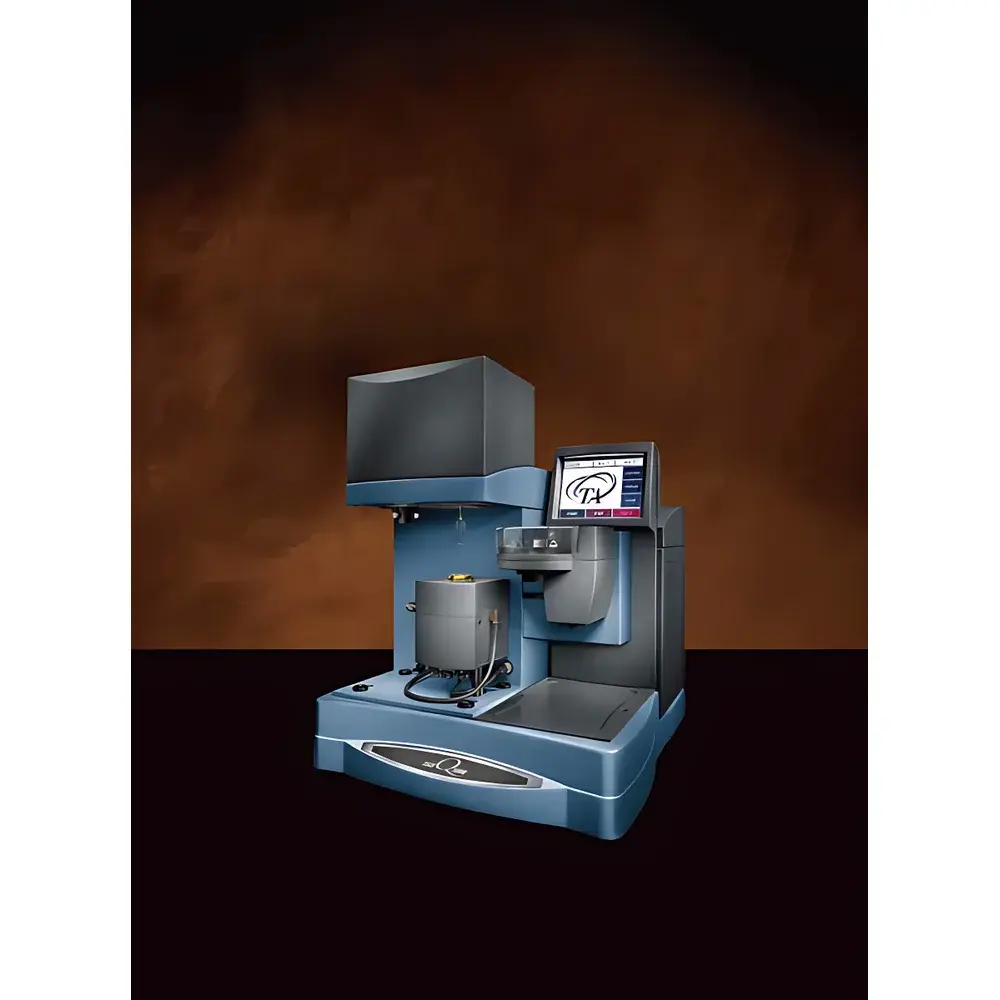
Thermo Fisher Scientific Discovery Q5000IR / Q500 / Q50 Thermogravimetric Analyzer
| Origin | USA |
|---|---|
| Manufacturer Type | Authorized Distributor |
| Origin Category | Imported |
| Model | Q5000IR, Q500, Q50 |
| Pricing | Upon Request |
Overview
The Thermo Fisher Scientific Discovery Series Thermogravimetric Analyzers (Q5000IR, Q500, and Q50) are high-performance benchtop TGA systems engineered for precision thermal stability, decomposition kinetics, compositional analysis, and moisture/volatiles quantification under controlled atmospheric conditions. These instruments operate on the fundamental principle of continuous mass measurement as a function of temperature or time in a defined gas environment—leveraging a patented high-resolution thermobalance, infrared (IR) heating furnace (Q5000IR), and advanced convection-controlled furnace designs (Q500/Q50). The core architecture integrates electromagnetic force compensation (EMFC) weighing technology with active drift compensation, enabling sub-microgram mass resolution and exceptional baseline stability across wide temperature ranges. Designed for R&D laboratories, quality control facilities, and regulatory-compliant environments, the Discovery TGA platform supports ISO 11358, ASTM E1131, ASTM E1641, and USP <41> thermal analysis requirements.
Key Features
- Patented High-Resolution TGA™ technology delivering <0.1 μg mass sensitivity and <0.03 μg RMS short-term noise
- Infrared heating furnace (Q5000IR) enabling rapid, uniform heating up to 1200 °C with programmable ramp rates from 0.1 to 500 °C/min (linear) and >2000 °C/min (impulse mode)
- Convection-enhanced furnace (Q500/Q50) with forced-air or nitrogen cooling: 1200 °C → 35 °C in <10 minutes
- 25-position automated sample changer with integrated calibration weight verification and inert atmosphere purging during loading
- Standard 4-channel gas delivery module supporting independent flow control, switching, and mixing of N₂, O₂, Ar, He, CO₂, or synthetic air
- Optional dual-gas module and vacuum operation capability (<10⁻² torr) for oxidative stability studies and low-pressure pyrolysis
- Integrated electromagnet (standard) for magnetic property–coupled thermal analysis (e.g., Curie point detection)
- Heated Evolved Gas Analysis (EGA) adapter (standard) compatible with FTIR, MS, and GC-MS coupling via heated transfer lines
- Full-color capacitive touchscreen interface with intuitive workflow navigation, real-time curve overlay, and multi-user access control
Sample Compatibility & Compliance
The Discovery TGA accommodates solid powders, granules, films, fibers, composites, and small metallic specimens—up to 750 mg maximum sample mass—with dynamic weighing range of ±100 mg and accuracy of ±0.1% full scale. Crucible options include platinum, alumina, silica, and gold-plated pans, all certified for inert or reactive atmospheres. All models comply with GLP/GMP data integrity requirements through built-in audit trail logging, electronic signatures (21 CFR Part 11 compliant software option), and secure user role management. Baseline linearity remains <1 μg over 50–1000 °C (20 °C/min, N₂ purge), and total drift is <10 μg under identical conditions—ensuring repeatability required for ICH Q5C stability protocols and ASTM D3850 interlaboratory validation.
Software & Data Management
TRIOS™ Software provides end-to-end experimental control, real-time visualization, and post-run kinetic modeling (e.g., Kissinger, Ozawa-Flynn-Wall, ASTM E698). It supports automated method templates, batch processing of multi-sample sequences, derivative (DTG) and second-derivative (DDTG) calculation, and customizable report generation with embedded metadata (operator, instrument ID, calibration status, gas flows, purge history). Raw data files (.tga) are stored in vendor-neutral ASCII format with timestamped headers, facilitating third-party analysis in MATLAB®, Python (SciPy), or OriginLab. Optional TRIOS IQ software adds enhanced security features including encrypted database storage, change tracking, and FDA 21 CFR Part 11–compliant electronic records.
Applications
- Quantitative determination of polymer filler content (e.g., CaCO₃, SiO₂), plasticizer loss, and carbon black residue
- Decomposition onset temperature (Td) and multi-step degradation profiling of pharmaceutical APIs and excipients
- Oxidative induction time (OIT) measurement per ASTM D3895 for polyolefin stabilization assessment
- Moisture, solvent, and volatile organic compound (VOC) content analysis in battery cathode materials and catalysts
- Thermal stability evaluation of nanocomposites, MOFs, and aerogels under inert, oxidative, or reducing atmospheres
- Reaction enthalpy estimation via TGA-DSC hybrid configurations (with optional DSC module)
- Corrosion product evolution and metal oxide formation kinetics in high-temperature alloys
FAQ
What is the difference between Q5000IR, Q500, and Q50 models?
The Q5000IR features an infrared heating furnace for ultra-fast heating/cooling and superior temperature uniformity; the Q500 uses a convection-heated furnace optimized for high reproducibility in routine QC; the Q50 is a cost-optimized variant retaining core TGA performance with simplified gas handling.
Can the system be validated for GMP environments?
Yes—when configured with TRIOS IQ software, 21 CFR Part 11 modules, and documented IQ/OQ/PQ protocols, the Discovery TGA meets FDA and EMA expectations for regulated thermal analysis.
Is TGA/MS coupling supported out-of-the-box?
The heated EGA adapter and standardized 6 mm OD transfer line port enable seamless integration with most commercial mass spectrometers; Thermo Fisher offers factory-tested TGA-MS configurations with the ISQ™ series.
How often does the balance require recalibration?
Automatic internal calibration occurs at startup and after major temperature transitions; external verification using NIST-traceable weights is recommended before critical batches or per internal SOPs (typically daily or per shift).
Does the system support modulated TGA (MTGA)?
Yes—Modulated TGA™ is standard on all Discovery models, allowing separation of reversible (e.g., dehydration) and irreversible (e.g., decomposition) mass losses via sine-wave temperature modulation.



