
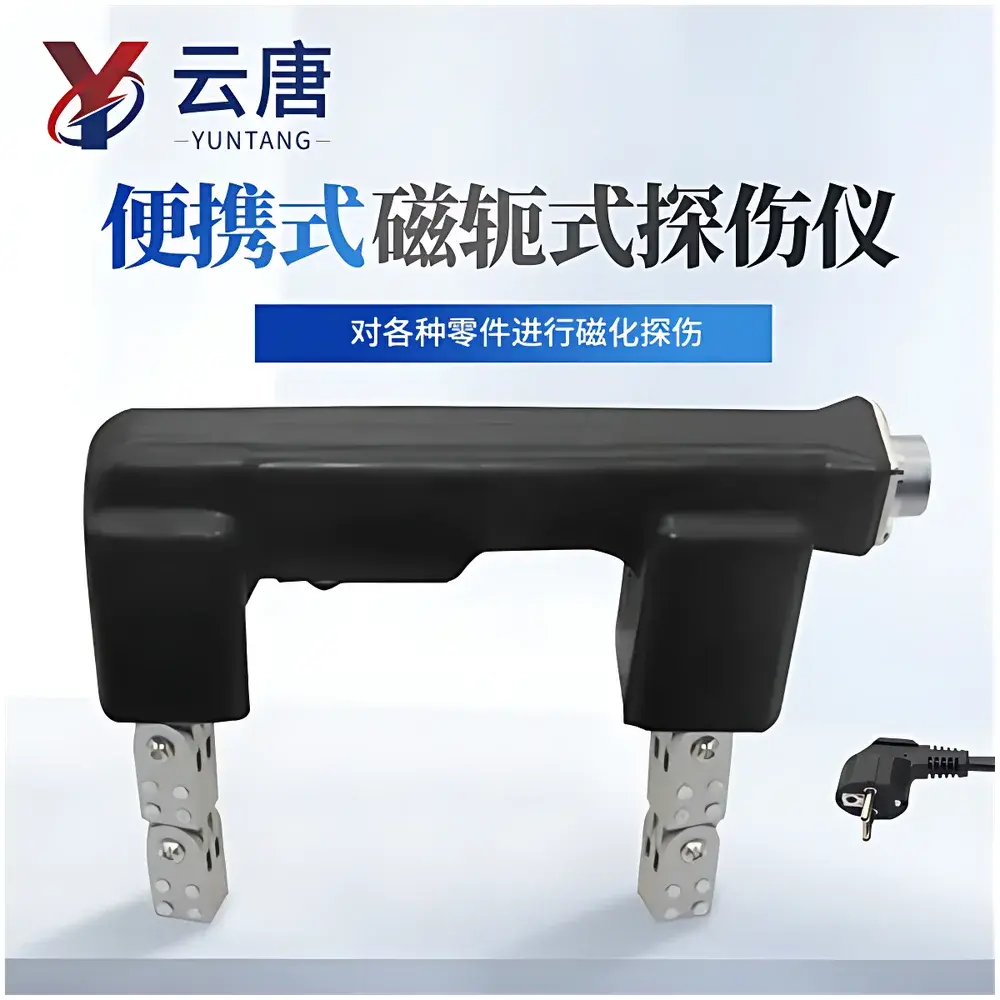
Yuntang YT-610 Portable Yoke-Type Magnetic Particle Inspection Equipment
| Brand | Yuntang |
|---|---|
| Origin | Shandong, China |
| Manufacturer Type | Direct Manufacturer |
| Country of Origin | China |
| Model | YT-610 |
| Magnetization Modes | AC Circumferential (0–2000 A, continuously adjustable with phase-controlled power-off) |
| Longitudinal Magnetization Force | AC 0–24,000 AT, continuously adjustable with phase-controlled power-off |
| Magnetization Configurations | Circumferential, Longitudinal, or Composite |
| Powder Application Method | Dry Powder |
| Demagnetization Residual Field | ≤0.2 mT |
| Inspection Cycle Time | 6 seconds per component |
| Continuous Operating Duration | >4 hours |
| Structural Design | Hand-Carried Yoke Configuration |
| Primary Application Sector | Rail Transportation Infrastructure |
Overview
The Yuntang YT-610 Portable Yoke-Type Magnetic Particle Inspection (MPI) Equipment is an AC-powered, hand-held electromagnetic yoke system engineered for rapid, on-site detection of surface and near-surface discontinuities in ferromagnetic materials. It operates on the principle of induced magnetic flux leakage: when a high-permeability yoke generates a localized magnetic field across a test piece, flaws such as cracks, seams, or inclusions disrupt the flux path, causing leakage fields that attract ferromagnetic dry powder particles—rendering defects visually detectable under appropriate lighting conditions. Designed specifically for field deployment in infrastructure-critical environments, the YT-610 supports three magnetization configurations—circumferential, longitudinal, and composite—to accommodate varying defect orientations and part geometries without repositioning or auxiliary fixtures. Its dual independent AC current control channels enable precise, synchronized adjustment of circumferential current (0–2000 A) and longitudinal magnetomotive force (0–24,000 AT), both incorporating phase-controlled power-off functionality to optimize particle mobility and indication contrast at the moment of current cessation.
Key Features
- Triple-mode magnetization capability: circumferential, longitudinal, and composite—enabling comprehensive flaw orientation coverage in a single setup
- Phase-controlled AC power-off circuitry for both magnetization channels, enhancing particle mobility and indication sensitivity during the critical inspection window
- Dry powder MPI method optimized for outdoor and high-wind environments where wet suspension systems are impractical
- Lightweight, ergonomic yoke architecture with insulated handles and thermal management design supporting >4 hours of continuous operation on standard industrial power sources
- Residual field after demagnetization ≤0.2 mT—meeting ASTM E1444/E709 requirements for post-inspection residual magnetism limits in safety-critical components
- Robust aluminum alloy yoke body with IP54-rated enclosure for dust and splash resistance in rail yard, refinery, and heavy equipment maintenance settings
Sample Compatibility & Compliance
The YT-610 is validated for use on carbon steels, low-alloy steels, and other ferromagnetic alloys commonly found in rail axles, wheel sets, couplers, boiler tubes, pressure vessel welds, and structural steel joints. It complies with core NDT standards including ASTM E1444 (Standard Practice for Magnetic Particle Testing), ASTM E709 (Guide for Magnetic Particle Testing), and ISO 9934-1 (Non-destructive testing — Magnetic particle testing — Part 1: General principles). Its output parameters satisfy minimum magnetizing force requirements specified in ASME BPVC Section V, Article 7 for ferritic steel components. The device is suitable for use in GLP-aligned QA/QC workflows where traceable calibration records and operator qualification documentation are maintained per employer-specific procedures.
Software & Data Management
As a non-digital, analog-operated yoke system, the YT-610 does not incorporate embedded software, wireless connectivity, or data logging capabilities. All operational parameters—including current settings, magnetization mode selection, and exposure timing—are manually controlled via front-panel rotary dials and toggle switches. Inspection records—including part ID, location, magnetization mode, current values, ambient conditions, and inspector signature—must be documented externally using paper-based or enterprise LIMS-integrated digital forms. This architecture ensures compliance with environments where electromagnetic interference (EMI) restrictions or cybersecurity policies prohibit onboard electronics, and aligns with legacy NDT procedure qualifications requiring manual parameter verification and sign-off.
Applications
The YT-610 is routinely deployed in rail transport maintenance depots for in-service inspection of locomotive frames, bogie components, and railcar couplers; in power generation facilities for turbine shaft and generator rotor yoke weld verification; in petrochemical plants for heat exchanger tube sheet welds and piping flange joints; and in heavy machinery manufacturing for castings and forged crankshafts. Its portability and dry-powder compatibility make it especially effective for elevated structures, confined spaces, and locations lacking stable water supply or drainage infrastructure—such as offshore platforms, wind turbine towers, and bridge support girders.
FAQ
What types of defects can the YT-610 reliably detect?
Surface-breaking cracks, lack-of-fusion in welds, grinding burns, and fatigue-initiated discontinuities up to ~2 mm below the surface in low-carbon steels.
Is the YT-610 certified for use in regulated industries such as rail or energy?
Yes—it meets technical performance criteria referenced in EN 1369, ASTM E1444, and ISO 9934-1; formal acceptance requires employer-specific procedure qualification per ISO 9712 Level 2 or ASNT SNT-TC-1A.
Can the unit be used with fluorescent magnetic particles?
No—the YT-610 is configured exclusively for visible dry powder; fluorescent applications require UV-compatible lighting and wet suspension systems not supported by this model.
Does the device include calibration certificates or traceable documentation?
Calibration is performed at factory level using NIST-traceable current shunts and gaussmeters; end users must implement periodic verification per ASTM E1316 Appendix X2 and maintain internal calibration logs.
What safety certifications does the YT-610 carry?
It conforms to IEC 61000-6-2 (immunity) and IEC 61000-6-4 (emission) for industrial environments, and carries CE marking under the Low Voltage Directive (2014/35/EU) and EMC Directive (2014/30/EU).



