
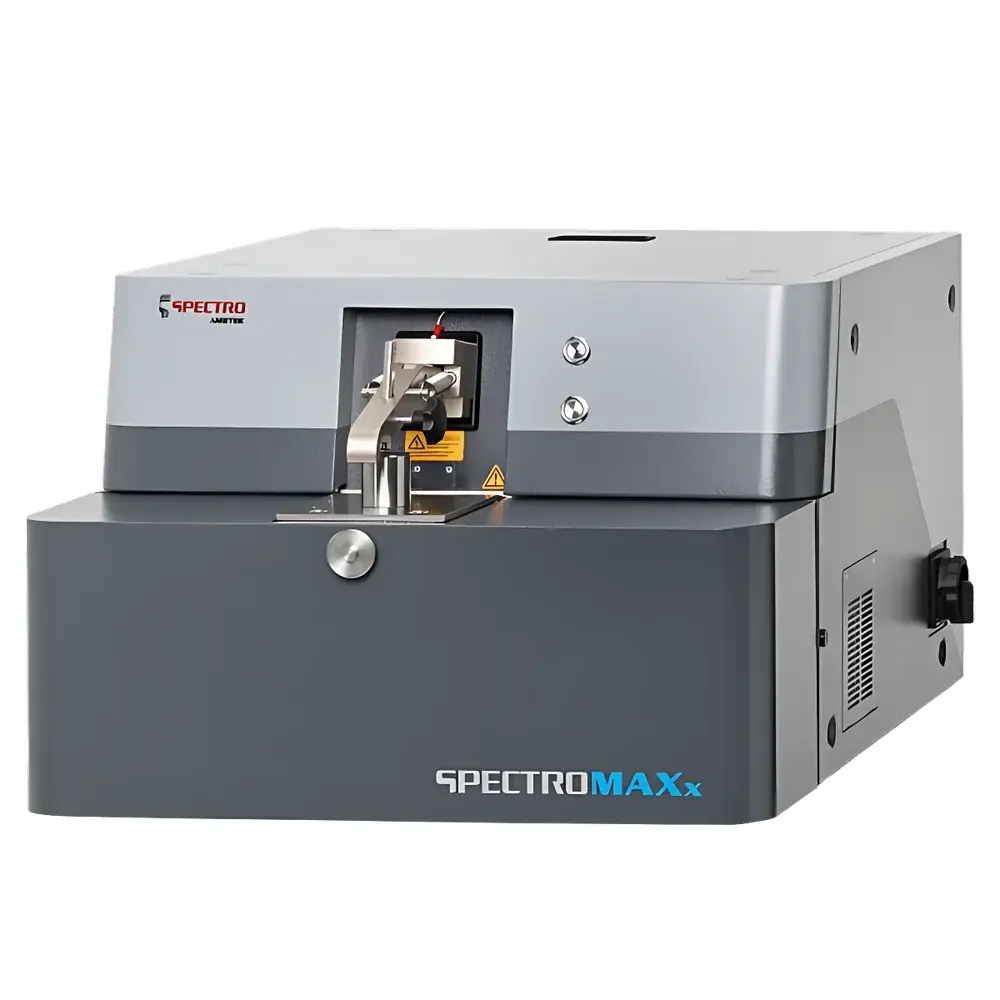
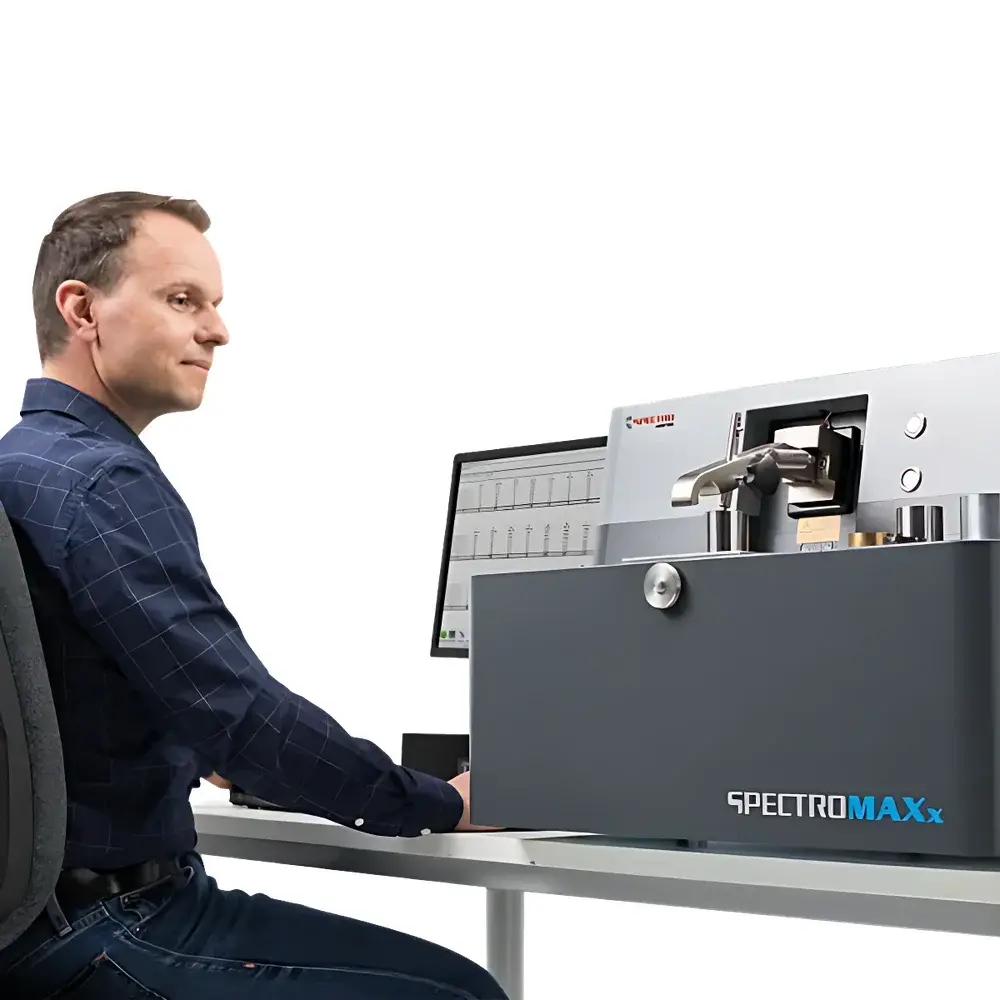
SPECTRO SPECTROMAXx (Desktop) Spark Optical Emission Spectrometer
| Brand | SPECTRO |
|---|---|
| Origin | Germany |
| Model | SPECTROMAXx (Desktop) |
| Instrument Type | Desktop |
| Excitation Method | Spark |
| Detector Type | CMOS |
| Focal Length | 400 mm |
| Grating Density | 3600 lines/mm |
| Wavelength Range | User-Configurable |
| Number of Channels | Application-Dependent |
Overview
The SPECTRO SPECTROMAXx (Desktop) is a high-performance spark optical emission spectrometer (OES) engineered for precision elemental analysis of metallic materials in industrial laboratory and foundry environments. Based on the well-established principle of atomic emission spectroscopy, the instrument excites solid metal samples using controlled high-voltage spark discharges, causing atoms to emit characteristic wavelengths of light. These emissions are dispersed via a Paschen–Runge optical system with a 400 mm focal length and a high-resolution 3600 lines/mm grating, then detected by a modern CMOS-based solid-state detector array. Designed and manufactured in Germany, the SPECTROMAXx integrates decades of OES expertise into a robust, compact desktop platform optimized for routine quality control, melt process monitoring, and final product certification across ferrous and non-ferrous metallurgy.
Key Features
- iCAL 2.0 single-standard calibration technology — dynamically compensates for thermal drift and environmental fluctuations, eliminating the need for multi-point recalibration and reducing daily standardization time by up to 30 minutes;
- Enhanced detection limits — 30–40% improvement over previous generations for key matrices (Fe-, Al-, Cu-based alloys), achieved through optimized spark source parameters, improved optical throughput, and advanced CMOS signal processing;
- Reduced operational cost — up to 64% lower argon consumption during standby mode without compromising analytical stability or purge efficiency;
- Intelligent hardware self-diagnosis — continuous real-time monitoring of critical subsystems (spark generator, optical chamber pressure, detector temperature, argon flow rate); automatic alerts for maintenance triggers such as spark stand cleaning intervals based on cumulative spark count and sample type;
- Application-driven configuration — pre-loaded factory calibration curves for 10 standard base materials (including Fe, Al, Cu, Ni, Ti, Mg, Zn, Pb, Sn, Co), covering 68 certified grade libraries and quantification of up to 59 elements — including nitrogen determination in steel and titanium alloys;
- Streamlined user interface — toolbar-driven operation with context-sensitive controls; only essential functions active during measurement; configurable application profiles store lab-specific settings (sample ID templates, reporting formats, pass/fail thresholds) to minimize operator input errors and support GLP-compliant workflows.
Sample Compatibility & Compliance
The SPECTROMAXx accepts standard 32 mm diameter, flat-faced solid metal samples prepared by milling or grinding per ISO 11577, ASTM E415, and EN 10316. It supports direct analysis of castings, forgings, billets, and rolled products across primary and secondary metallurgical production. The instrument complies with IEC 61000-6-3 (EMC), IEC 61010-1 (safety), and meets essential requirements of the EU Machinery Directive 2006/42/EC. Its software architecture supports audit trails, electronic signatures, and data integrity protocols aligned with FDA 21 CFR Part 11 and EU Annex 11 for regulated environments. All factory calibrations are traceable to NIST and BAM reference materials.
Software & Data Management
Controlled by SPECTRO’s proprietary WinWDS software, the SPECTROMAXx provides full spectral acquisition, background correction, inter-element interference correction, and multivariate calibration modeling. Raw intensity data, corrected concentrations, and QC statistics are stored in an embedded SQL database with configurable export options (CSV, XML, PDF, LIMS-compatible ASTM E1382 format). Version-controlled method files, user access levels (administrator/operator/auditor), and automated report generation ensure compliance with ISO/IEC 17025 internal quality management systems. Remote diagnostics and firmware updates are supported via secure HTTPS-based SPECTRO Service Portal integration.
Applications
- Real-time melt shop control — rapid verification of alloy composition prior to casting, enabling immediate adjustment of scrap blends and master alloy additions;
- Finished goods certification — quantitative verification of specification compliance for automotive, aerospace, energy, and construction-grade metals;
- Scrap sorting and recycling — identification and segregation of alloy families based on minor and trace element fingerprints;
- Failure analysis laboratories — compositional mapping of inclusions, segregation zones, and heat-affected regions via sequential spark analysis;
- Supplier qualification and incoming inspection — high-throughput screening of raw materials against purchase specifications with statistical process control (SPC) charting.
FAQ
Does the SPECTROMAXx require daily recalibration?
No — iCAL 2.0 enables stable operation for extended periods using a single reference standard; full recalibration is only required after major maintenance or optical alignment adjustments.
Can it analyze nitrogen in low-alloy steels?
Yes — equipped with vacuum-purged optics and optimized UV transmission, the system delivers reliable nitrogen quantification down to 30 ppm in ferritic and austenitic stainless steels per ISO 10700.
Is argon purity critical for performance?
Yes — instrument performance requires ≥99.996% pure argon (ISO 8573-1 Class 2:2:2) to maintain spectral resolution and prevent carbon contamination from air ingress.
How is data security ensured in multi-user labs?
WinWDS implements role-based access control, encrypted local database storage, and optional LDAP/Active Directory integration for centralized authentication and session logging.
What maintenance intervals are recommended?
Spark stand cleaning every 500–1000 sparks (automatically tracked); optical chamber inspection annually; detector and lamp replacement per manufacturer service schedule (typically 5+ years under normal use).




