
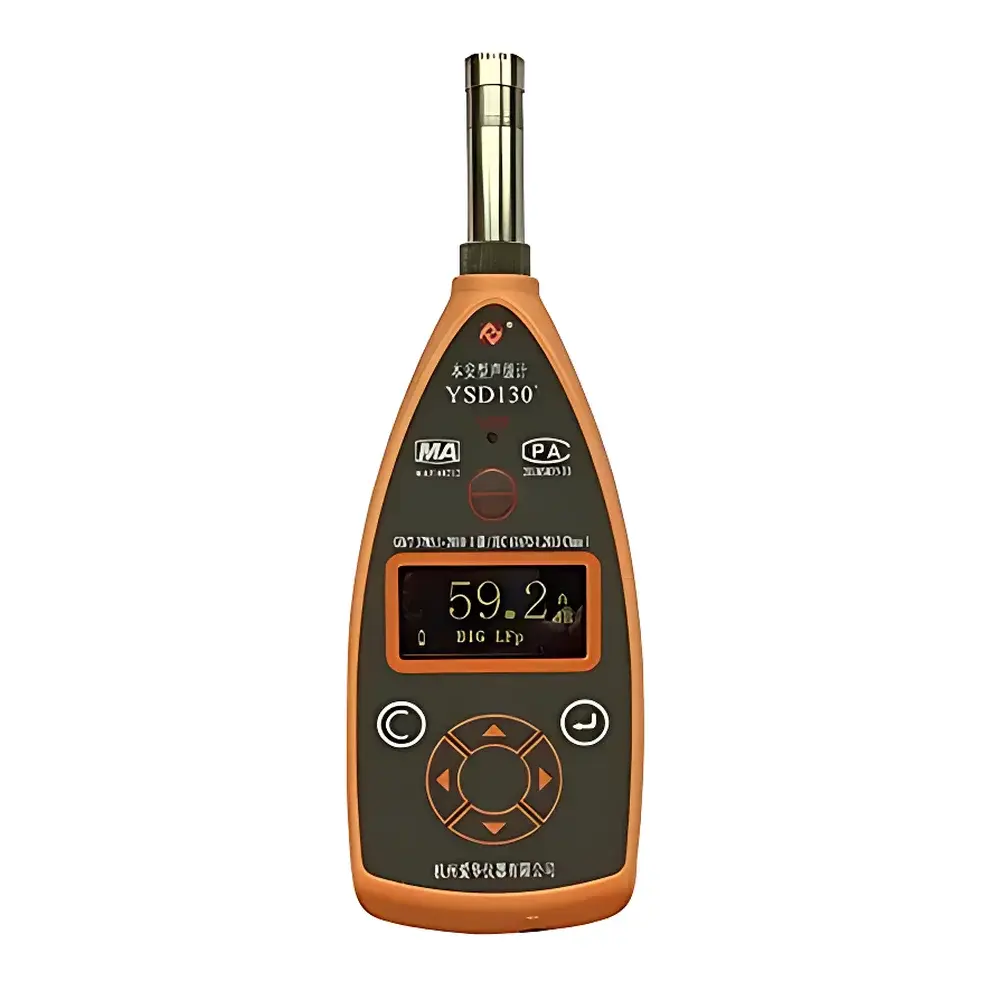
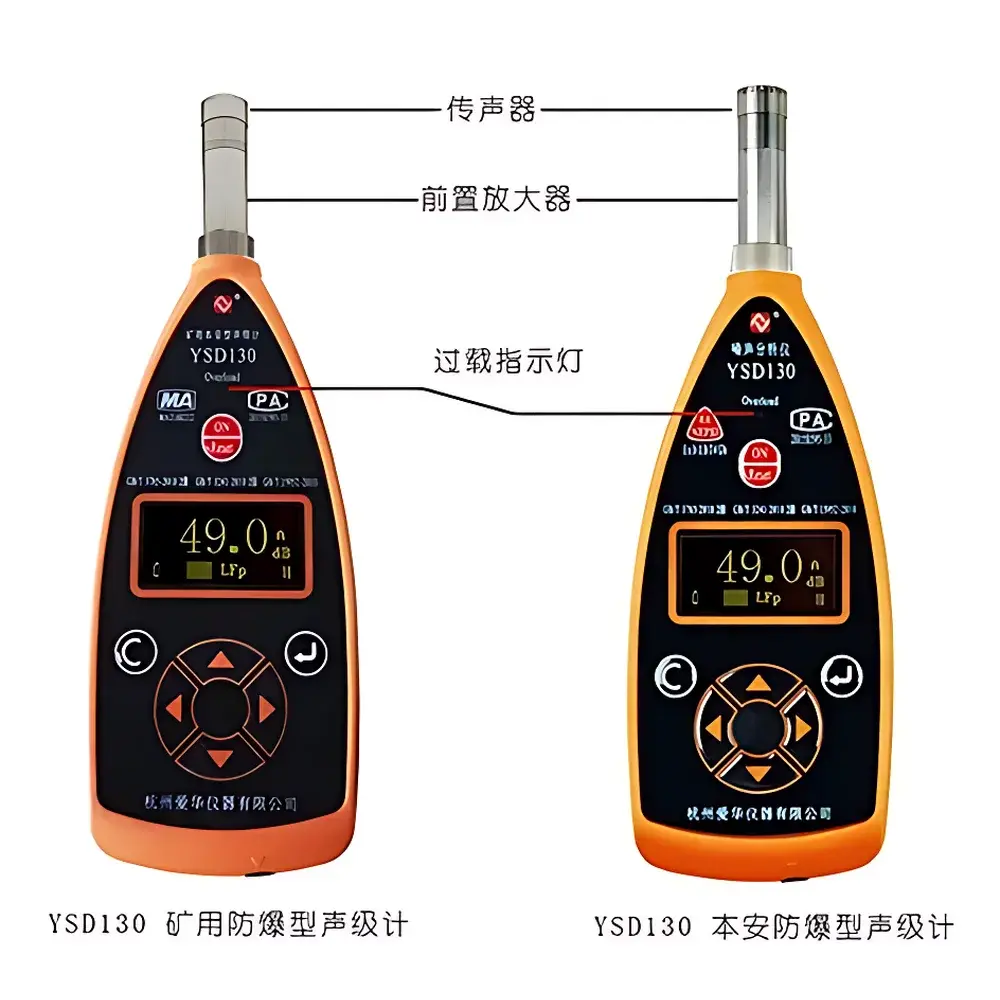
AWA YSD130+ Intrinsically Safe Sound Level Meter for Mining Applications
| Brand | AWA |
|---|---|
| Origin | Shandong, China |
| Model | YSD130+ |
| Frequency Range | 20 Hz – 12.5 kHz |
| Measurement Ranges | 30–130 dB(A), 35–130 dB(C), 40–130 dB(Z) |
| Self-Noise | 17 dB(A) |
| Accuracy | ±0.7 dB |
| Integration Time | 1 s – 24 h |
Overview
The AWA YSD130+ is an intrinsically safe, Class 2 sound level meter engineered for reliable acoustic monitoring in hazardous environments—particularly underground coal mines and other industrial sites where explosive atmospheres may be present. It operates on the principle of electroacoustic transduction using a pre-polarized 1/2″ condenser microphone (AWA14421), converting incident sound pressure into proportional voltage signals for digital signal processing. The instrument complies fully with IEC 61672:2013 Class 2 and GB/T 3785-2010 for sound level meters, IEC 61250:2002 / GB/T 15952-2010 for personal sound exposure meters, and IEC 61260:2014 Class 2 (when optional 1:1 octave band analysis is installed). Its intrinsic safety certification—Ex ib IIB T4 Gb per GB 3836.1–2010 and GB 3836.4–2010—ensures safe operation in Zone 1 explosive gas atmospheres, including methane-air mixtures typical of coal mining operations.
Key Features
- Intrinsically safe design certified to Ex ib IIB T4 Gb, enabling deployment in coal mines, petrochemical facilities, refineries, and grain silos where flammable gases or vapors may accumulate
- Digital true-RMS detection architecture eliminates manual range switching and ensures stable performance across its full dynamic range (30–130 dB)
- Triple frequency weighting: A-, C-, and Z-weighting per IEC 61672; supports occupational noise assessment (e.g., Lex,8h, TWA, DOSE) and environmental compliance reporting
- Time weighting options: Fast (F), Slow (S), and Impulse (I), configurable per measurement task and regulatory requirement (e.g., OSHA 1910.95, ISO 9612)
- OLED display (128 × 64 pixels) with high contrast and wide viewing angle, operable at temperatures from −20 °C to +50 °C
- Integrated audio recording (32 kHz/16-bit, 16 kHz/16-bit, or 8 kHz/8-bit) with trigger modes: synchronized with integration or threshold-based activation (10–90 s duration)
- 2 GB Flash RAM storage supporting up to 8,000 measurement records, plus 32 customizable parameter sets, 128 location tags, and 128 calibration logs
- Real-time octave-band analysis (optional): parallel filter bank covering 31.5 Hz to 8 kHz per IEC 61260:2014 Class 2, with simultaneous A/C/Z-weighted outputs
Sample Compatibility & Compliance
The YSD130+ is validated for use with standard 1/2″ pre-polarized condenser microphones (e.g., AWA14421, nominal sensitivity ≈30 mV/Pa) and calibrated using Class 2 or higher acoustic calibrators (e.g., AWA6221B). It meets mechanical and environmental robustness requirements for field instrumentation: IP54 ingress protection (dust and splash resistant), operating humidity range 25–90% RH, and atmospheric pressure tolerance 65–108 kPa. Regulatory alignment includes: IEC 61672:2013 Class 2 (sound level meter), IEC 61250:2002 (personal sound exposure), IEC 61260:2014 Class 2 (octave filters), and GB 3836.1/4–2010 (intrinsic safety). It is suitable for GLP-aligned noise surveys and supports audit-ready data traceability when used with compliant calibration and documentation practices.
Software & Data Management
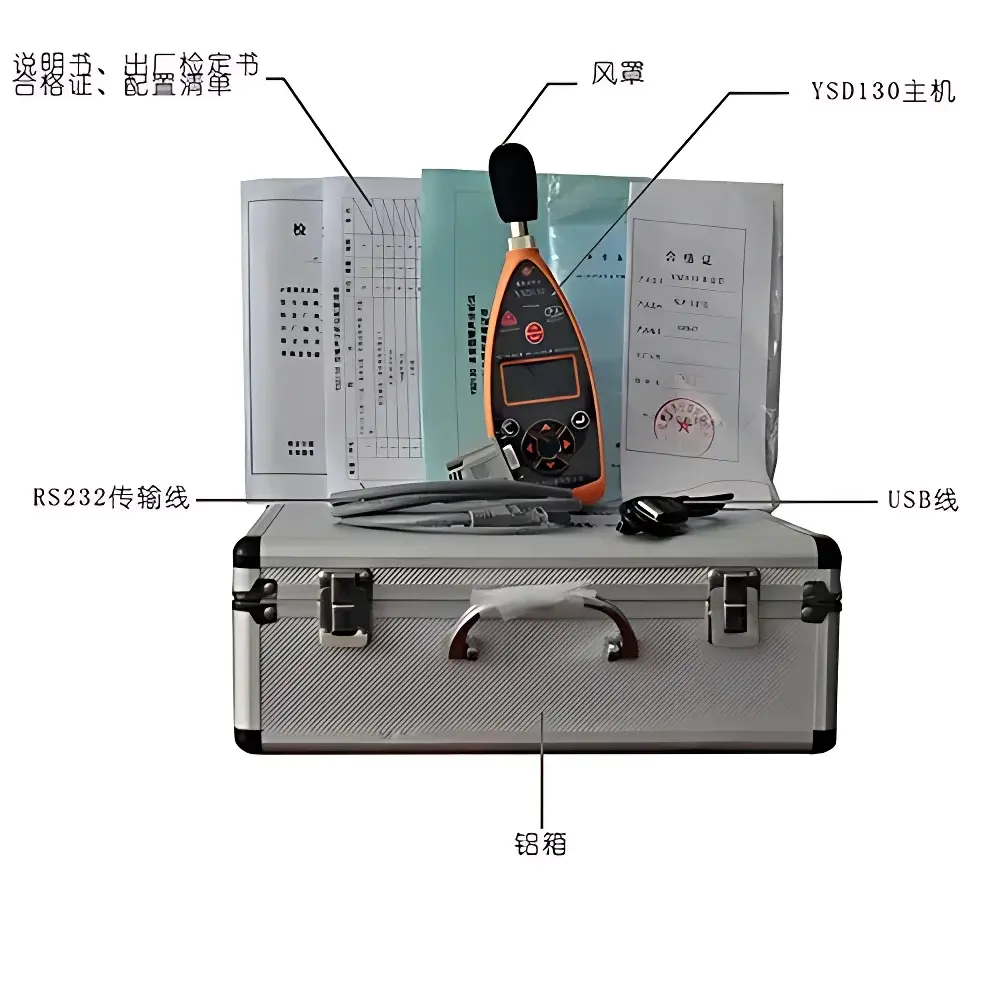
Data export is supported via USB, RS-232, PWM, AC, and DC outputs—though all electrical interfaces are restricted to safe-area use only, per intrinsic safety design constraints. Raw and processed measurements—including Leq,t, Lpeak, SEL, Lex,8h, TWA, DOSE, Ln statistics, and time-history waveforms—are stored in non-volatile Flash memory. The internal file structure enables direct import into third-party analysis tools (e.g., MATLAB, Python pandas, or noise modeling software such as SoundPLAN or CadnaA) via standard CSV or binary formats. While no proprietary PC software is bundled, the device’s structured data logging conforms to ISO/IEC 17025 traceability expectations when paired with documented calibration certificates and chain-of-custody logs.
Applications
- Occupational health monitoring in underground coal mines, tunneling operations, and surface mineral processing plants
- Noise mapping and engineering controls verification in oil & gas refineries, chemical plants, and steel mills with Zone 1 classification
- Regulatory compliance testing for national and regional noise ordinances (e.g., China’s GB 12348, EU Directive 2003/10/EC)
- Acoustic source identification and machinery diagnostics using time-stamped spectral snapshots and impulse response capture
- Long-term environmental noise trend analysis (e.g., 24-hour Leq monitoring near mine portals or haul roads)
- Training and awareness programs requiring real-time audible feedback and visual confirmation of exposure thresholds
FAQ
Is the YSD130+ certified for use in methane-rich coal mine environments?
Yes. It holds Ex ib IIB T4 Gb certification per GB 3836.1–2010 and GB 3836.4–2010, permitting use in Zone 1 explosive gas atmospheres containing Group IIB gases—including methane—with maximum surface temperature limited to ≤135 °C.
Does it support FDA 21 CFR Part 11 or EU Annex 11 compliance?
No. As a field-deployed physical measurement instrument without electronic signature or role-based access control, it does not implement Part 11 or Annex 11 features. However, its immutable timestamped data logs and calibration traceability support ALCOA+ principles in GxP-aligned workflows when integrated into validated laboratory information management systems (LIMS).
Can octave band data be exported for spectral analysis?
Yes—when the optional 1:1 octave band module is installed, real-time band-level Lp, Lmax, Lmin, and Leq,T values for all nine center frequencies (31.5–8 kHz) are recorded and exportable alongside broadband metrics.
What battery type is required, and how long does it last?
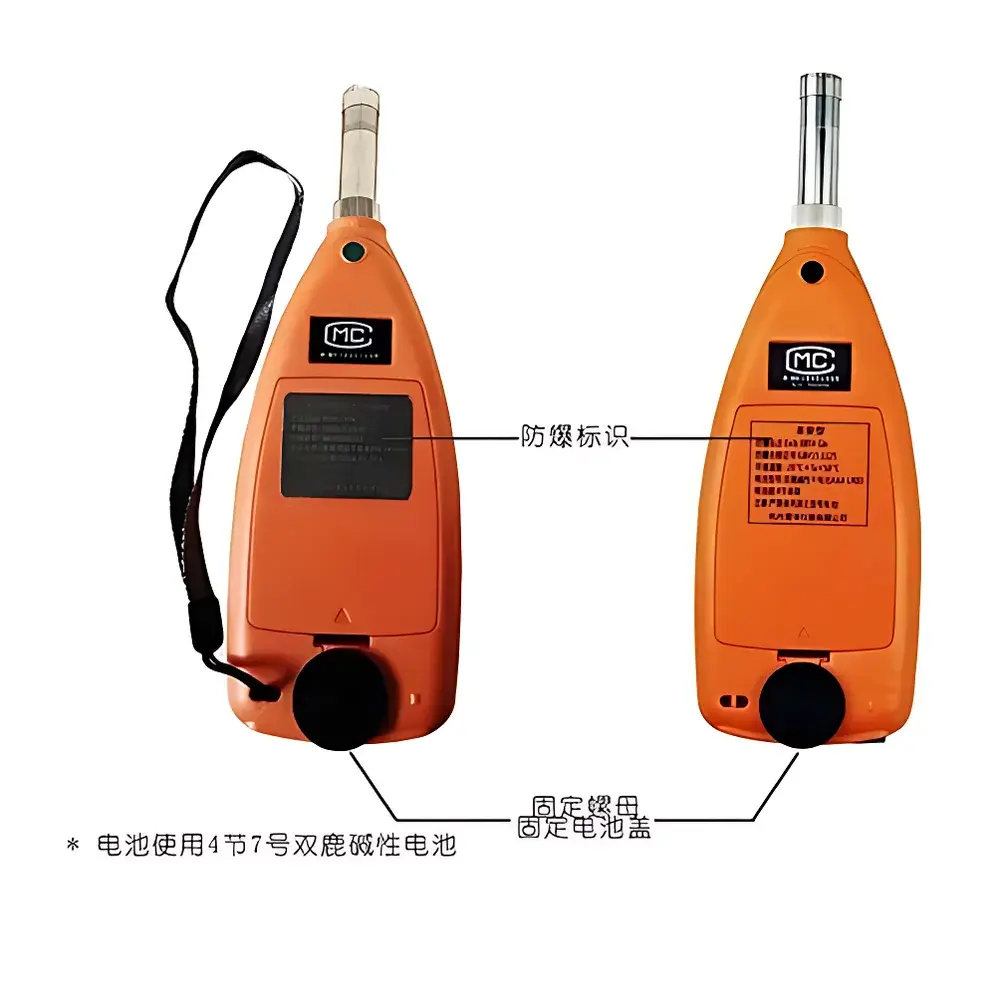
Four AAA LR03 alkaline cells (e.g., Double Deer brand) provide ≥10 hours of continuous operation under standard conditions. Battery life is reduced by ~50% when audio recording or octave analysis is active.
Is remote firmware update supported?
No. Firmware updates require local connection via USB and must be performed using AWA-supplied utilities under controlled conditions—consistent with functional safety requirements for intrinsically safe devices.







