

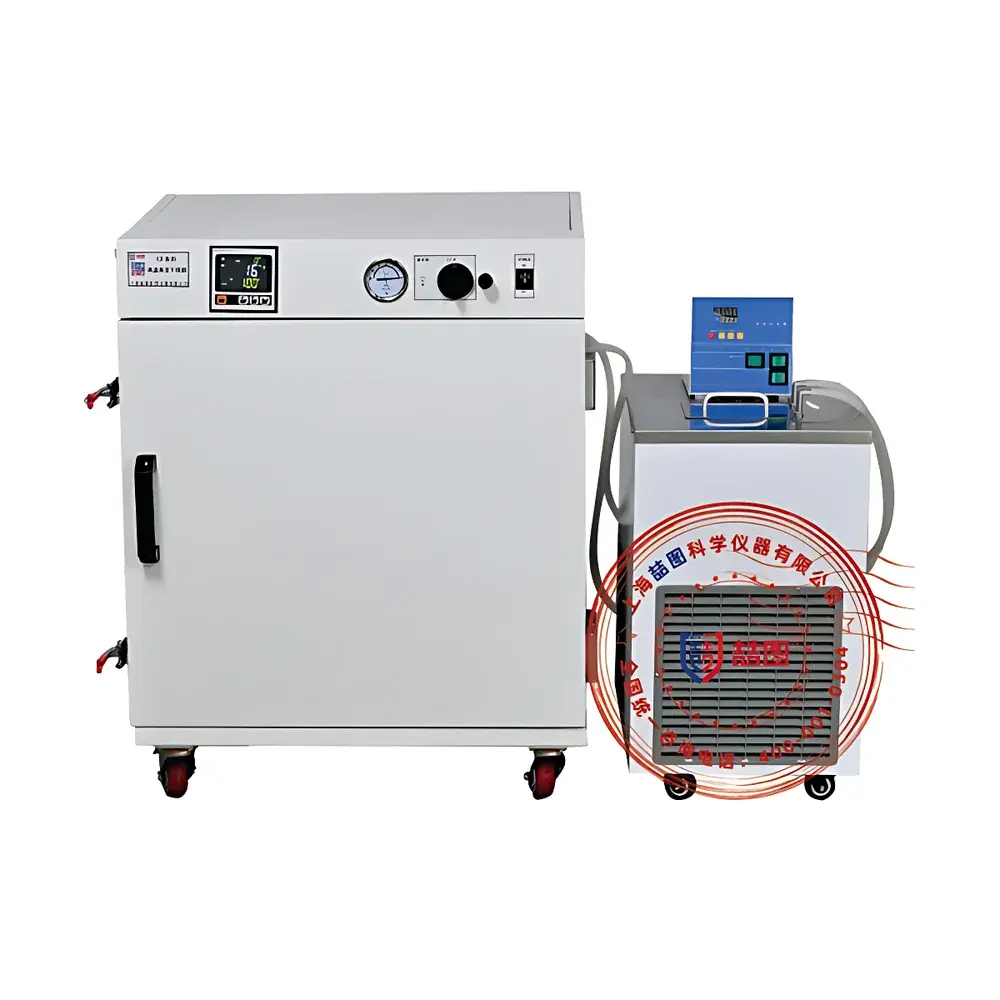
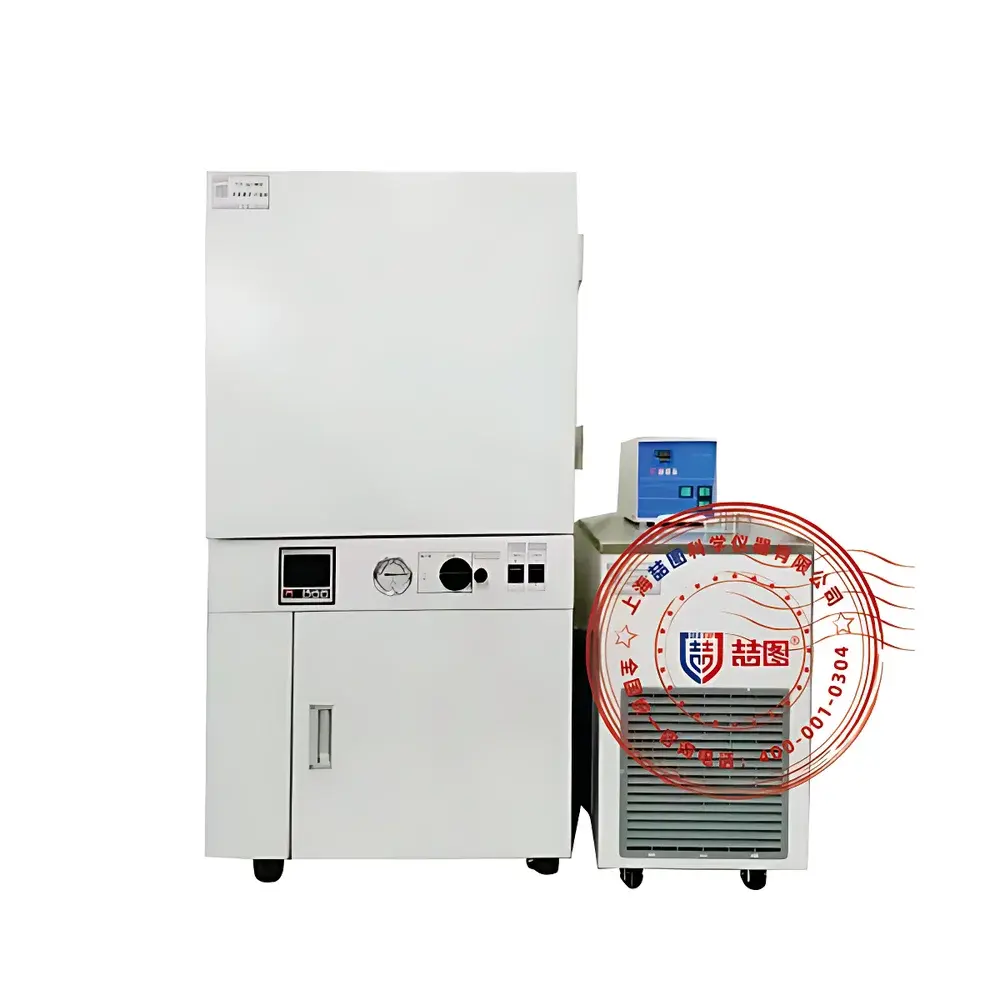
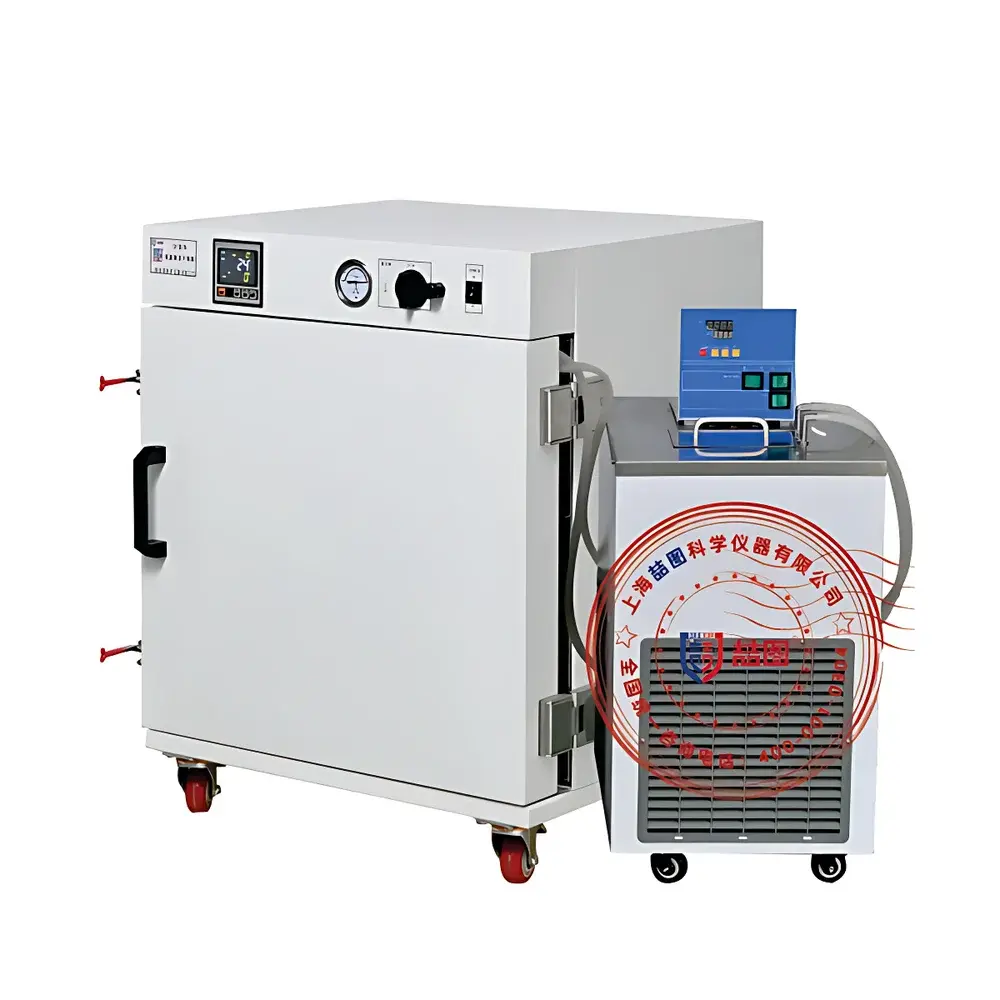
DRETOP UR6-125JVT Programmable High-Temperature Vacuum Drying Oven
| Brand | DRETOP |
|---|---|
| Origin | Shanghai, China |
| Manufacturer Type | Direct Manufacturer |
| Product Category | Domestic |
| Model | UR6-125JVT |
| Instrument Type | Vacuum Oven |
| Temperature Range | RT+10 to 600°C |
| Temperature Uniformity | Not specified |
| Temperature Fluctuation | ±1°C |
| Temperature Resolution | 0.1°C |
| Vacuum Degree | ≤133 Pa |
| Inner Chamber Dimensions | 500 × 500 × 500 mm |
| Inner Chamber Material | Stainless Steel |
| Heating Method | Forced Air Circulation |
| Operating Ambient Temperature | 5–45°C |
| Power Supply | AC 220 V / 380 V, 50 Hz |
| Standard Accessories | Circulating Water Cooling Unit, Carbon Steel Soundproof Cabinet, Rotary Vane Vacuum Pump, J-Type Intermediate Condensation Protection Device |
Overview
The DRETOP UR6-125JVT Programmable High-Temperature Vacuum Drying Oven is a precision-engineered thermal processing system designed for controlled dehydration, thermal stabilization, degassing, annealing, and vacuum-assisted curing under inert or reduced-pressure conditions. It operates on the principle of lowering the vapor pressure of volatile components—primarily water and solvents—by reducing ambient pressure within the chamber, thereby enabling efficient moisture removal at significantly lower temperatures than atmospheric drying. This principle is critical for preserving thermally sensitive materials such as lithium-ion battery electrode slurries, semiconductor packaging resins, aerospace-grade composites, and pharmaceutical intermediates. With a maximum operating temperature of 600°C and vacuum capability down to ≤133 Pa, the UR6-125JVT supports high-temperature vacuum treatments essential for metallurgical sintering pre-baking, ceramic binder burnout, and oxide layer stabilization—applications where oxidation inhibition and residual gas elimination are mandatory.
Key Features
- Programmable T-type multifunctional color touchscreen controller integrating digital vacuum display, real-time temperature logging, and multi-step process scheduling (e.g., ramp-hold-cool cycles with independent vacuum hold and inert gas purge timing).
- Double-walled stainless steel inner chamber with argon arc welding joints and high-temperature silicone door gasket, reinforced by water-cooled jacketing to maintain seal integrity and suppress thermal degradation of sealing components.
- Forced air circulation heating system with rear-mounted axial fan and baffle-guided airflow distribution, engineered to minimize thermal stratification while maintaining vacuum integrity during operation.
- Robust safety architecture including over-temperature cut-off, leakage current protection, short-circuit interruption, motor overload detection, and non-volatile parameter memory to retain setpoints after power interruption.
- Triple-layer viewing window composed of tempered bulletproof glass with vacuum-sealed interlayer, enabling real-time visual monitoring without compromising chamber vacuum or thermal stability.
- Modular shelf system with adjustable stainless steel trays (3 standard positions), fully extractable and reconfigurable to accommodate irregularly shaped substrates or stacked wafers.
Sample Compatibility & Compliance
The UR6-125JVT accommodates a broad spectrum of sample formats—including powders, thin-film coated wafers, battery pouch cells, ceramic green bodies, polymer composites, and metal alloy precursors—without risk of particle dispersion or surface oxidation. Its vacuum environment eliminates convective heat transfer, preventing mechanical disturbance of fine particulates during drying. The system complies with foundational laboratory safety standards including IEC 61010-1 (Electrical Safety for Laboratory Equipment) and meets structural requirements for Class II cleanroom integration. While not certified for GMP manufacturing, its programmable logic, audit-trail-capable controller (with optional time-stamped event logging), and configurable alarm thresholds support GLP-aligned documentation practices in R&D and QC laboratories. For regulated applications involving moisture-sensitive APIs or battery electrolyte formulations, the unit may be validated per ASTM E2019 (Standard Guide for Validation of Thermal Processing Equipment) and ISO 17025 calibration protocols.
Software & Data Management
The integrated T-type controller provides embedded data acquisition with up to 100 programmable segments per recipe, each defining target temperature, dwell time, vacuum setpoint, and nitrogen purge duration. All operational parameters—including actual chamber temperature, vacuum pressure, elapsed cycle time, and fault codes—are logged at user-defined intervals (1–60 sec resolution) and exportable via USB to CSV format. Optional RS485/Modbus RTU interface enables integration into centralized lab management systems (LIMS) or SCADA platforms for remote supervision and batch traceability. Firmware supports password-protected user levels (Operator, Technician, Administrator) to enforce procedural control and prevent unauthorized parameter modification—critical for method reproducibility across shifts or operators.
Applications
- Lithium-ion battery R&D: Electrode drying, separator coating solvent removal, and cell stack degassing prior to lamination—ensuring low residual moisture (<20 ppm) required for SEI layer formation.
- Semiconductor packaging: Encapsulant curing under vacuum to eliminate voids and delamination in leadframe assemblies and wafer-level chip-scale packages (WLCSP).
- Aerospace materials: Outgassing of composite prepregs and adhesive films used in cryogenic fuel tanks and thermal protection systems (TPS).
- Advanced ceramics: Binder burnout of zirconia, alumina, and silicon carbide green bodies prior to sintering—preventing carbon residue and microcracking.
- Environmental testing: Accelerated aging studies of coatings and polymers under controlled thermal-vacuum stress, simulating space or high-altitude exposure.
- Academic research: Kinetic studies of desorption isotherms, thermal decomposition pathways, and solid-state reaction mechanisms in catalytic and energy storage materials.
FAQ
What vacuum level does the UR6-125JVT achieve, and how is it measured?
The chamber achieves a base vacuum of ≤133 Pa (1 Torr), verified using an integrated digital vacuum gauge calibrated to NIST-traceable standards. Measurement is performed via a capacitance manometer compatible with condensable vapors.
Can this oven operate under inert gas purging (e.g., N₂ or Ar)?
Yes—the controller supports programmable inert gas introduction sequences with timed valve actuation, enabling partial-pressure control and atmosphere exchange between vacuum cycles.
Is the temperature uniformity specification available for validation purposes?
Temperature uniformity is application-dependent and requires on-site mapping per ISO 17025 procedures; DRETOP provides empty-chamber uniformity test reports upon request for IQ/OQ protocol development.
What maintenance is required for long-term vacuum integrity?
Routine inspection of door gaskets, periodic replacement of vacuum pump oil (every 500 operating hours), and annual verification of condensate trap functionality are recommended to sustain ≤133 Pa performance.
Does the system comply with FDA 21 CFR Part 11 for electronic records?
The base controller does not include Part 11-compliant audit trail or electronic signature modules; however, third-party middleware solutions can be deployed to meet ALCOA+ data integrity requirements in regulated environments.



