
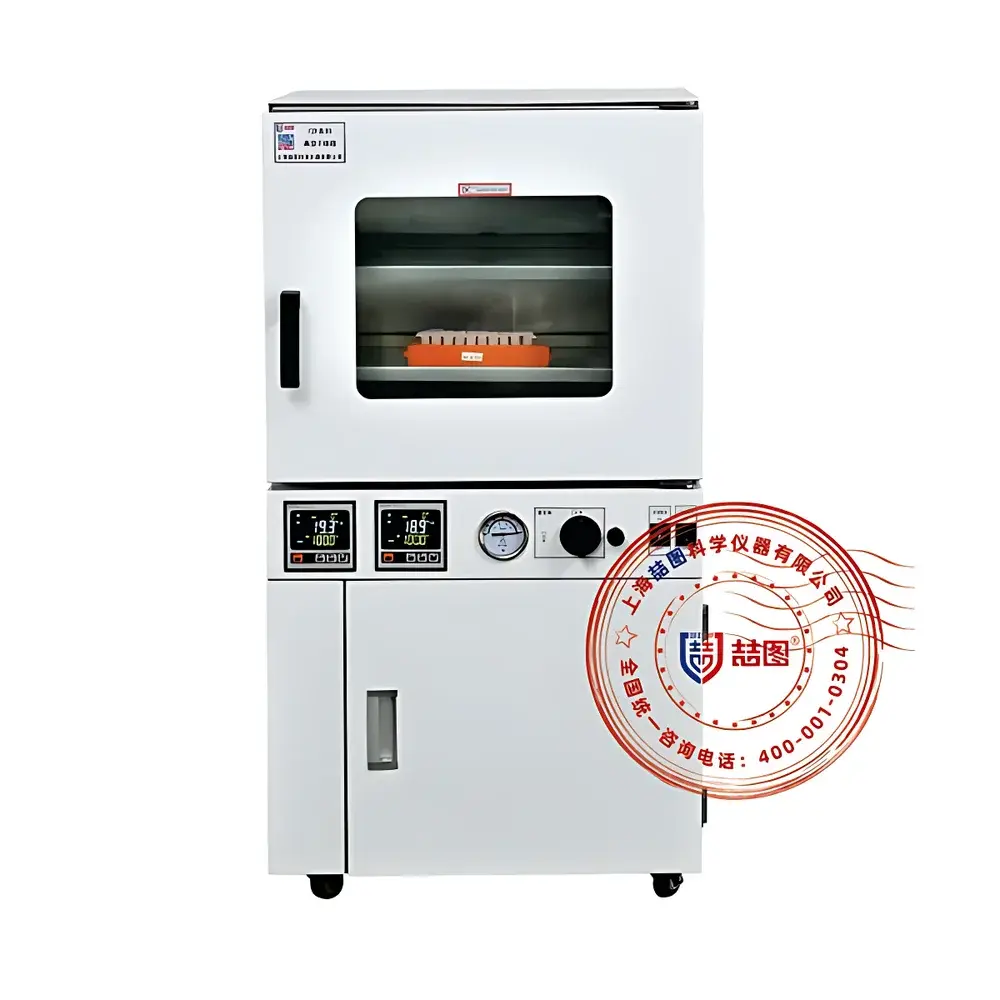
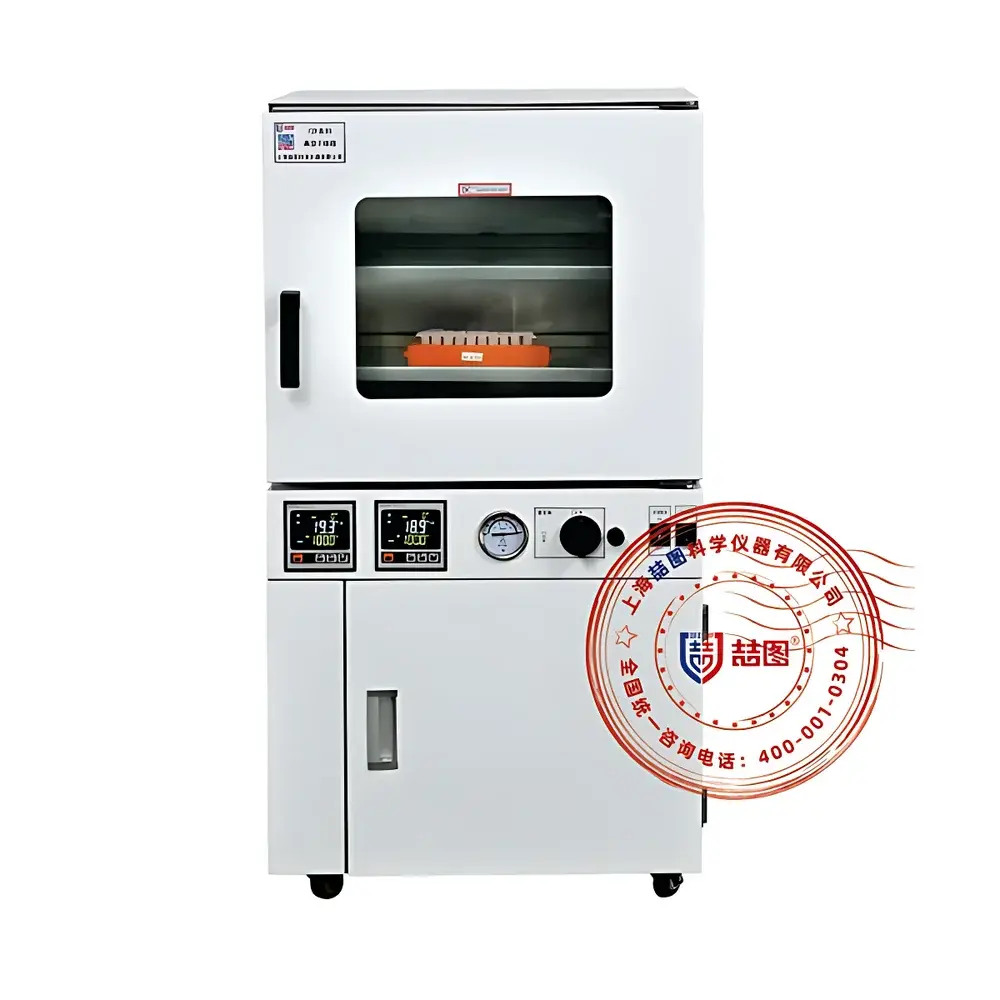
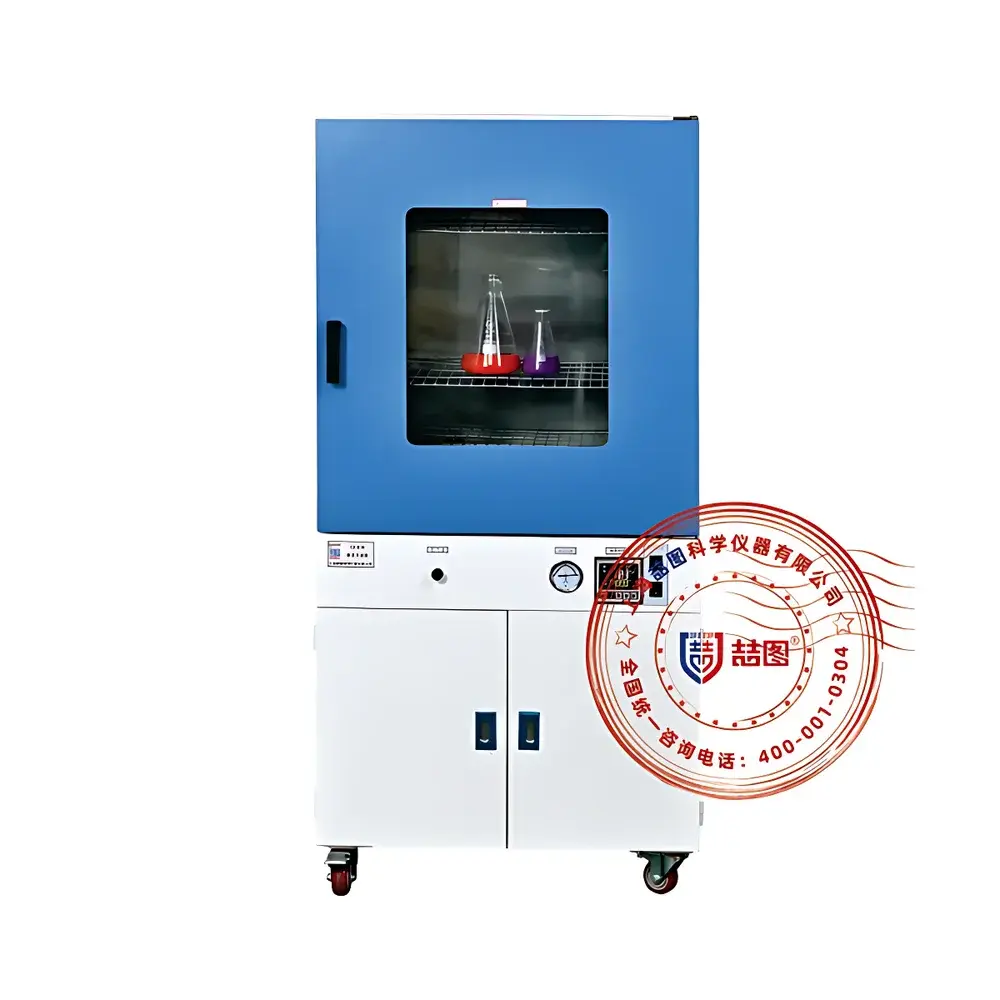
DRETOP HVG-DS10-50 High-Vacuum Gradient Drying Oven
| Brand | DRETOP |
|---|---|
| Origin | Shanghai, China |
| Manufacturer Type | Direct Manufacturer |
| Product Category | Domestic |
| Model | HVG-DS10-50 |
| Instrument Type | Vacuum Drying Oven |
| Temperature Range | RT+10 to 250 °C |
| Temperature Uniformity | Not specified |
| Temperature Fluctuation | ±0.5 °C |
| Temperature Resolution | 0.1 °C |
| Vacuum Level | ≤133 Pa |
| Internal Chamber Dimensions | 415 × 370 × 345 mm (W×D×H) |
| Internal Material | 304 Stainless Steel |
| Heating Method | Four-Side External Heating |
| Operating Ambient Temperature | 5–45 °C |
| Insulation | Glass Fiber |
| Safety Protections | Over-Temperature Alarm, Leakage Protection, Short-Circuit Protection, Overload Protection, Power-Failure Data Retention |
Overview
The DRETOP HVG-DS10-50 High-Vacuum Gradient Drying Oven is an engineered solution for controlled thermal processing under reduced-pressure environments. It operates on the principle of vacuum-assisted drying—removing ambient air via a mechanical vacuum pump to achieve sub-atmospheric pressure (≤133 Pa), thereby lowering the boiling point of volatile components and enabling moisture or solvent removal at significantly reduced temperatures. This prevents thermal degradation of heat-sensitive materials, eliminates oxidative side reactions, and ensures residue-free drying of complex formulations. Unlike conventional convection ovens, the HVG-DS10-50 maintains uniform thermal distribution across its stainless-steel chamber using four-side external heating elements, minimizing hot spots and ensuring reproducible drying kinetics. Its design complies with fundamental requirements for laboratory-grade vacuum thermal processing in regulated R&D and pilot-scale manufacturing settings.
Key Features
- Four-side external heating architecture for rapid, uniform thermal response without internal heating element exposure—eliminating risk of vacuum arcing, carbon deposition, or localized overheating.
- 304 stainless-steel interior chamber (415 × 370 × 345 mm) with reinforced double-layer tempered glass observation window for real-time sample monitoring under vacuum conditions.
- Microprocessor-based PID temperature controller with 0.1 °C resolution, ±0.5 °C fluctuation tolerance, and programmable timer (1–9999 minutes); includes over-temperature alarm and auto-cutout protection.
- Integrated self-diagnostic system displaying fault codes directly on the large-format LCD interface—reducing downtime and supporting preventive maintenance protocols.
- Robust dual-stage rotary door latch with high-compression silicone gasket ensures long-term vacuum integrity and repeatable seal performance across thousands of operational cycles.
- Multi-layer thermal insulation using high-density glass fiber between chamber and outer casing—reducing surface temperature rise and improving energy efficiency per ASTM E145-22 guidelines for laboratory ovens.
Sample Compatibility & Compliance
The HVG-DS10-50 accommodates diverse sample forms—including powders, thin-film coatings, battery electrode slurries, pharmaceutical granules, polymer composites, and biological tissue sections—without particle dispersion or oxidation during drying. Its ≤133 Pa operating vacuum falls within the “medium vacuum” regime (10²–10⁻¹ Pa), where gas-phase interference is minimized while maintaining compatibility with standard oil-sealed rotary vane pumps (e.g., V-series or VGM-series optional configurations). The unit supports inert gas purging via optional mass-flow-controlled nitrogen or argon inlet valves (KF16/KF25 interface compatible), facilitating oxygen-sensitive processes aligned with ISO 14644 cleanroom handling practices. While not certified to UL/CSA or IEC 61010-1 out-of-the-box, its electrical architecture, grounding design, and redundant safety interlocks meet baseline requirements for GLP-compliant laboratories conducting method validation per USP and ISO/IEC 17025 Annex A.3.
Software & Data Management
The HVG-DS10-50 utilizes an embedded microcontroller platform with non-volatile memory that retains user-defined parameters—including setpoint temperature, dwell time, and alarm thresholds—during power interruption. Optional upgrades include RS485 serial communication (Modbus RTU protocol) for integration into centralized lab management systems, and USB data logging (with external storage) for audit-ready temperature/vacuum trend records. When paired with the DRETOP VT-series touch-screen controller (sold separately), users gain access to multi-step gradient drying profiles, real-time vacuum-pressure trending, and electronic signature-capable operation logs compliant with FDA 21 CFR Part 11 Annex 11 requirements for traceability and data integrity. All firmware versions undergo version-controlled release cycles with documented change logs available upon request.
Applications
This vacuum drying oven serves critical functions across multiple technical domains: In semiconductor packaging labs, it performs post-molding dehumidification of IC substrates prior to wire bonding; in lithium-ion battery R&D, it dries cathode/anode electrodes under inert atmosphere to prevent Li₂CO₃ formation; in biopharmaceutical development, it stabilizes lyophilized protein formulations without denaturation; and in advanced materials synthesis, it removes residual solvents from MOFs, perovskite precursors, and nanocomposite dispersions. Its stable thermal gradient control also supports ASTM D2243-20 (plastic film drying), ISO 62-2020 (polymer water absorption testing), and IPC-TM-650 2.6.25.1 (PCB moisture removal prior to reflow).
FAQ
What vacuum level does the HVG-DS10-50 achieve, and how is it measured?
The unit achieves ≤133 Pa (1 Torr) using a standard mechanical vacuum pump; vacuum level is monitored via analog pointer gauge (standard) or optional digital vacuum sensor (KF16 interface compatible).
Can this oven be used for inert-gas purging during drying?
Yes—optional inert gas inlet valve (with precision flow control) enables continuous N₂ or Ar purge to maintain reducing or oxygen-free environments.
Is the chamber volume customizable?
Standard internal dimensions are fixed at 415 × 370 × 345 mm (50 L), but DRETOP offers OEM customization for alternative chamber geometries, larger volumes (up to 430 L), or multi-tier stacked configurations (XZ/XZS series).
Does the system support regulatory-compliant data archiving?
With VT-series controller and USB logging module, full temperature/vacuum/time stamp records are exportable in CSV format and support ALCOA+ principles for data reliability and long-term retention.
What maintenance is required for long-term vacuum integrity?
Routine inspection of door gasket compression, periodic cleaning of vacuum port filters, and annual verification of pressure sensor calibration are recommended per ISO/IEC 17025 Clause 6.4.6.



