
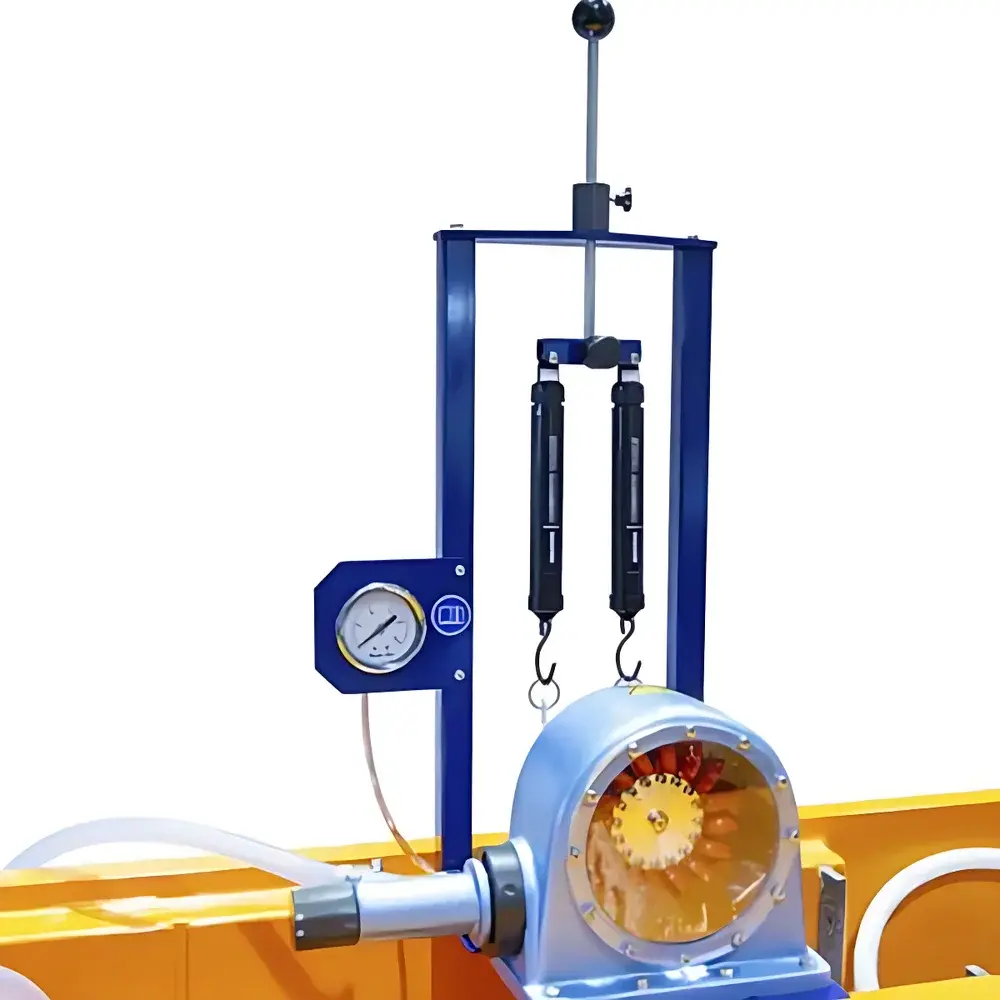
Pelton Turbine Demonstration Unit Armfield F1-25
| Brand | Armfield |
|---|---|
| Origin | United Kingdom |
| Model | F1-25 |
| Application | Educational Hydraulics & Turbomachinery Laboratory Equipment |
| Enclosure | Cast Housing with Transparent Observation Panel |
| Torque Measurement | Spring-Balanced Mechanical Dynamometer |
| Pressure Indication | Remote Bourdon-Tube or Digital Pressure Gauge |
| Speed Measurement | Optional Non-Contact Tachometer (100–2000 rpm range) |
| Load Control | Calibrated Weights for Pelton Injector Needle Actuation |
| Software Option | Armfield Educational Software Suite (Data Logging, Real-Time Plotting, Efficiency Calculation) |
Overview
The Armfield F1-25 Pelton Turbine Demonstration Unit is a bench-mounted, self-contained educational apparatus engineered to illustrate the fundamental operating principles of impulse-type hydraulic turbines. It implements the classical Pelton wheel configuration—where high-velocity water jets impinge radially on double-cupped buckets mounted on a peripheral rim—enabling direct visualization and quantitative analysis of energy conversion from hydraulic head to mechanical shaft work. The unit operates under controlled open-channel flow conditions on an Armfield hydraulic bench (e.g., F1-10 or F1-20 series), with supply pressure regulated via an upstream needle valve and monitored continuously by a calibrated remote pressure gauge. The turbine’s rotational output is absorbed by a friction-based mechanical dynamometer incorporating a spring-balanced lever arm and calibrated weights, allowing direct torque measurement in accordance with ISO 3964:2015 (Hydraulic machinery — Testing of hydraulic turbines). This configuration supports first-principles derivation of power output (P = 2π·N·T/60), hydraulic input power (Phyd = ρgQH), and overall efficiency (η = P/Phyd × 100%), making it suitable for undergraduate thermofluids, fluid mechanics, and renewable energy laboratories.
Key Features
- Robust cast-metal housing with integrated transparent acrylic observation panel for real-time visualization of jet-bucket interaction and wheel rotation dynamics
- Precision-machined miniature Pelton runner (typically ~120 mm diameter) with symmetrical double-split buckets optimized for stable impulse response at low to medium flow rates (0.5–4.0 L/s)
- Adjustable spear-valve injector assembly mounted on a rigid support frame, enabling fine control of jet diameter and impact velocity
- Mechanical torque measurement system based on ISO-compliant spring-lever dynamometer with calibrated mass set (10 g to 500 g increments) and vernier scale readout
- Standard pressure sensing interface compatible with Armfield’s digital or analog remote gauges (0–10 bar range, ±0.5% FS accuracy)
- Optional non-contact optical tachometer (Armfield part no. 100-2/1) providing pulse-based speed measurement from 100 to 2000 rpm with ±1 rpm resolution
- Modular mounting design facilitating integration with Armfield hydraulic benches and standardized lab infrastructure
Sample Compatibility & Compliance
The F1-25 is designed exclusively for use with clean, filtered water within laboratory-grade hydraulic circuits. It complies with BS EN ISO 9001:2015 quality management requirements for educational instrumentation manufacturing. All wetted components—including brass injector nozzle, stainless-steel shaft, and aluminum runner—are corrosion-resistant and compatible with deionized or tap water under typical teaching-lab operating conditions (max. inlet pressure 6 bar, max. temperature 40 °C). The unit satisfies pedagogical safety standards outlined in CLEAPSS LabPack Section 12.3 (Hydraulic Apparatus) and aligns with UK Department for Education (DfE) guidelines for secondary and tertiary engineering laboratory equipment. No hazardous materials or pressurized gas interfaces are involved; all operational pressures remain below 10 bar, eliminating requirement for PED 2014/68/EU certification.
Software & Data Management
An optional Armfield Educational Software Suite (v5.2+) is available for data acquisition and analysis. The software communicates via USB or RS-232 with compatible pressure transducers, tachometers, and load-cell interfaces (when upgraded). It provides synchronized time-stamped logging of pressure, flow rate (derived from hydraulic bench volumetric timer), rotational speed, and applied torque. Predefined calculation modules automatically compute hydraulic power, brake power, and overall efficiency per ISO 20964:2017 (Hydraulic turbines — Performance testing). Audit trails, user-defined experiment templates, and export to CSV/Excel formats support GLP-aligned recordkeeping. While the base F1-25 does not include FDA 21 CFR Part 11-compliant electronic signatures, the software architecture supports future validation protocols required for accredited teaching labs undergoing external QA review.
Applications
- Verification of Euler’s turbine equation and specific speed correlations for impulse turbines
- Experimental determination of optimal bucket pitch-to-jet-diameter ratio and jet centering effects on efficiency
- Mapping of efficiency vs. speed curves under constant head and variable load conditions
- Comparative analysis of Pelton performance against Francis and Kaplan demonstrators (e.g., Armfield F1-26, F1-27)
- Introduction to transient behavior: jet cut-off response, runaway speed estimation, and governor action simulation
- Support for BEng/MEng module assessments in Fluid Machinery, Sustainable Energy Systems, and Experimental Methods in Mechanical Engineering
FAQ
What hydraulic bench models is the F1-25 compatible with?
The unit is mechanically and hydraulically interfaced with Armfield F1-10, F1-20, and F1-30 series hydraulic benches using standard 1/2″ BSP quick-connect fittings and alignment jigs.
Is calibration documentation supplied with the unit?
Yes—each F1-25 ships with a manufacturer’s calibration certificate for the pressure gauge and dynamometer lever arm, traceable to UKAS-accredited standards.
Can the F1-25 be used for research-grade measurements?
While optimized for pedagogy, its repeatability (±1.2% full-scale torque, ±0.8% pressure) supports supervised final-year undergraduate projects and postgraduate teaching labs meeting EFQM Level 2 accreditation criteria.
Is the observation panel resistant to UV degradation and thermal stress?
The 8 mm thick acrylic panel conforms to BS EN ISO 11341:2019 for accelerated weathering resistance and maintains optical clarity after 500 hours of continuous operation at 40 °C.
Does Armfield offer curriculum-aligned lab manuals for this unit?
Yes—comprehensive instructor guides (including learning outcomes, pre-lab quizzes, raw data templates, and sample uncertainty analysis worksheets) are provided under license to accredited academic institutions.






