
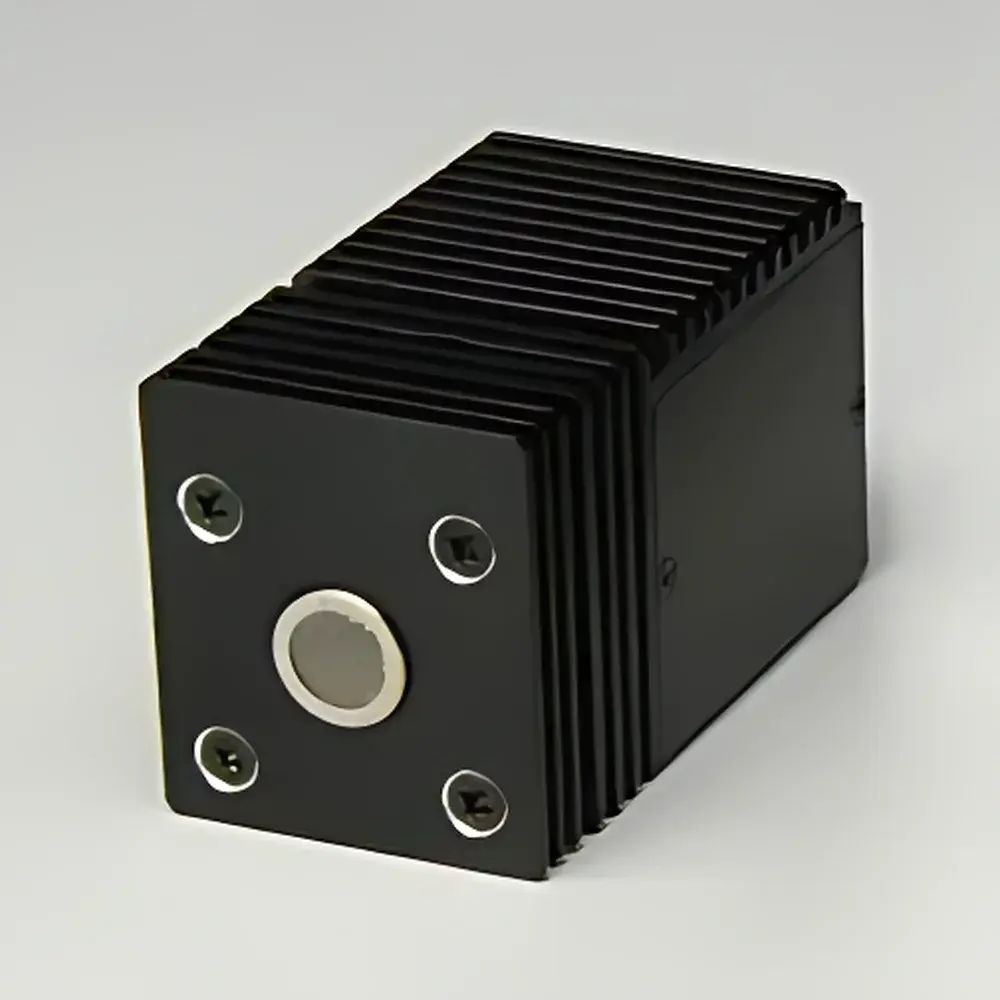
Hamamatsu Fast Fluorescent Screen J13550-09D
| Brand | Hamamatsu |
|---|---|
| Origin | Japan |
| Manufacturer Type | Original Equipment Manufacturer (OEM) |
| Product Origin | Imported |
| Model | J13550-09D |
| Pricing | Available Upon Request |
Overview
The Hamamatsu Fast Fluorescent Screen J13550-09D is a high-performance, vacuum-compatible phosphor screen engineered for real-time visualization and spatial characterization of ion beams, electron beams, and energetic particle trajectories in mass spectrometry systems—particularly in time-of-flight (TOF), magnetic sector, and reflectron-based instruments. Utilizing a fast-decay P47 phosphor (ZnS:Ag + Al₂O₃ binder) deposited on a conductive, thermally stable ceramic substrate, the J13550-09D delivers sub-microsecond decay time (τdecay ≈ 0.3–0.6 µs), high quantum efficiency in the UV–visible range (peak emission at ~450 nm), and exceptional resistance to beam-induced degradation under continuous or pulsed irradiation. Its 9 mm active diameter and hermetically sealed metal-ceramic feedthrough design ensure compatibility with ultra-high vacuum (UHV) environments down to 1×10⁻⁹ Pa, making it suitable for integration into OEM mass spectrometer optical chambers, beam alignment stations, and diagnostic ports where non-invasive, high-temporal-fidelity beam profiling is required.
Key Features
- Vacuum-rated construction: All-metal (Kovar/Invar) housing with ceramic insulator; bakeable to 250 °C without performance loss
- Optimized phosphor layer: P47 formulation with controlled grain size distribution for uniform brightness and minimal afterglow (<0.1% residual intensity at 10 µs post-excitation)
- Low-noise signal output: Integrated bias voltage terminal (0–5 kV) enables direct coupling to photomultiplier tubes (PMTs) or scientific CMOS cameras without external amplification
- High spatial resolution: Effective line-pair resolution ≥ 25 lp/mm (measured at MTF 10%) under 10 keV electron beam excitation
- OEM-ready interface: Standard 16-pin D-subminiature feedthrough (MIL-DTL-24308 compliant) with pinout documentation per Hamamatsu Technical Note TN-J13550-09D Rev. 3
- Traceable calibration: Supplied with individual spectral responsivity curve (300–700 nm) and decay kinetics report measured per ISO 11146-2:2019 Annex D
Sample Compatibility & Compliance
The J13550-09D is designed for use with charged particle beams up to 30 keV (electrons) or 100 keV (ions), including singly and multiply charged species typical in MALDI-TOF, ESI-Q-TOF, and SIMS instrumentation. It exhibits no measurable outgassing in UHV conditions when preconditioned per ASTM E595-22 (Total Mass Loss ≤ 0.05%, Collected Volatile Condensable Materials ≤ 0.01%). The device conforms to IEC 61000-6-3:2019 (EMC emissions) and carries CE marking for laboratory equipment under Directive 2014/30/EU. While not a medical device, its materials and surface finish comply with USP Class VI requirements for polymer-contacting components used in analytical hardware assemblies.
Software & Data Management
As a passive detection component, the J13550-09D does not incorporate embedded firmware or onboard processing. However, it is fully interoperable with industry-standard imaging and data acquisition platforms—including Hamamatsu’s C13440-20C camera system, National Instruments LabVIEW-based beam diagnostics suites, and open-source tools such as Micro-Manager and PyMeasure—when paired with compatible PMTs or sCMOS sensors. Beam profile data acquired via the screen supports quantitative analysis workflows compliant with FDA 21 CFR Part 11 when integrated into validated instrument control software featuring electronic audit trails, user access controls, and secure data export (e.g., HDF5 or vendor-neutral mzML formats). Calibration metadata (phosphor decay constants, spectral response, and geometric distortion maps) are provided in machine-readable JSON format for traceability in GLP/GMP environments.
Applications
- Real-time alignment and tuning of ion optics in quadrupole and time-of-flight mass analyzers
- Beam centroid tracking and divergence measurement during source optimization (e.g., electrospray, laser desorption, or thermal ionization sources)
- Diagnostics of space-charge effects and beam halo formation in high-current TOF systems
- Validation of ion mirror and reflectron focusing performance via streak imaging
- Qualitative assessment of detector saturation thresholds and secondary electron yield in microchannel plate (MCP) test configurations
- Teaching and demonstration modules for graduate-level mass spectrometry laboratories requiring visual beam feedback
FAQ
Is the J13550-09D compatible with differential pumping stages in hybrid mass spectrometers?
Yes—its UHV rating and low outgassing characteristics permit installation downstream of intermediate vacuum stages (10−4–10−6 Pa) without compromising chamber integrity.
Can this screen be used with proton or alpha particle beams?
It is qualified for protons up to 5 MeV and He2+ ions up to 10 MeV under pulsed operation (duty cycle < 10−3); continuous exposure requires beam current density limits below 1 nA/mm² to prevent thermal quenching.
Does Hamamatsu provide custom mounting flanges or optical coupling options?
Standard configuration uses CF-16 or KF-16 vacuum flange adaptors; custom kinematic mounts, fiber-optic tapers, or UV-transmissive quartz windows are available under NRE agreement (lead time: 12–16 weeks).
What is the recommended operating temperature range?
Ambient to +80 °C during operation; storage range is −20 °C to +60 °C in inert atmosphere. Thermal cycling beyond ±5 °C/min is not advised due to CTE mismatch between ceramic and metal layers.
How often does the phosphor require recalibration?
Under normal usage (≤ 10⁶ pulses/hour at ≤ 1 keV), spectral responsivity drift remains within ±2% over 24 months; annual verification against NIST-traceable UV-Vis reference standards is recommended for regulated environments.





