
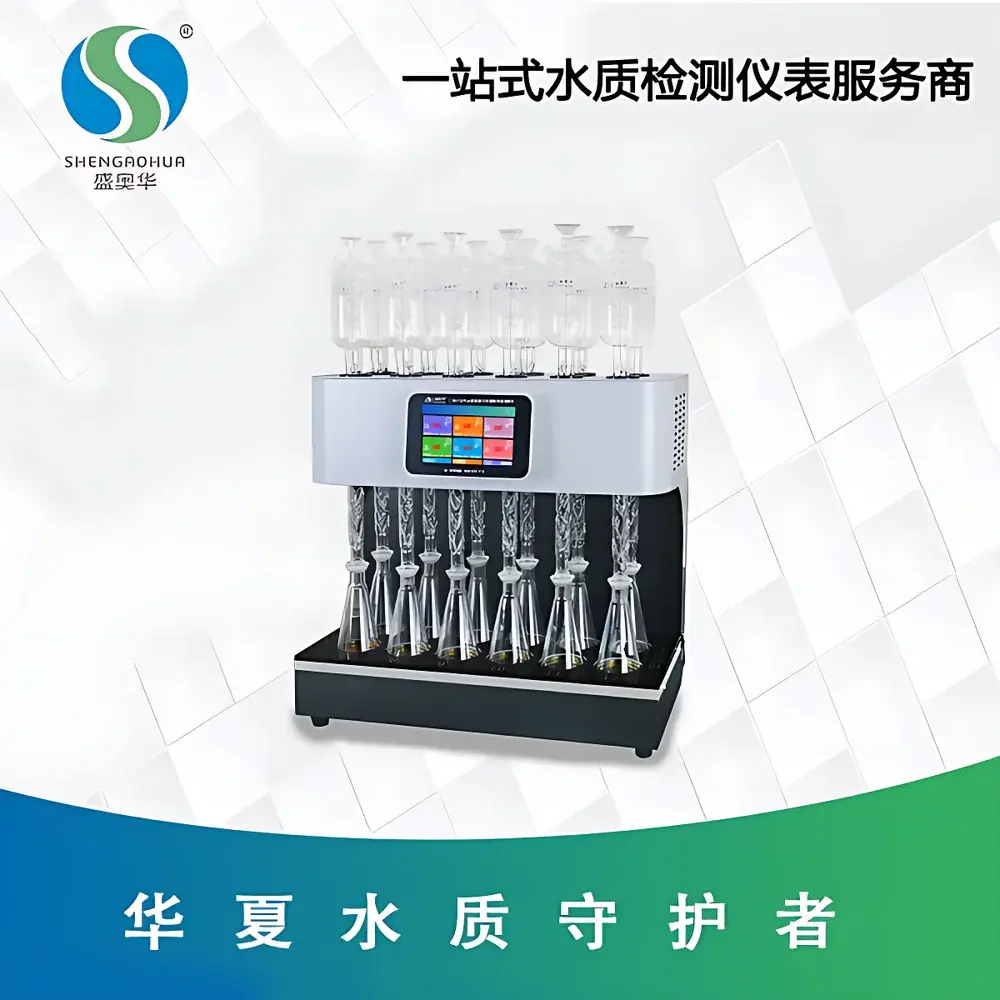
Shengaohua SH-12PLUS Intelligent COD Reflux Digestion System
| Brand | Shengaohua |
|---|---|
| Origin | Jiangsu, China |
| Manufacturer Type | Direct Manufacturer |
| Country of Origin | China |
| Model | SH-12PLUS |
| Digestion Method | Reflux Digestion |
| Heating Module | Integrated Aluminum Block with Independent Zone Control |
| Batch Capacity | 12 samples |
| Temperature Range | Ambient to 200 °C |
| Temperature Accuracy | ±1 °C |
| Digestion Vessel Volume | 250 mL |
| Timer Resolution | 0.1 s |
| Power Rating | 3000 W (AC 220 V ±10%, 50 Hz) |
| Display | 7-inch Capacitive Touchscreen (Chinese UI) |
| Cooling Mode | Dual-mode — Air-cooled (forced convection, sealed high-flow fan) or Optional Water-cooled Condensation |
| Alarm Function | Audible End-of-Digestion Alert with Automatic Heater Shutdown |
| Weight | 32 kg |
| Environmental Operating Range | −5 °C to 45 °C |
| COD Measurement Range | 4–700 mg/L (direct) |
| Digestion Time Setting | 1–999 min (user-programmable) |
| Fan Control | Auto/Manual Switching |
| Precision | RSD ≤5.0% for KHP standard (500 mg/L) |
Overview
The Shengaohua SH-12PLUS Intelligent COD Reflux Digestion System is an engineered solution designed specifically for compliant execution of the HJ 828–2017 standard method—“Determination of Chemical Oxygen Demand (COD) in Water by Dichromate Oxidation.” This system implements a controlled reflux digestion process based on the classical open-reflux principle, wherein water samples are heated under acidic conditions with excess potassium dichromate and silver sulfate catalyst in a strongly sulfuric acid medium. The oxidation reaction proceeds at elevated temperatures (typically 150–165 °C for 120 min), converting organic matter to CO₂ and H₂O, while unreacted dichromate is titrated or photometrically quantified to derive COD concentration. The SH-12PLUS ensures thermal uniformity, precise time–temperature coordination, and reproducible oxidation kinetics across all 12 digestion channels—critical prerequisites for inter-laboratory comparability and regulatory data integrity.
Key Features
- Independent single-channel temperature control per digestion position—eliminates cross-zone thermal drift and enables parallel processing of heterogeneous sample matrices.
- Integrated aluminum heating block with precision-machined wells accommodating standard 250 mL digestion tubes; optimized thermal mass distribution ensures ±1 °C uniformity across full load (12 samples).
- Dual-mode condensation system: factory-configured high-volume forced-air cooling (sealed axial fans, >120 m³/h total airflow) with optional retrofit-compatible water-cooled condenser for high-humidity or low-ventilation lab environments.
- 7-inch capacitive touchscreen interface with Chinese-language menu navigation, real-time temperature/time display, and intuitive parameter entry—no external PC required for routine operation.
- Programmable digestion protocol: user-defined ramp profiles, hold durations (1–999 min), and power modulation (stepwise or continuous) to accommodate method variants beyond HJ 828–2017—including ASTM D1252 (Parts A & B) and ISO 6060 adaptations.
- Automated endpoint management: audible alarm activation upon timer completion, immediate heater deactivation, and persistent status flagging in the UI until manual acknowledgment.
- Energy-efficient architecture: dynamic power regulation reduces standby consumption by >65% versus legacy resistive-heater systems; surface temperature rise <25 K above ambient during full-load operation.
Sample Compatibility & Compliance
The SH-12PLUS supports digestion of diverse aqueous matrices including municipal wastewater, industrial effluents (e.g., textile dye baths, electroplating rinse waters, pharmaceutical process streams), surface water, and digested sludge supernatants. Its 250 mL vessel capacity accommodates standard EPA-compliant digestion tubes (e.g., Pyrex® borosilicate glass, 16 × 150 mm). The system meets functional requirements of HJ 828–2017, GB/T 11914–1989, and ISO 6060:1989. While not certified to IEC 61000-6-3 (EMC) or UL 61010-1 out-of-the-box, its electrical design complies with GB 4793.1–2007 (equivalent to IEC 61010-1:2010) for laboratory equipment safety. For GLP/GMP environments, audit-ready operation logs (time-stamped start/end, setpoint, actual temperature mean) can be exported via USB to support 21 CFR Part 11–aligned record retention when paired with validated LIMS software.
Software & Data Management
The onboard firmware stores up to 100 method protocols with versioned naming (e.g., “HJ828_150C_120min_v2”). All run-time parameters—including actual block temperature (recorded every 5 s), elapsed time, and fan duty cycle—are logged internally and exportable as CSV files via USB-A port. No proprietary drivers or cloud dependencies: exported logs open natively in Excel or Python/Pandas for statistical validation (e.g., ANOVA across batches, control charting per ASTM E2587). Firmware updates are delivered as signed .bin files with SHA-256 checksum verification to ensure traceability and prevent unauthorized modification—supporting laboratory QA/QC documentation requirements.
Applications
This system serves core analytical workflows in environmental monitoring labs (e.g., municipal water authorities, provincial EPBs), contract testing facilities accredited to CNAS/ISO/IEC 17025, and industrial QC laboratories managing discharge compliance per local pollutant discharge standards (e.g., DB31/199–2018, DB11/307–2013). It is routinely deployed for batch validation of biological treatment efficiency in activated sludge plants, pretreatment verification prior to anaerobic digestion, and raw material screening in food/beverage manufacturing (e.g., brewery spent wash, dairy whey). Its modular thermal control also supports method development for chloride-interference mitigation (e.g., HgSO₄ masking optimization) and high-COD matrix adaptation (e.g., landfill leachate digestion at extended hold times).
FAQ
Does the SH-12PLUS comply with U.S. EPA Method 410.4?
It supports the procedural framework of EPA 410.4 (reflux digestion + titrimetric detection), though final compliance requires lab-specific validation against reference materials (e.g., NIST SRM 1596) and documented uncertainty budgets per ISO/IEC 17025 Clause 7.7.
Can digestion vessels from other manufacturers be used?
Yes—any standard 250 mL borosilicate glass tube with outer diameter ≤32 mm and height ≤180 mm fits the well geometry; compatibility with tapered or flanged rims must be verified empirically.
Is remote monitoring or Ethernet connectivity available?
No native network interface is provided; however, third-party RS-232-to-Ethernet converters (e.g., Moxa NPort) may be integrated using the optional serial port (TTL-level UART, 9600 bps, no flow control) for SCADA linkage.
What maintenance intervals are recommended for long-term accuracy?
Calibration of the PT100 sensor array is advised annually using a NIST-traceable dry-block calibrator (±0.2 °C tolerance); fan filter cleaning every 3 months prevents airflow degradation in dusty environments.
How is temperature uniformity verified across all 12 positions?
Per HJ 828–2017 Annex B, verification requires simultaneous insertion of calibrated reference thermometers (Class A, ±0.1 °C) into empty vessels at each position, held at 150 °C for 30 min; deviation must remain within ±1 °C of setpoint and ≤1.5 °C inter-position spread.







