
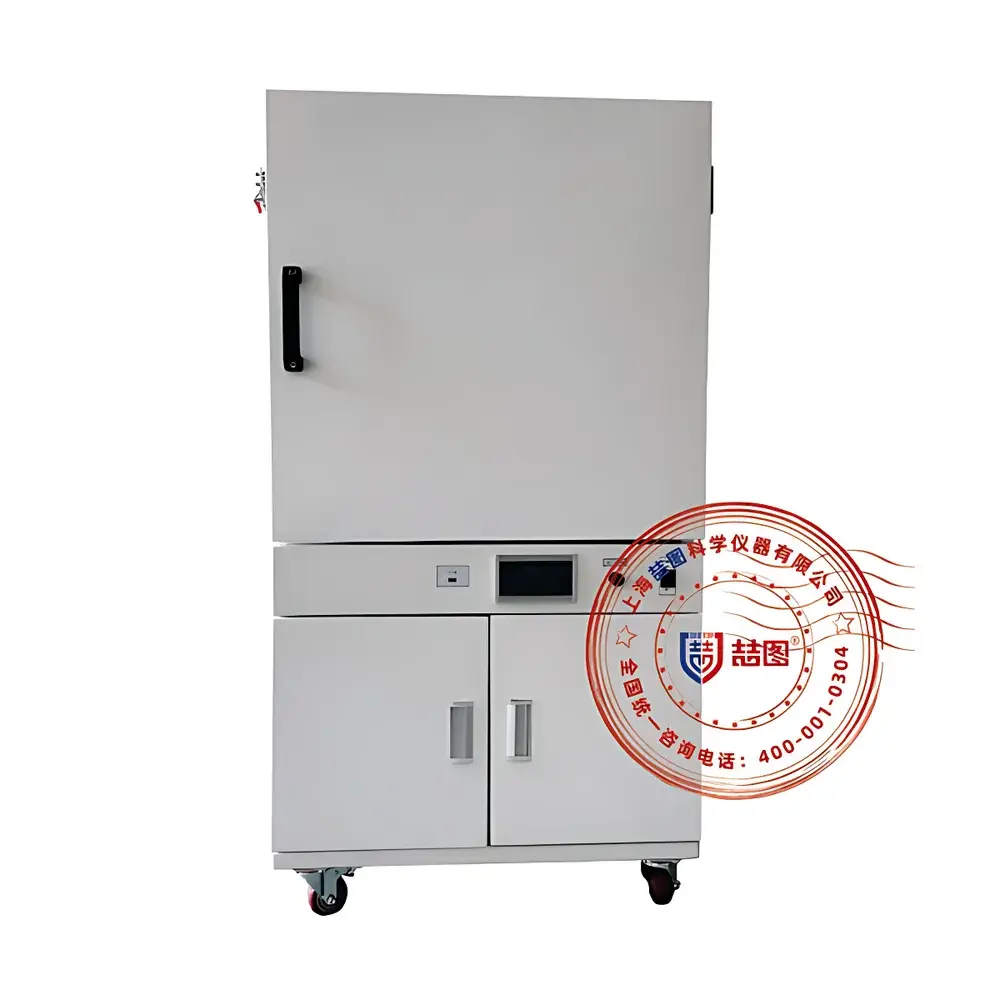
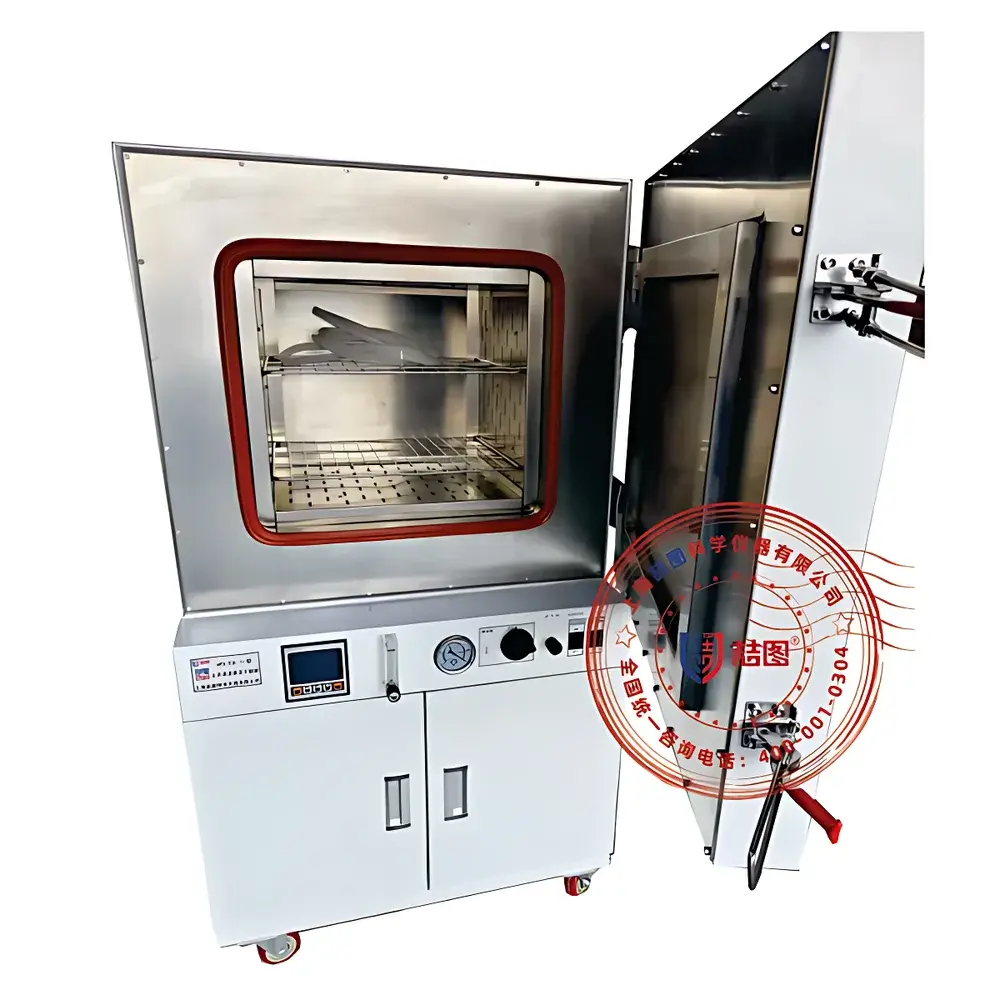
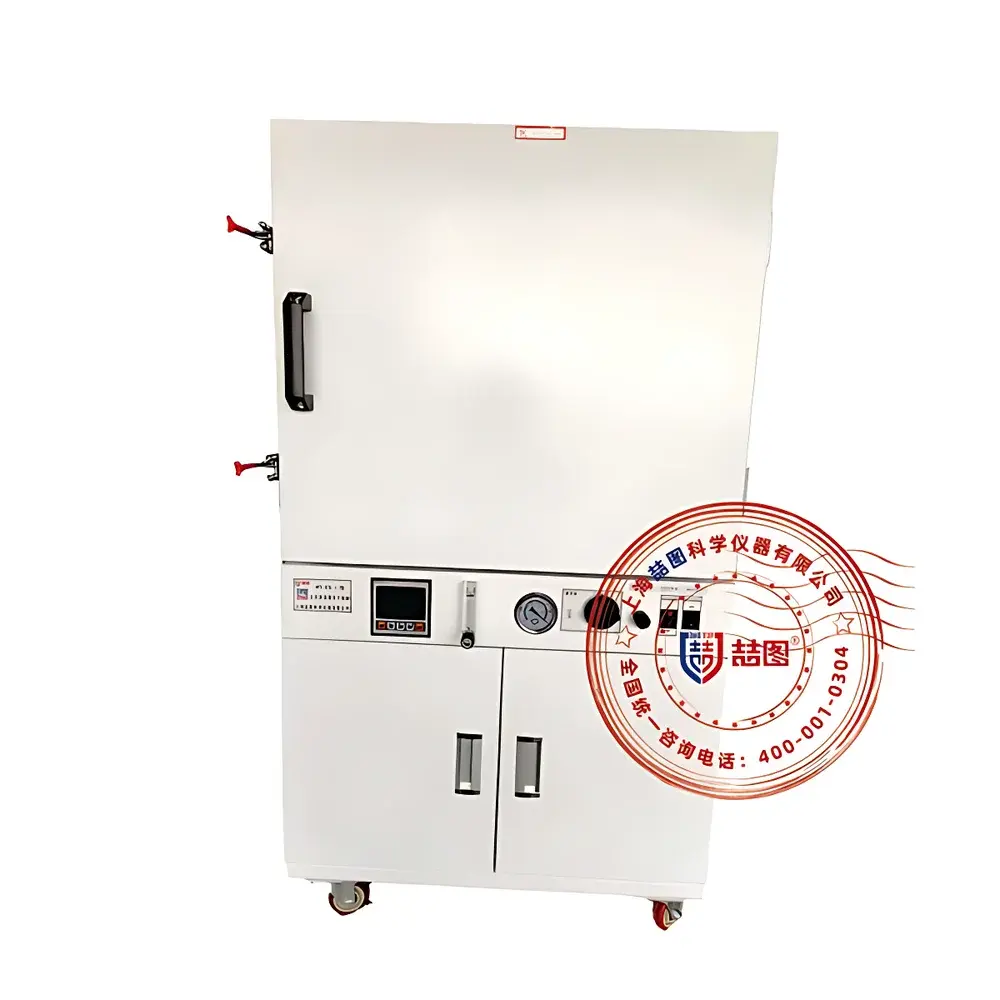
DRETOP TNF-6125VP Vertical Vacuum Drying Oven
| Brand | DRETOP |
|---|---|
| Origin | Shanghai, China |
| Manufacturer Type | Direct Manufacturer |
| Instrument Type | Vacuum Oven |
| Temperature Range | RT +10 to 250 °C |
| Temperature Uniformity | ±1 °C |
| Temperature Fluctuation | ±0.5 °C |
| Temperature Resolution | 0.1 °C |
| Vacuum Level | ≤133 Pa |
| Internal Chamber Dimensions (W×D×H) | 500×500×500 mm |
| External Dimensions (W×D×H) | 825×690×1420 mm |
| Inner Chamber Material | 304 Stainless Steel |
| Heating Method | Internal Heating |
| Working Ambient Temperature | 5–40 °C |
| Insulation Material | Glass Fiber |
| Safety Protections | Over-temperature alarm, over-current protection, short-circuit protection, leakage current protection, power-failure data retention |
Overview
The DRETOP TNF-6125VP Vertical Vacuum Drying Oven is an engineered solution for precision thermal processing under controlled low-pressure environments. It operates on the principle of vacuum-assisted convective and conductive heat transfer—removing ambient air via integrated vacuum pump interface (optional) to suppress oxidation, inhibit thermal decomposition, and eliminate moisture without phase transition interference. Unlike atmospheric ovens, this system maintains a stable vacuum level ≤133 Pa throughout operation, enabling solvent removal at reduced boiling points and preserving structural integrity of thermally labile compounds. Designed for laboratories requiring reproducible, contamination-free drying protocols, the TNF-6125VP meets foundational requirements for GLP-compliant workflows in pharmaceutical development, battery material synthesis, semiconductor packaging, and biomolecular stabilization.
Key Features
- Internal heating architecture with embedded stainless-steel heating elements ensures minimal air movement inside the chamber—critical for handling fine powders, nanoparticles, or fragile crystalline samples without dispersion or cross-contamination.
- Microprocessor-based PID temperature controller with 0.1 °C resolution and ±0.5 °C fluctuation tolerance delivers high repeatability across extended dwell cycles; programmable timer supports up to 9999 minutes.
- Double-layer tempered glass observation window with silicone-sealed gasket enables real-time visual monitoring while maintaining vacuum integrity and thermal insulation.
- 304 stainless steel interior chamber (500 × 500 × 500 mm) resists corrosion from organic solvents, acids, and alkaline residues; smooth-welded seams prevent particle accumulation and simplify cleaning validation.
- Dual-stage mechanical lock mechanism with zinc-alloy handle ensures uniform compression of fluorosilicone door seal, achieving consistent vacuum hold-down performance over repeated cycling.
- Comprehensive safety suite includes over-temperature cut-off, ground-fault circuit interruption, thermal fuse backup, and non-volatile memory that retains setpoints and runtime parameters after unexpected power loss.
Sample Compatibility & Compliance
The TNF-6125VP accommodates diverse sample formats—including lyophilized biologics, cathode/anode slurries for Li-ion batteries, photoresist-coated wafers, herbal extracts, and polymer composites—without risk of surface oxidation or volatile loss. Its internal heating configuration minimizes thermal gradients, satisfying ASTM E2234–22 criteria for uniformity assessment in vacuum thermal equipment. The unit complies with IEC 61000-6-3 (EMC emissions) and IEC 61000-6-2 (immunity), and its electrical design conforms to UL 61010-1 and GB 4793.1 safety standards. When paired with optional inert gas inlet valves (N₂ or Ar), it supports ISO 8573-1 Class 2 compressed air purity protocols for oxygen-sensitive applications.
Software & Data Management
While the base model features a high-contrast LCD interface with tri-color status indicators (green/amber/red), optional RS485 serial communication enables integration into centralized lab management systems. With compatible SCADA or LIMS platforms, users can log temperature profiles, vacuum decay curves, and cycle timestamps with audit-trail capability—fully aligned with FDA 21 CFR Part 11 requirements for electronic records and signatures. Optional embedded thermal printers provide hard-copy verification of each drying run, including start/end times, max/min temperatures, and final vacuum pressure—supporting traceability in GMP-regulated QC labs.
Applications
- Pharmaceutical R&D: Residual solvent removal from active pharmaceutical ingredients (APIs) per ICH Q5C guidelines; moisture content reduction in sterile powder formulations prior to vial sealing.
- Electrochemical Materials: Drying of NMC, LFP, and silicon-anode slurries under inert vacuum to prevent premature SEI formation and ensure electrode homogeneity.
- Microelectronics: Degassing of encapsulants and conformal coatings pre-cure; post-lithography resist baking without micro-bubble entrapment.
- Academic Research: Thermal stabilization of MOFs, perovskites, and enzymatic scaffolds where ambient oxygen exposure compromises catalytic activity or crystal lattice fidelity.
- Environmental Testing: Gravimetric analysis of total suspended solids (TSS) and volatile suspended solids (VSS) in wastewater per APHA Standard Methods 2540G.
FAQ
What distinguishes internal heating from external heating in vacuum ovens?
Internal heating eliminates convective airflow by embedding resistance wires directly into chamber walls or shelves—ideal for ultrafine powders, nanomaterials, or biological specimens prone to displacement. External heating routes heat through double-wall conduction, offering easier cleaning but introducing minor turbulence during pump-down phases.
Can the TNF-6125VP be validated for IQ/OQ/PQ protocols?
Yes. Its stable temperature uniformity (±1 °C), documented calibration traceability path, and configurable data logging support full qualification under ISO/IEC 17025 and ASTM E2877–21 frameworks.
Is vacuum pump included with the system?
No. A compatible two-stage rotary vane pump (e.g., DRETOP D8 or D16 series) is available as an optional accessory; pump selection must align with required ultimate vacuum and vapor load capacity.
Does the oven support inert atmosphere purging?
Yes—via optional mass-flow-controlled inert gas inlet kits, enabling nitrogen or argon backfilling to <100 ppm O₂ residual levels before or after drying cycles.
What maintenance intervals are recommended for long-term reliability?
Vacuum seal inspection every 6 months; door gasket replacement every 12–18 months depending on usage frequency; annual verification of temperature sensor accuracy against NIST-traceable reference standard.



