
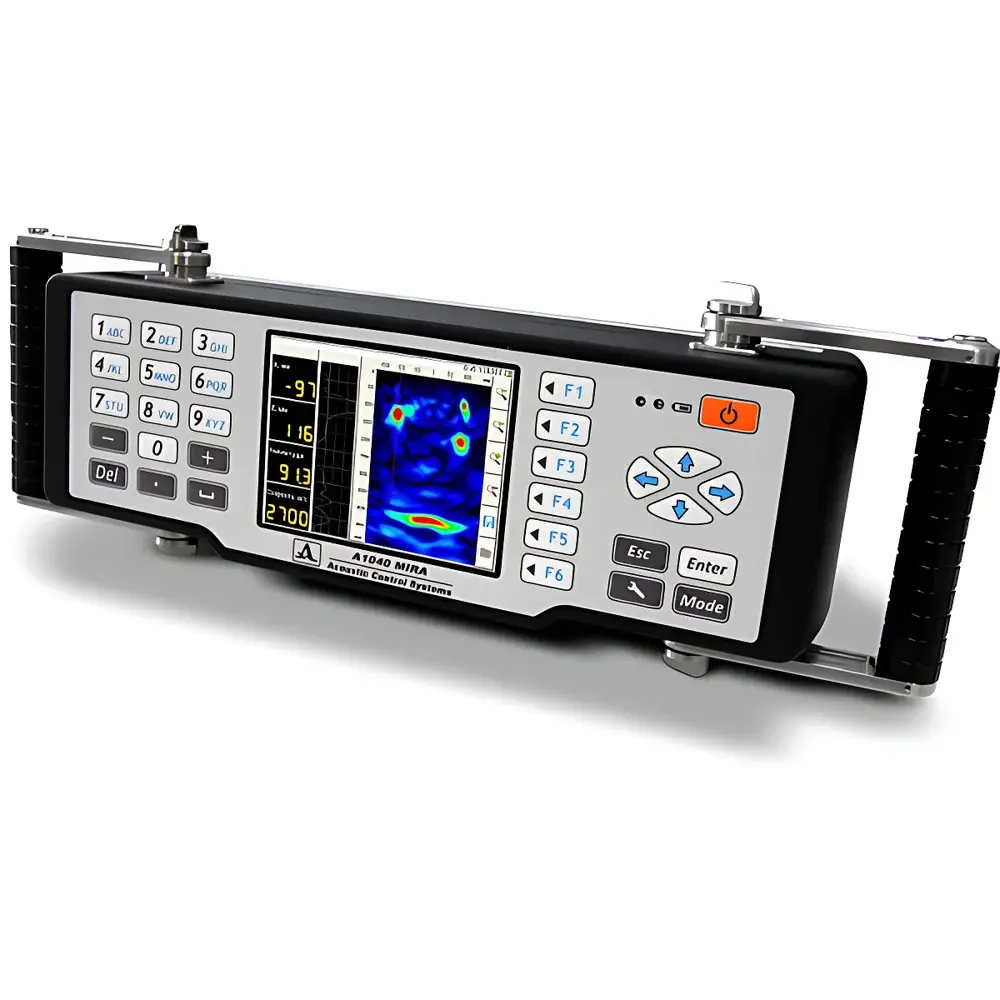
ACS MIRA A1040 Portable 3D Ultrasonic Imaging System for Concrete Inspection
| Brand | ACS |
|---|---|
| Origin | Russia |
| Manufacturer Type | Authorized Distributor |
| Origin Category | Imported |
| Model | A1040 MIRA |
| Pricing | Upon Request |
Overview
The ACS MIRA A1040 is a portable, single-sided ultrasonic tomographic imaging system engineered specifically for non-destructive evaluation (NDE) of reinforced concrete structures. Unlike conventional pulse-echo or through-transmission ultrasound methods requiring access to both sides of the test object, the MIRA A1040 employs an array-based shear-wave transmission technique with dry-point acoustic coupling—enabling high-fidelity volumetric reconstruction from one surface only. Its core measurement principle relies on time-of-flight (ToF) analysis of low-frequency shear waves (center frequency: 50 kHz) propagating through heterogeneous concrete media. The system reconstructs internal discontinuities—including voids, delaminations, grouting defects, and rebar positions—via synthetic aperture focusing and iterative tomographic inversion algorithms embedded in its onboard processing unit. Designed for field deployment in infrastructure diagnostics, the MIRA A1040 meets the operational demands of bridge deck assessment, tunnel lining integrity verification, and post-tensioning duct quality control under real-world site constraints.
Key Features
- Single-sided inspection capability: No opposite-side access required—ideal for slabs, walls, tunnel linings, and precast elements.
- 48-element transducer array (12 rows × 4 columns) with independent spring-suspended ceramic-faced shear-wave transducers for consistent coupling on rough, uneven, or contaminated surfaces.
- Dry-point contact operation: Eliminates need for liquid couplants, surface grinding, or moisture conditioning—reducing preparation time and enabling rapid survey workflows.
- Onboard tomographic reconstruction engine: Real-time B-scan generation and full 3D volume synthesis (B-, C-, and D-scan modalities) without external hardware dependency during acquisition.
- Ruggedized polymer housing with IP54-rated ingress protection and shock-absorbing design for sustained use in construction environments.
- Integrated data storage: Internal flash memory retains raw waveform datasets, scan metadata, GPS-tagged location stamps (optional), and processed images for traceable archiving.
- Shear-wave velocity auto-calculation: Derives local wave speed maps across the scanned volume—supporting estimation of concrete homogeneity, density variation, and early-age strength correlation per ASTM C597 and EN 12504-4 guidelines.
Sample Compatibility & Compliance
The MIRA A1040 is validated for use on standard Portland cement-based concretes (normal, lightweight, and fiber-reinforced), masonry units, and shotcrete substrates with compressive strengths ranging from 15 MPa to 60 MPa. It detects cylindrical discontinuities ≥10 mm in diameter and spherical anomalies ≥25 mm in diameter at depths up to 600 mm—subject to aggregate size distribution and reinforcement density. The system complies with ISO 12715:2021 (Ultrasonic testing — Terminology), EN 13791:2019 (Assessment of in-situ compressive strength), and supports documentation workflows aligned with ISO/IEC 17025:2017 (testing laboratory competence). While not FDA-regulated, its data integrity architecture—including immutable file timestamps, checksum-verified export protocols, and audit-ready log files—facilitates adoption in GLP-compliant structural health monitoring programs.
Software & Data Management
Data acquired by the MIRA A1040 is exported via USB 2.0 to Windows-based workstations running the proprietary MIRA View Suite v4.x. This desktop application enables advanced post-processing: slice alignment correction, amplitude thresholding, depth-gated filtering, coordinate-based defect localization (X/Y/Z in mm relative to scan origin), and export of orthogonal cross-sections (B-scans), plan-view projections (C-scans), and volumetric renderings (D-scans) in DICOM, PNG, CSV, and proprietary .MIRA binary formats. All processing steps are logged with user ID, timestamp, and parameter settings—ensuring full traceability per ISO 9001:2015 and supporting Part 11–compliant electronic record retention when deployed with validated IT infrastructure.
Applications
- Non-destructive thickness mapping of bridge decks, parking structures, and marine pilings.
- Detection and spatial quantification of grout voids in post-tensioning ducts—critical for verifying tendon corrosion protection per AASHTO LRFD Bridge Design Specifications.
- Identification of delamination and debonding at concrete–steel or concrete–asphalt interfaces.
- Locating honeycombing, air pockets, and casting defects in cast-in-place and precast concrete elements.
- Subsurface void detection beneath roadways, airport pavements, and tunnel invert slabs.
- Rebar spacing and cover depth estimation—supplementing electromagnetic induction methods where ferromagnetic interference is present.
FAQ
What is the maximum detectable depth for voids in standard concrete?
Typical effective penetration depth is 400–600 mm depending on aggregate size (max. 20 mm nominal), water-cement ratio, and presence of dense rebar mesh.
Does the system require calibration against reference standards before each use?
No routine recalibration is needed; factory calibration is retained across power cycles. Optional annual verification using NIST-traceable concrete phantoms is recommended for QA/QC compliance.
Can the MIRA A1040 distinguish between water-filled and air-filled voids?
Yes—differences in shear-wave attenuation and phase velocity allow qualitative differentiation, though quantitative fluid identification requires supplementary GPR or dielectric profiling.
Is the device certified for use in explosive atmospheres (ATEX/IECEx)?
No—MIRA A1040 is rated for general industrial environments only (IEC 60529 IP54); it is not intrinsically safe for Zone 1/2 hazardous locations.
How is data security and integrity ensured during transfer and archival?
All exported datasets include SHA-256 hash signatures; the MIRA View Suite enforces write-once-read-many (WORM) export modes and supports integration with enterprise document management systems via RESTful API.



