
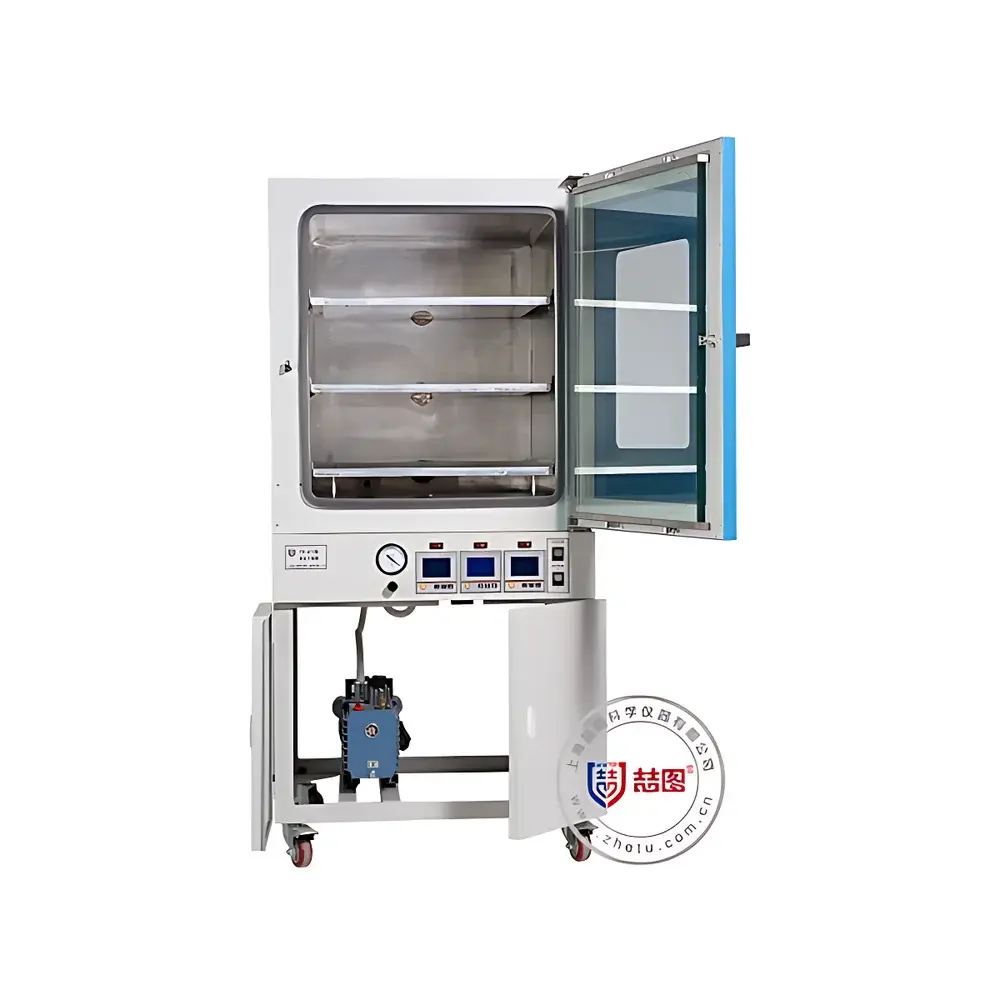
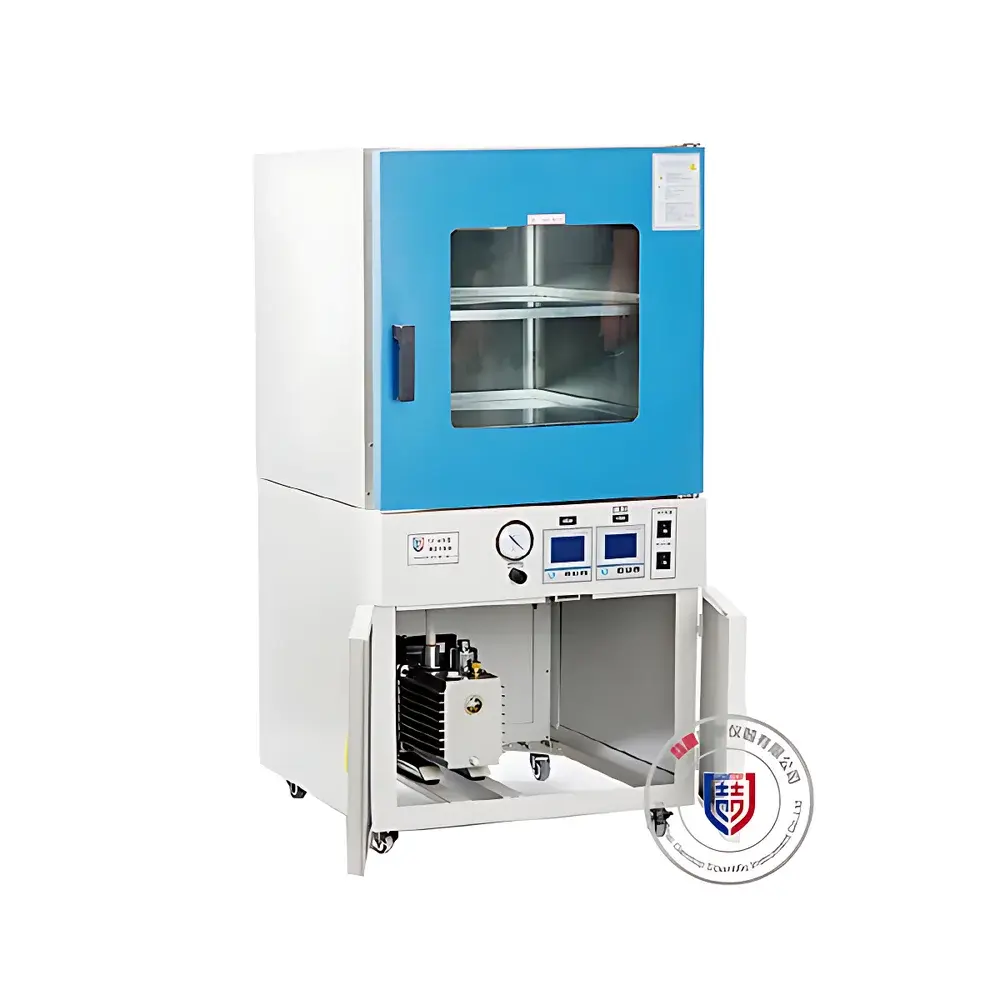
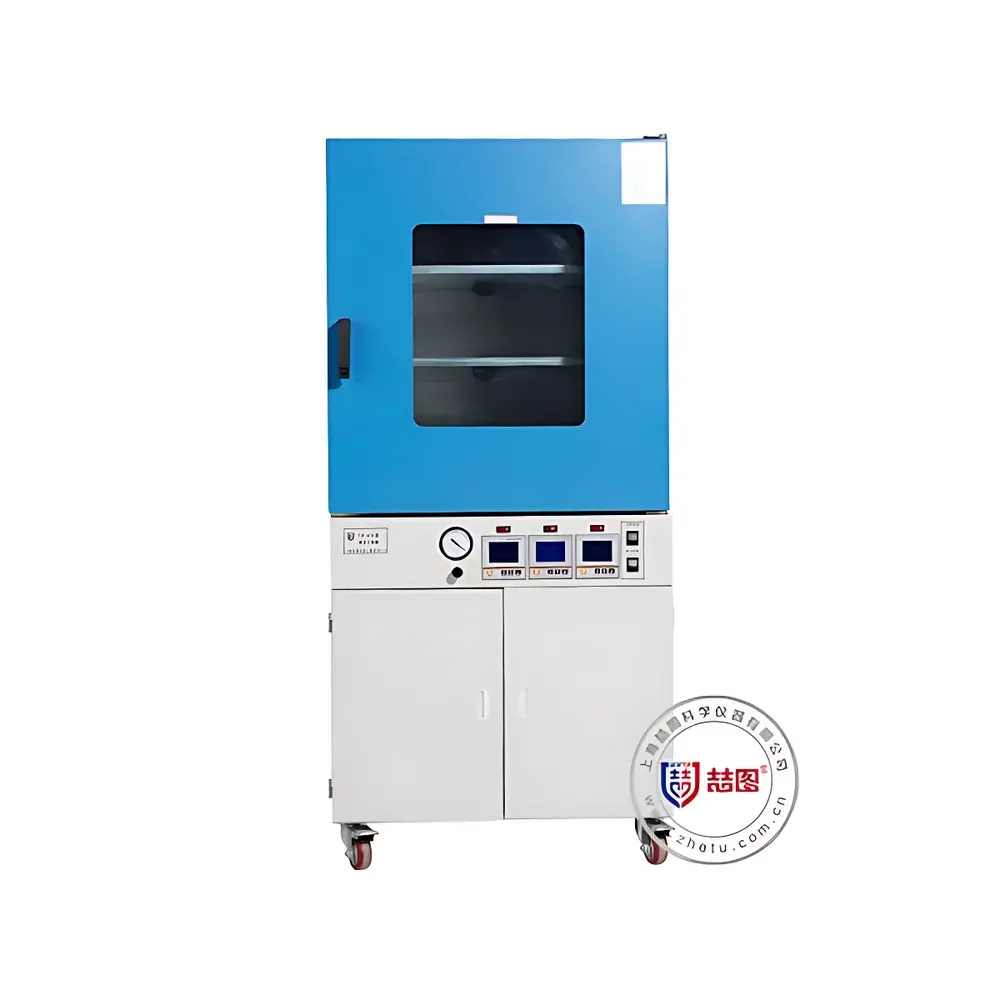
DRETOP TZF-6090LU Vertical Vacuum Drying Oven
| Brand | DRETOP |
|---|---|
| Origin | Shanghai, China |
| Manufacturer Type | Direct Manufacturer |
| Instrument Type | Vacuum Oven |
| Temperature Range | RT+10 to 300 °C |
| Temperature Uniformity | ±1 °C |
| Temperature Fluctuation | ±0.5 °C |
| Temperature Resolution | 0.1 °C |
| Vacuum Degree | ≤133 Pa |
| Internal Chamber Dimensions | 450 × 450 × 450 mm (W×D×H) |
| External Dimensions | 615 × 590 × 1235 mm (W×D×H) |
| Chamber Material | 304 Stainless Steel |
| Heating Method | External Four-Side Radiant Heating |
| Operating Ambient Temperature | +5 to 40 °C |
| Insulation | Glass Fiber Mat |
| Safety Protections | Overheat, Overcurrent, Short-Circuit, Leakage, and Power-Failure Data Retention |
Overview
The DRETOP TZF-6090LU is a vertically configured, microprocessor-controlled vacuum drying oven engineered for precision thermal processing under reduced-pressure environments. It operates on the principle of lowering the partial pressure of water vapor inside the chamber—via integrated vacuum pumping—to significantly reduce the boiling point of solvents and moisture, enabling gentle, low-temperature drying of thermally sensitive, oxygen-sensitive, or chemically unstable materials. Unlike conventional convection ovens, this system eliminates oxidative degradation, prevents surface hardening, suppresses foaming or bubbling in viscous or porous samples, and avoids mechanical disturbance of fine particulates or fragile structures. Its design conforms to fundamental requirements for vacuum thermal treatment in R&D and production-grade applications across semiconductor fabrication, lithium-ion battery electrode conditioning, optoelectronic component curing, pharmaceutical lyophilization pre-drying, and analytical sample preparation where residual solvent content, structural integrity, and chemical purity are critical.
Key Features
- Stainless steel (304) seamless inner chamber with reinforced double-layer tempered glass observation window—providing real-time visual monitoring without compromising vacuum integrity.
- Four-side external radiant heating system: heating elements embedded in the chamber walls ensure uniform thermal distribution, eliminate risk of vacuum arcing or carbon deposition, and support stable operation at up to 300 °C.
- Intelligent P.I.D. temperature controller with LCD interface, 0.1 °C resolution, ±0.5 °C fluctuation tolerance, and programmable timer (1–9999 minutes).
- Two-stage rotary locking mechanism with zinc alloy handle and high-compression silicone gasket—guaranteeing long-term vacuum seal performance down to ≤133 Pa.
- Modular drawer-type stainless steel shelving with adjustable height spacing—facilitating flexible load configuration and rapid cleaning.
- Comprehensive safety architecture: dual-limit overtemperature protection, ground-fault circuit interruption, thermal cutoff, and non-volatile memory retention for setpoints and runtime data during power interruption.
- Energy-efficient insulation using high-density glass fiber mat between chamber and outer casing—reducing standby heat loss and improving thermal stability.
Sample Compatibility & Compliance
The TZF-6090LU accommodates a broad spectrum of sample forms—including powders, granules, thin films, coated wafers, biological tissues, polymer composites, and small-volume liquid residues—without mechanical agitation or oxidation-induced decomposition. Its inert vacuum environment supports ASTM E145-22 (Standard Specification for Gravity-Convection and Forced-Ventilation Ovens) and ISO 12780-1:2021 (Determination of moisture content—Vacuum drying method), and is routinely deployed in GLP-compliant laboratories for pre-analytical sample conditioning. While not intrinsically certified for FDA 21 CFR Part 11, its optional RS485/USB data logging interface enables integration with validated LIMS or ELN systems supporting audit-trail generation when paired with compliant software.
Software & Data Management
The standard control system features a multi-parameter LCD display showing real-time chamber temperature, setpoint, elapsed time, and vacuum status. Optional upgrades include programmable P-series controllers or full-color touch-screen interfaces capable of storing ≥10 multi-step drying profiles—each defining ramp rates, dwell durations, vacuum hold periods, and inert gas purge sequences. All variants support parameter recall, error-code diagnostics (e.g., E01 = sensor open circuit, E03 = overtemperature), and configurable alarm thresholds. Data export via USB flash drive (optional) allows traceable recordkeeping aligned with internal QA protocols; analog output (4–20 mA) and Modbus RTU over RS485 enable centralized SCADA integration.
Applications
- Semiconductor manufacturing: post-lithography bake, photoresist stabilization, and wafer-level moisture removal prior to encapsulation.
- Lithium battery R&D: cathode/anode electrode drying under nitrogen-purged vacuum to minimize Li₂CO₃ formation and improve interfacial adhesion.
- LED packaging: epoxy and silicone curing with minimized void formation and stress-induced delamination.
- Pharmaceutical development: active pharmaceutical ingredient (API) drying, excipient moisture profiling, and stability study sample conditioning per ICH Q1A(R3).
- Materials science: solvent removal from MOFs, aerogels, and nanocomposites without structural collapse.
- Environmental testing labs: soil/sediment moisture analysis per EPA Method 5035B (vacuum-assisted purging and trapping).
FAQ
What vacuum level does the TZF-6090LU achieve, and how is it measured?
The chamber achieves a base pressure of ≤133 Pa (1 Torr) using a standard 2 L/s rotary vane pump; vacuum level is monitored via an analog Bourdon-tube gauge (Class 1.6 accuracy) as standard, with digital vacuum meters (±5 Pa repeatability) available as optional accessories.
Can inert gas be introduced during operation?
Yes—an optional inert gas inlet valve (N₂ or Ar) allows controlled backfilling to atmospheric or sub-atmospheric partial pressures; flow regulation requires separate mass flow controller (not included).
Is the unit compatible with cold trap integration?
Yes—KF-flanged cold traps (e.g., −40 °C condenser units) can be installed between the chamber and vacuum pump to capture volatile solvents and protect pump oil integrity.
What maintenance intervals are recommended for the vacuum system?
Rotary vane pump oil should be changed every 200 operating hours or quarterly (whichever occurs first); silicone door gaskets require inspection and replacement every 12 months under continuous use.
Does the oven support validation documentation (IQ/OQ/PQ)?
DRETOP provides factory calibration certificates (traceable to NIST standards) and mechanical verification reports; full qualification packages—including sensor mapping, vacuum decay testing, and temperature uniformity surveys—can be performed onsite by authorized service engineers upon request.



