
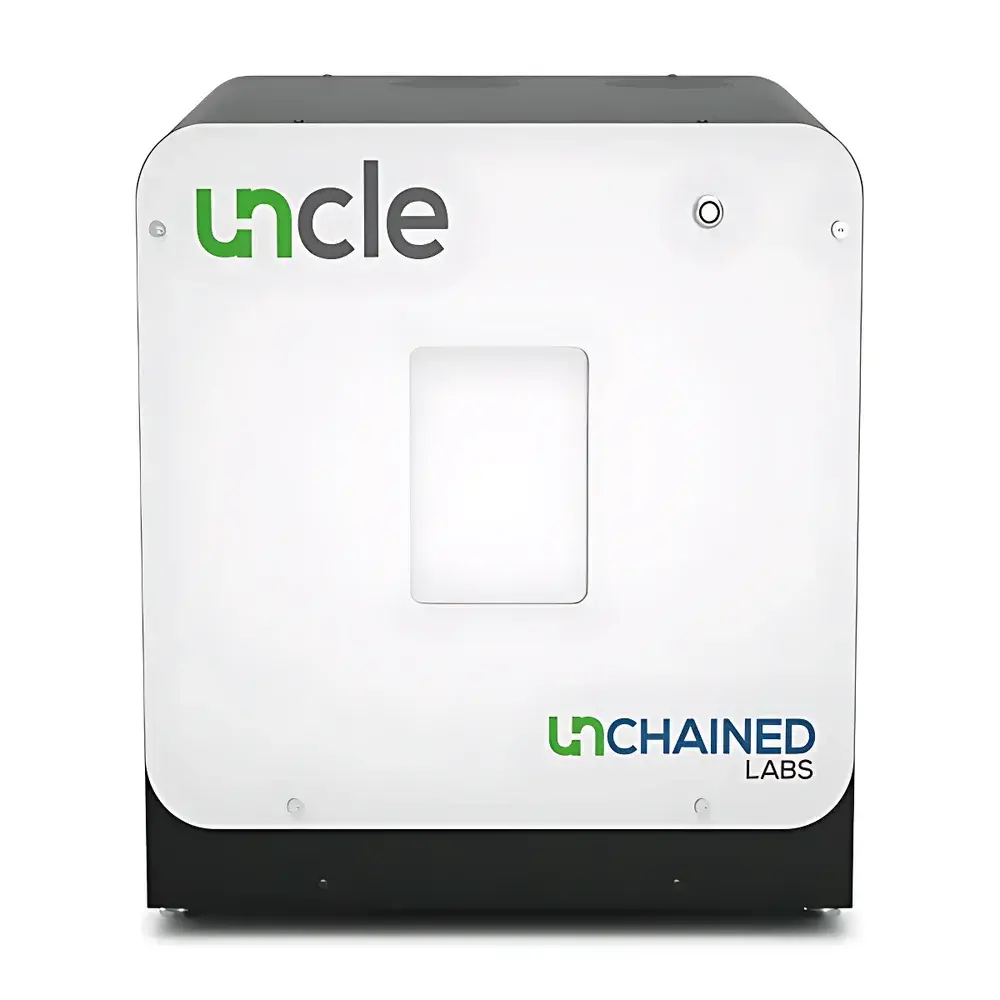
Unchained Labs Uncle Protein Stability Analyzer
| Brand | Unchained Labs |
|---|---|
| Origin | Belgium |
| Manufacturer Type | Manufacturer |
| Origin Category | Imported |
| Model | Uncle |
| Instrument Principle | Differential Scanning Fluorescence (DSF) |
| Measured Parameters | Tm, Tagg, Tonset, Isothermal Stability, Viral Capsid Stability, Viral Genome Release Temperature, Dye-based Tm (DSF), Hydrodynamic Size & Polydispersity Index (PDI), Tsize, Tagg660, Thermal Refolding Assay, Viscosity, kD, B22, G22, ΔG |
| Sample Volume | 9 µL |
| Protein Concentration Range | 0.05–300 mg/mL |
| Temperature Control Range | 15–95 °C |
| Sample Capacity | 48 samples |
| Sample Introduction Method | Quartz Capillaries |
| 21 CFR Part 11 Compliance | Yes |
| Dimensions | 54 cm × 50 cm × 58 cm |
Overview
The Unchained Labs Uncle Protein Stability Analyzer is an integrated, benchtop stability assessment platform engineered for high-throughput, multi-parameter biophysical characterization of therapeutic proteins, antibodies, viral vectors, and other biologics. Unlike conventional single-mode instruments—such as standalone DSF, DLS, or SLS systems—the Uncle leverages a unified optical architecture to simultaneously acquire data from three orthogonal biophysical techniques: Differential Scanning Fluorescence (DSF), Static Light Scattering (SLS), and Dynamic Light Scattering (DLS). This concurrent acquisition eliminates inter-instrument variability, reduces sample handling, and enables true cross-correlative analysis across thermal denaturation, aggregation onset, size distribution, and colloidal stability metrics—all within a single run. Designed for QC laboratories, formulation development teams, and early-stage biopharmaceutical R&D, the Uncle delivers reproducible, information-rich stability profiles with minimal material consumption (as low as 9 µL per measurement) and no requirement for labeling or immobilization.
Key Features
- Triple-Mode Simultaneous Detection: Real-time, synchronized acquisition of DSF (Tm, Tonset, Tagg), SLS (kD, B22, G22, ΔG), and DLS (hydrodynamic diameter, PDI, Tsize, Tagg660) under identical thermal ramp or isothermal conditions.
- Ultra-Low Sample Consumption: Optimized quartz capillary geometry and microfluidic path design enable robust measurements using only 9 µL of sample—critical for scarce clinical-grade or early-expressing candidates.
- Broad Concentration Flexibility: Validated performance across a dynamic range of 0.05–300 mg/mL, supporting both dilute discovery-phase screening and concentrated formulation studies without dilution artifacts.
- Comprehensive Thermal & Isothermal Protocols: Programmable temperature ramps (15–95 °C, ±0.1 °C control accuracy), hold steps, and multi-cycle refolding assays to assess reversibility and hysteresis behavior.
- Viral Vector-Specific Workflows: Dedicated modules for capsid integrity profiling (viral capsid stability), genome release temperature determination, and thermal resilience mapping—aligned with ICH Q5A and regulatory expectations for gene therapy products.
- FDA 21 CFR Part 11-Ready Architecture: Role-based user access, electronic signatures, full audit trail, and secure data storage compliant with GLP/GMP environments.
Sample Compatibility & Compliance
The Uncle accommodates native, unmodified proteins—including monoclonal antibodies, Fc-fusions, enzymes, and intrinsically disordered proteins—as well as complex biologics such as AAV, lentivirus, and lipid nanoparticles. Its label-free, solution-phase measurement approach avoids dye-binding artifacts common in traditional DSF and preserves native conformational dynamics. All assays are performed in standard 1-mm pathlength quartz capillaries compatible with automated loading systems. The platform adheres to ISO/IEC 17025 calibration traceability standards and supports method validation per ICH Q5C (stability testing of biotechnological/biological products) and USP <1117> (light scattering applications). Data integrity controls meet ALCOA+ principles, and system qualification documentation (IQ/OQ/PQ) is provided per client requirements.
Software & Data Management
Uncle Control Software v4.x provides intuitive assay setup, real-time visualization, and automated parameter extraction (e.g., Tm via first-derivative inflection, Tagg via SLS intensity threshold, PDI via cumulant fit). Raw data (intensity vs. temperature/time, correlation functions, scattering spectra) are stored in vendor-neutral HDF5 format with embedded metadata (instrument settings, user ID, timestamp, calibration logs). Integrated reporting tools generate PDF summaries compliant with internal SOPs or regulatory submissions. For enterprise deployment, optional integration with LIMS (via ASTM E1578-compliant API) and secure cloud backup (AES-256 encrypted) are available. All software modules undergo annual cybersecurity review and maintain compatibility with Windows 10/11 LTSB editions in validated lab environments.
Applications
- Formulation scouting and buffer optimization for improved shelf-life and freeze-thaw stability
- Comparability assessment across manufacturing lots and process changes
- Lead candidate ranking based on thermodynamic (ΔG), colloidal (kD, B22), and kinetic (Tagg, Tonset) stability indices
- Thermal refolding analysis to evaluate structural resilience after stress exposure
- Viral vector stability profiling for CMC development and regulatory filing (IND/BLA)
- High-concentration viscosity prediction (kD-derived) for subcutaneous delivery formulation
FAQ
Does Uncle require fluorescent dyes for DSF measurements?
No—Uncle supports intrinsic tryptophan fluorescence for label-free DSF. Exogenous dyes (e.g., SYPRO Orange) may be used optionally for enhanced sensitivity with low-tryptophan proteins.
Can Uncle distinguish between reversible and irreversible aggregation?
Yes—by combining thermal ramping with isothermal holds and post-ramp DLS/SLS re-measurement, users can quantify refolding yield and identify hysteresis, a key indicator of irreversibility.
Is method transfer possible between Uncle instruments?
Yes—hardware standardization, firmware version control, and calibrated optical alignment protocols ensure consistent results across global sites, supporting multi-center studies and tech transfer.
What maintenance is required for long-term operational reliability?
Annual optical alignment verification and capillary path cleaning are recommended; no consumables beyond quartz capillaries are required. Preventive maintenance kits and remote diagnostics support are included with service contracts.
How does Uncle handle highly viscous or turbid samples?
The dual-angle SLS detection (90° and 173°) and adaptive correlation algorithm mitigate multiple scattering effects, enabling reliable kD and B22 estimation up to ~50 cP viscosity and OD350 ≤ 1.5.




