
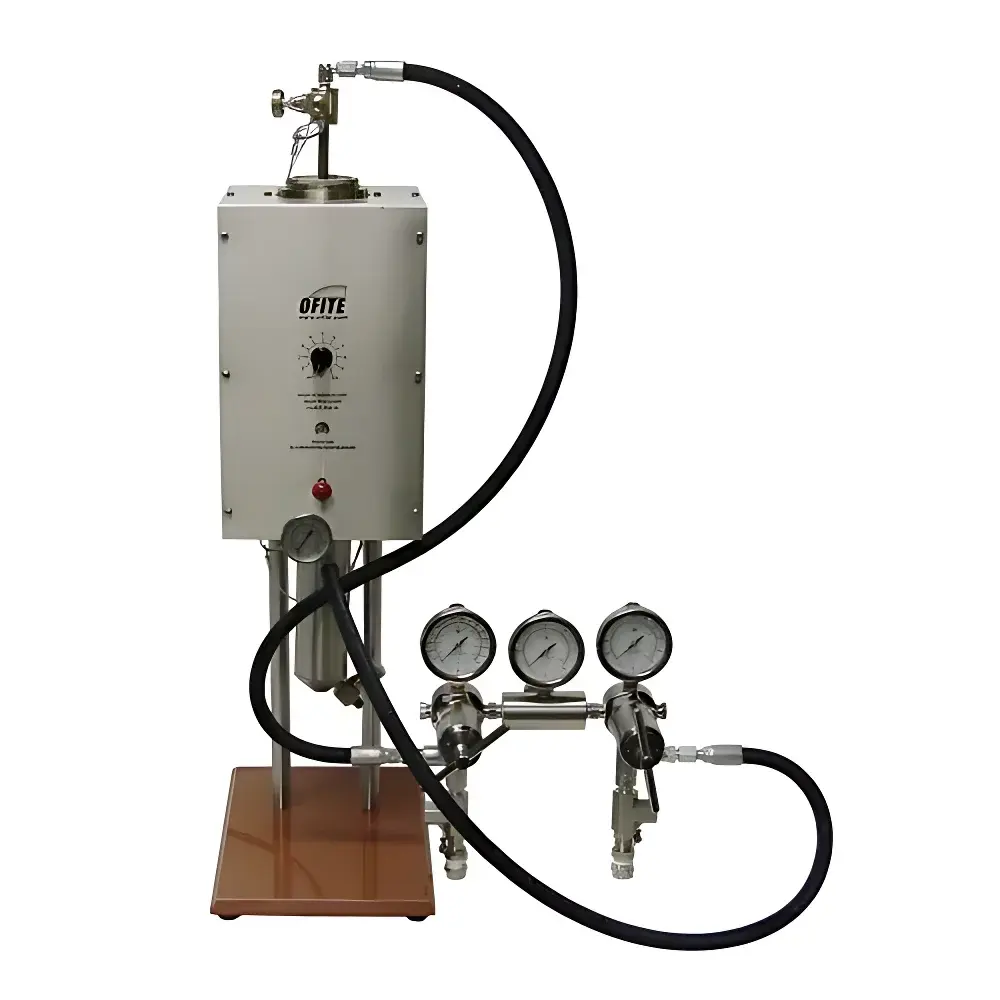
OFITE 171-04 / 171-192-1 High-Temperature High-Pressure Fluid Loss Tester (500 mL)
| Brand | OFITE |
|---|---|
| Origin | USA |
| Model | 171-04 / 171-192-1 |
| Max Temperature | 260 °C |
| Max Pressure | 2000 psi (standard tank) / 5000 psi (threaded tank) |
| Sample Volume | 500 mL |
| Heating Power | 800 W (four 200 W heaters) |
| Power Supply | 115–220 V AC, 50/60 Hz |
| Dimensions (W×D×H) | 25.4 × 45.7 × 106.7 cm |
| Weight | 24.1 kg |
| Pressure Source | Nitrogen (≥10.343 MPa / 1500 psi supply) |
Overview
The OFITE 171-04 and 171-192-1 High-Temperature High-Pressure (HTHP) Fluid Loss Testers are engineered for precise measurement of fluid loss behavior under simulated downhole conditions—critical for evaluating drilling fluids, cement slurries, and fracturing fluids in oilfield laboratory environments. These instruments operate on the principle of controlled-pressure filtration through standardized retention media (e.g., filter paper, ceramic discs, or cement screen assemblies), where filtrate volume is quantified over time under defined thermal and mechanical stress. The system maintains isothermal test conditions via a fully insulated, electrically heated jacket surrounding a robust pressure-rated test cell, while nitrogen gas serves as the inert, controllable pressure medium. Designed to ASTM D1309, API RP 13B-1, and ISO 10414-2 compliant testing protocols, the instrument supports reproducible evaluation of fluid loss control performance at temperatures up to 260 °C and pressures up to 5000 psi—enabling correlation with wellbore stability, formation damage potential, and rheological integrity under reservoir-representative conditions.
Key Features
- Modular threaded sample cell design (171-192-1 model) with interlocking cap geometry—mechanically prevents accidental opening under pressure and ensures safe, repeatable sealing at up to 5000 psi.
- Dual-pressure manifold with independent main and back-pressure regulators for accurate differential pressure control and stable filtration driving force.
- 800 W heating system comprising four independently monitored 200 W cartridge heaters, enabling rapid thermal equilibration and uniform temperature distribution across the 500 mL test chamber.
- Full traceability: Each pressure vessel carries certified material documentation, ASME-stamped pressure rating validation, and a unique serialized identifier for audit-ready compliance records.
- Electrical compatibility with global lab infrastructure: dual-voltage operation (115 V / 220 V, 50/60 Hz) and CE-compliant power interface.
- Cross-manufacturer interchangeability: Standardized flange dimensions, port threading (NPT), and mounting interfaces allow integration with third-party pressure transducers, data loggers, and safety interlocks.
Sample Compatibility & Compliance
The tester accommodates diverse sample types—including water-based, oil-based, and synthetic-based drilling muds; Class G/H cement slurries; and crosslinked polymer fracturing fluids—using interchangeable filtration assemblies. Standard configurations support API-standard filter papers (e.g., Whatman No. 50), porous ceramic discs (ASTM C20), and ASTM-specified cement screen meshes (API RP 10B-2). All operational procedures align with Good Laboratory Practice (GLP) requirements, and the system’s pressure containment architecture meets ASME BPVC Section VIII, Division 1 standards. Optional pressure transducer calibration kits and temperature sensor validation tools enable full traceability per ISO/IEC 17025 requirements. For regulated environments, the instrument supports integration with electronic lab notebooks (ELNs) that maintain FDA 21 CFR Part 11–compliant audit trails when paired with validated software platforms.
Software & Data Management
While the base unit operates manually via analog pressure and temperature readouts, it is fully compatible with third-party digital acquisition systems. Analog outputs (4–20 mA or 0–5 V) from optional RTD sensors and pressure transducers enable real-time streaming into SCADA-compatible DAQ hardware (e.g., National Instruments CompactDAQ or Keysight DAQ970A). Time-stamped filtrate volume measurements can be logged alongside temperature and differential pressure data for automated calculation of fluid loss coefficients (e.g., spurt loss, linear filtration rate, cake permeability). When used with validated LIMS or ELN platforms, all raw parameters—including operator ID, calibration dates, and environmental ambient logs—are retained for regulatory review and method verification reporting.
Applications
- Quantification of static fluid loss in cement slurries per API RP 10B-2 for primary cementing design validation.
- Evaluation of high-temperature thickener stability and fluid loss additive efficiency in deepwater and HPHT drilling fluid formulations.
- Screening of bridging agent effectiveness in fracture fluid systems under elevated thermal stress.
- Comparative assessment of filter cake quality and compressibility using ceramic disc filtration under variable differential pressure profiles.
- Support of QC/QA workflows in API-certified mud labs and cement testing facilities operating under ISO 9001:2015 quality management systems.
FAQ
What pressure sources are compatible with this instrument?
Nitrogen gas is the recommended inert pressure medium. A supply pressure of ≥1500 psi (10.343 MPa) is required to achieve full 5000 psi test pressure using the 171-192-1 threaded cell.
Can the same test cell be used for both drilling fluid and cement slurry testing?
Yes—the modular cap system allows rapid reconfiguration between filter paper, ceramic disc, and cement screen assemblies without requiring separate vessels.
Is third-party calibration support available?
OFITE provides NIST-traceable calibration certificates for pressure transducers and RTDs; field verification services are offered through authorized service partners in North America, EMEA, and APAC regions.
Does the instrument meet explosion-proof requirements for hazardous area use?
The base unit is rated for general laboratory use (non-classified location). Integration with intrinsically safe signal conditioners and purged enclosures enables deployment in Zone 2/Class I Div 2 environments when specified during ordering.
How is thermal uniformity verified during operation?
Each heater zone is individually monitored via embedded Pt100 RTDs; temperature deviation across the test chamber is ≤±2 °C at steady state (260 °C), verified per ASTM E740 thermal mapping protocol.






