
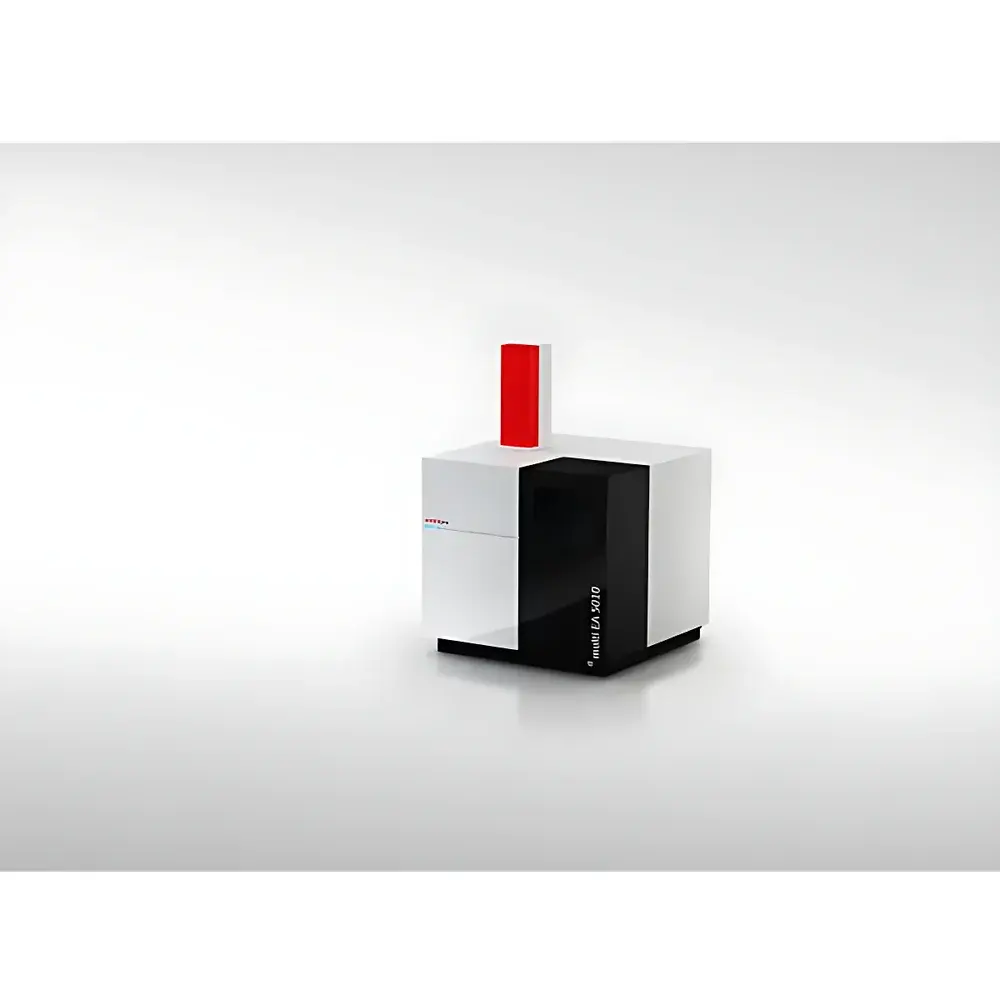
Analytik Jena multi EA 5010 N Carbon, Sulfur, Nitrogen and Halogen Elemental Analyzer
| Brand | Analytik Jena |
|---|---|
| Origin | Germany |
| Model | multi EA 5010 N |
| Measurement Principle | High-Temperature Combustion Coupled with Chemiluminescence (N), UV-Fluorescence (S), and Microcoulometric Titration (Cl/Br) |
| Detection Limits | Sub-ppb for N and S in liquid/gas matrices |
| Analysis Time | 2–5 min per sample |
| Sample Types | Liquids, Gases, LPG, LNG, Solids (with optional solid module) |
| Automation | Unattended 24/7 operation with remote monitoring capability |
| Dimensions | < 0.3 m² footprint |
| Interface | Integrated 10.1" capacitive touchscreen with intuitive GUI |
| Detection Technology | HiPerSens™ optimized signal processing |
| Compliance | Designed to meet ISO 14852, ISO 14855, ASTM D5762, D7183, D7556, USP <381>, and EPA Method 524/525/5310C requirements |
Overview
The Analytik Jena multi EA 5010 N is a high-performance, modular elemental combustion analyzer engineered for the simultaneous or independent quantification of carbon, sulfur, nitrogen, and halogens (chlorine, bromine) in diverse environmental and industrial matrices. Unlike conventional single-element analyzers, this system integrates three orthogonal detection technologies within a unified high-temperature combustion platform (up to 1,150 °C): chemiluminescence detection (CLD) for nitrogen oxides (NOx), ultraviolet fluorescence (UVF) for sulfur dioxide (SO2), and microcoulometric titration for reactive halogens (Cl/Br). This architecture enables trace-level analysis across heterogeneous sample types—including aqueous solutions, hydrocarbon liquids, liquefied petroleum gas (LPG), liquefied natural gas (LNG), and solid particulates—without cross-interference or method reconfiguration. The instrument operates on the principle of complete oxidative pyrolysis under controlled oxygen-rich conditions, followed by selective, real-time gas-phase detection with digital signal optimization via HiPerSens™ firmware. Its design prioritizes regulatory readiness, analytical robustness, and operational autonomy—making it suitable for accredited environmental testing laboratories, refinery QC labs, and contract research organizations performing routine compliance monitoring.
Key Features
- Triple-detection capability: Simultaneous N/S/halogen analysis in a single run using CLD, UVF, and microcoulometric modules—eliminating sequential instrument switching.
- Sub-ppb detection limits: Achieves ≤0.05 ppb N and ≤0.02 ppb S in liquid standards; validated linear dynamic range spans 4–5 orders of magnitude (e.g., 0.05 ppb to 100 ppm).
- Automated 24/7 operation: Integrated autosampler (up to 120 positions), self-diagnostic routines, and predictive maintenance alerts reduce manual intervention.
- Remote accessibility: Web-based instrument control and data review via secure HTTPS interface; compatible with LIMS integration through ASTM E1384-compliant export protocols.
- Compact footprint & modular scalability: Occupies < 0.3 m²; optional solid-sample combustion module (multi EA 5010 SP) and halogen-specific calibration kits extend application scope.
- Touchscreen-driven workflow: 10.1-inch capacitive display with context-sensitive guidance, method wizard, and real-time chromatogram visualization.
Sample Compatibility & Compliance
The multi EA 5010 N accommodates liquid samples (aqueous, organic solvents, fuels), gaseous streams (via gas loop injection), and volatile cryogenic media (LPG/LNG) without derivatization or pre-concentration. Solid samples require optional quartz boat handling and ash-free combustion aids but remain fully supported under ISO 14855-2 and ASTM D7556 protocols. All measurement modes are aligned with internationally recognized standard methods: nitrogen analysis complies with ASTM D5762 (Kjeldahl alternative) and ISO 14852 (aerobic biodegradability); sulfur determination satisfies ASTM D7183 (diesel fuel) and EPA Method 524 (VOCs in water); chlorine/bromine quantification adheres to USP (halogenated impurities in pharmaceuticals) and EPA Method 5310C (adsorbable organic halides). Full audit trail functionality—including user login logs, parameter change history, and raw signal timestamps—meets FDA 21 CFR Part 11 and GLP/GMP data integrity requirements.
Software & Data Management
The embedded EA Control Software v4.x provides method development, sequence programming, real-time peak integration, and automated report generation (PDF/CSV/XLSX). Calibration curves support multi-point non-linear regression (quadratic, cubic) with residual diagnostics. Raw detector signals are stored in vendor-neutral HDF5 format, enabling third-party spectral reprocessing. Data security features include role-based access control (RBAC), electronic signatures, and encrypted database backups. Integration with enterprise LIMS is achieved via ODBC drivers and configurable XML schema mapping—ensuring seamless transfer of metadata, results, and QC flags (e.g., system suitability pass/fail status).
Applications
- Environmental water testing: Quantification of total nitrogen (TN), total oxidized nitrogen (TON), and adsorbable organic halides (AOX) in wastewater, surface water, and drinking water per EU Directive 2000/60/EC.
- Petroleum product certification: Sulfur content verification in gasoline, diesel, and marine fuels against ISO 8217 and IMO 2020 sulfur cap regulations.
- Pharmaceutical impurity profiling: Residual halogenated solvents (e.g., chloroform, dichloromethane) in APIs per ICH Q3C guidelines.
- Plastics & polymer recycling: Halogen screening in e-waste shredder fractions and PVC-containing feedstocks for RoHS/REACH compliance.
- Geochemical research: Total organic carbon (TOC)/total nitrogen (TN) ratios in sediment cores and porewater extracts.
FAQ
What detection technologies are used for nitrogen, sulfur, and halogens?
Nitrogen is measured via chemiluminescence detection (CLD) of NOx generated during high-temperature combustion; sulfur is quantified by UV fluorescence (UVF) of SO2; halogens (Cl/Br) are determined by microcoulometric titration following thermal conversion to AgCl/AgBr.
Can the instrument analyze solid samples without modification?
No—solid sample analysis requires the optional multi EA 5010 SP module, which includes a ceramic combustion tube, quartz boat handling mechanism, and ash-tolerant catalyst configuration.
Is the system compliant with FDA 21 CFR Part 11?
Yes—the software implements full electronic signature support, audit trail logging, and data immutability controls required for regulated environments.
How is calibration verified during long-term unattended operation?
The system performs automatic calibration verification (ACV) using certified reference materials at user-defined intervals; drift correction is applied in real time if deviations exceed ±5% of initial response.
What sample introduction options are available for gaseous matrices?
Gas analysis is supported via programmable gas loop injection (1–10 mL volume), pressure-regulated carrier gas flow, and optional heated transfer lines to prevent condensation of volatile species.







