
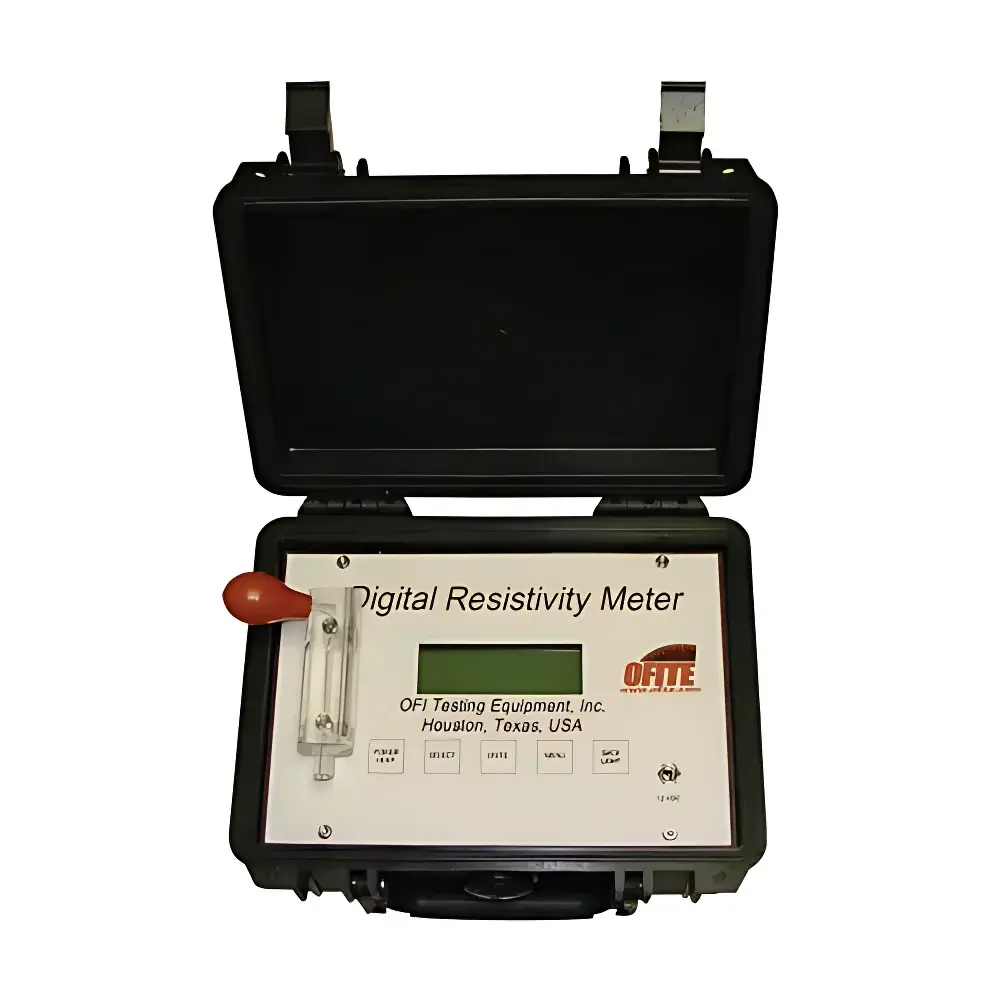
OFITE Model 130-87 Digital Resistivity Meter
| Brand | OFITE |
|---|---|
| Origin | USA |
| Model | 130-87 |
| Resistivity Range | 0.01–400 Ω·m |
| Temperature Range | −10 to +60 °C |
| NaCl Concentration Range | 0.2–300 kppm |
| NaCl Units | ppm, kppm, gr/gal |
| Cell Length | 86.4 mm |
| Power Supply | Two 9 V batteries or optional 220 V AC adapter |
| Display | High-contrast LCD with simultaneous triple-parameter readout (resistivity, temperature, NaCl) |
| Calibration | Built-in reference check function for field validation |
| Sample Cell | Removable transparent Lucite™ cylindrical cell with integrated Pt100 temperature sensor |
Overview
The OFITE Model 130-87 Digital Resistivity Meter is a field-deployable, precision-engineered instrument designed for the direct measurement of electrical resistivity in drilling fluids, completion brines, cement slurries, and semi-solid geotechnical samples. It operates on the principle of four-terminal (Kelvin) DC resistivity measurement—eliminating lead resistance errors and ensuring high reproducibility across variable sample conductivities. Unlike analog or two-electrode meters, the 130-87 employs a calibrated, fixed-geometry cylindrical cell (86.4 mm effective path length) with embedded stainless-steel electrodes and an integrated Pt100 temperature sensor, enabling simultaneous, traceable measurements of resistivity (Ω·m), temperature (°C), and derived NaCl concentration. Its design adheres to ASTM D257 and ISO 8503-3 methodologies for volume resistivity determination in non-metallic media, supporting routine QC in oilfield fluid laboratories and on-rig monitoring under API RP 13B-1 compliance requirements.
Key Features
- Triple-parameter real-time display: Resistivity (0.01–400 Ω·m), temperature (−10 to +60 °C), and NaCl concentration (0.2–300 kppm) shown concurrently on a high-contrast LCD with 0.01 Ω·m resolution
- Integrated Pt100 temperature sensor embedded within the transparent Lucite™ sample cell—ensuring direct, contact-based thermal measurement without external probe drift or lag
- Built-in calibration verification function using internal reference resistors; eliminates need for external standards during daily field checks
- Automatic NaCl conversion algorithm compliant with industry-standard empirical correlations (e.g., Schlumberger and Halliburton mud engineering tables), removing manual interpolation from printed charts
- Ruggedized housing rated IP54 for dust and splash resistance; operational with dual power options—two 9 V alkaline batteries (typical 100+ hours runtime) or optional 220 V AC adapter for lab bench use
- Removable, autoclavable Lucite™ cell with precision-machined electrode spacing (86.4 mm) and smooth internal finish—minimizing surface adhesion and enabling rapid cleaning between samples
Sample Compatibility & Compliance
The 130-87 accommodates Newtonian and mildly non-Newtonian fluids—including water-based muds, KCl-polymer systems, calcium chloride brines, bentonite suspensions, and low-viscosity cement filtrates—without requiring viscosity compensation. Its fixed-cell geometry ensures consistent geometric factor application per ASTM D1171, while the low-current DC excitation (<1 mA) prevents electrolytic polarization at the electrode interface. The instrument meets IEC 61000-4-2 (ESD immunity) and complies with API RP 13B-1 Annex A for resistivity reporting in drilling fluid qualification. Data outputs satisfy GLP documentation requirements when used with OFITE’s optional traceable calibration certificate (NIST-traceable reference resistors and Pt100 sensor calibration report).
Software & Data Management
While the 130-87 operates as a standalone meter with no onboard data logging, its analog output (0–5 V DC proportional to resistivity) supports integration into SCADA or LIMS environments via third-party DAQ modules. OFITE provides a companion Excel-based Resistivity Data Tracker template (v3.2), which accepts manual entry of timestamped readings, auto-calculates temperature-corrected resistivity (per ASTM D257 Eq. 5), logs calibration events, and generates PDF reports compliant with internal QA audit trails. All firmware and calibration routines are version-controlled and auditable per FDA 21 CFR Part 11 Annex 11 principles when deployed in regulated GMP environments.
Applications
- Routine resistivity screening of drilling fluid systems to monitor salinity changes, contamination ingress (e.g., formation water influx), or additive degradation
- Field verification of brine density/resistivity correlation in completion fluid preparation per ISO 10414-2
- Quality control of lost-circulation material (LCM) slurries where resistivity correlates with solid-phase dispersion stability
- Geotechnical assessment of clay-rich soil pore-fluid resistivity for resistivity imaging (ERT) baseline studies
- Educational laboratory use in petroleum engineering curricula for hands-on demonstration of Archie’s law relationships
FAQ
Does the 130-87 require periodic recalibration by an accredited lab?
No—its built-in reference check allows daily functional verification. However, NIST-traceable recalibration of the cell constant and Pt100 sensor is recommended annually or after 500 measurements, per OFITE Technical Bulletin TB-130-87-REV4.
Can the Lucite cell be replaced with a stainless-steel alternative for abrasive slurries?
No—the cell geometry and dielectric properties are integral to the certified cell constant (K = 86.4 mm). Stainless-steel cells alter capacitance and introduce stray current paths, invalidating calibration.
Is temperature compensation applied automatically during resistivity calculation?
Yes—the displayed resistivity value is always corrected to 25 °C using the measured temperature and the standard 2.14 %/°C coefficient for aqueous NaCl solutions, per API RP 13B-1 Section 7.3.2.
What is the minimum sample volume required?
Exactly 120 mL, corresponding to full immersion of the 86.4 mm electrode path within the Lucite cell’s calibrated fill line.
Does the instrument meet explosion-proof requirements for offshore rig use?
It is not intrinsically safe (IS) certified. For Zone 1/2 environments, it must be operated inside an approved Ex-d enclosure or used only in non-hazardous areas per IEC 60079-0.






