
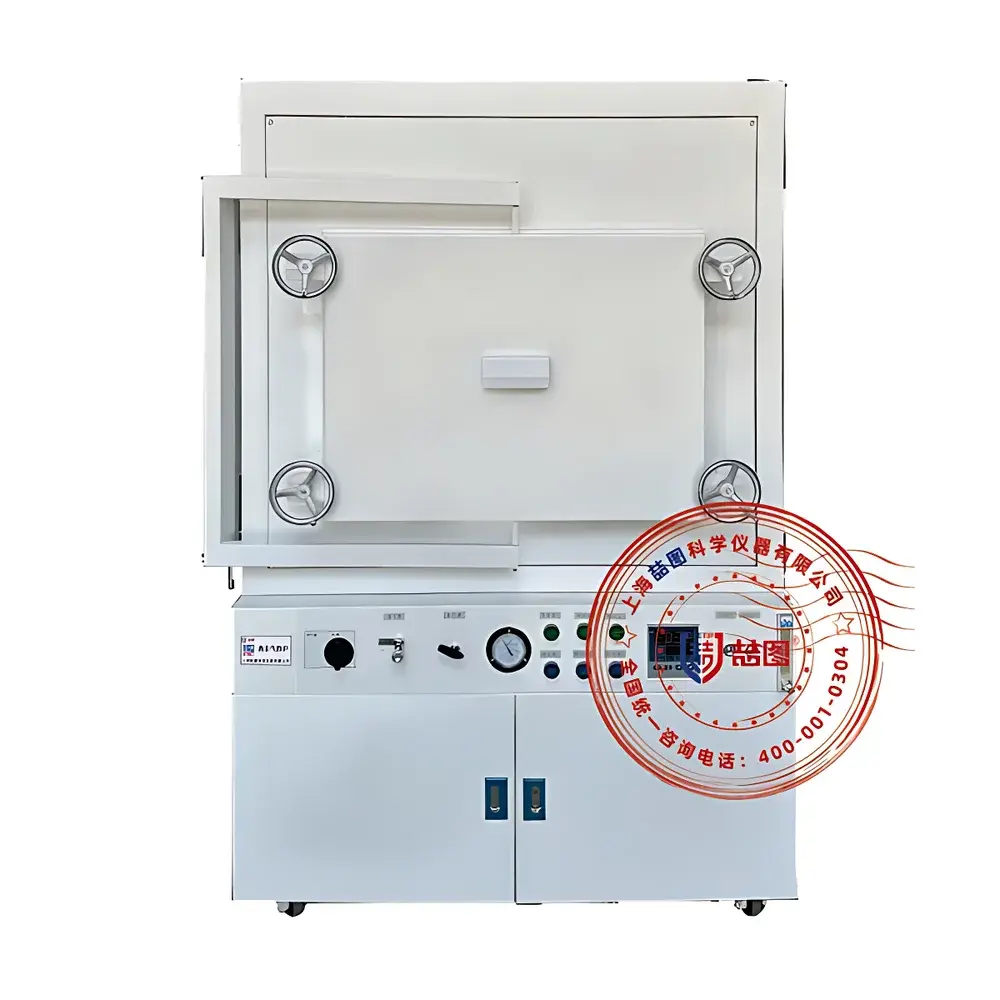
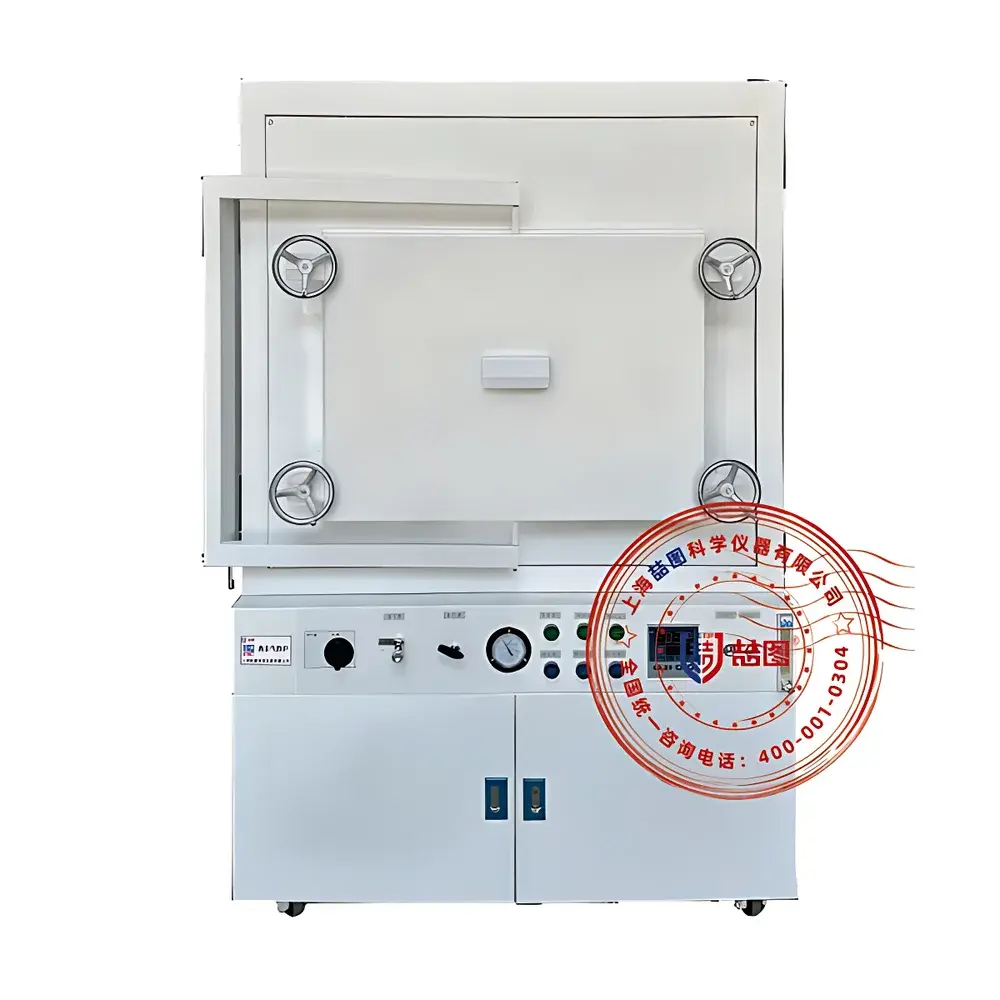
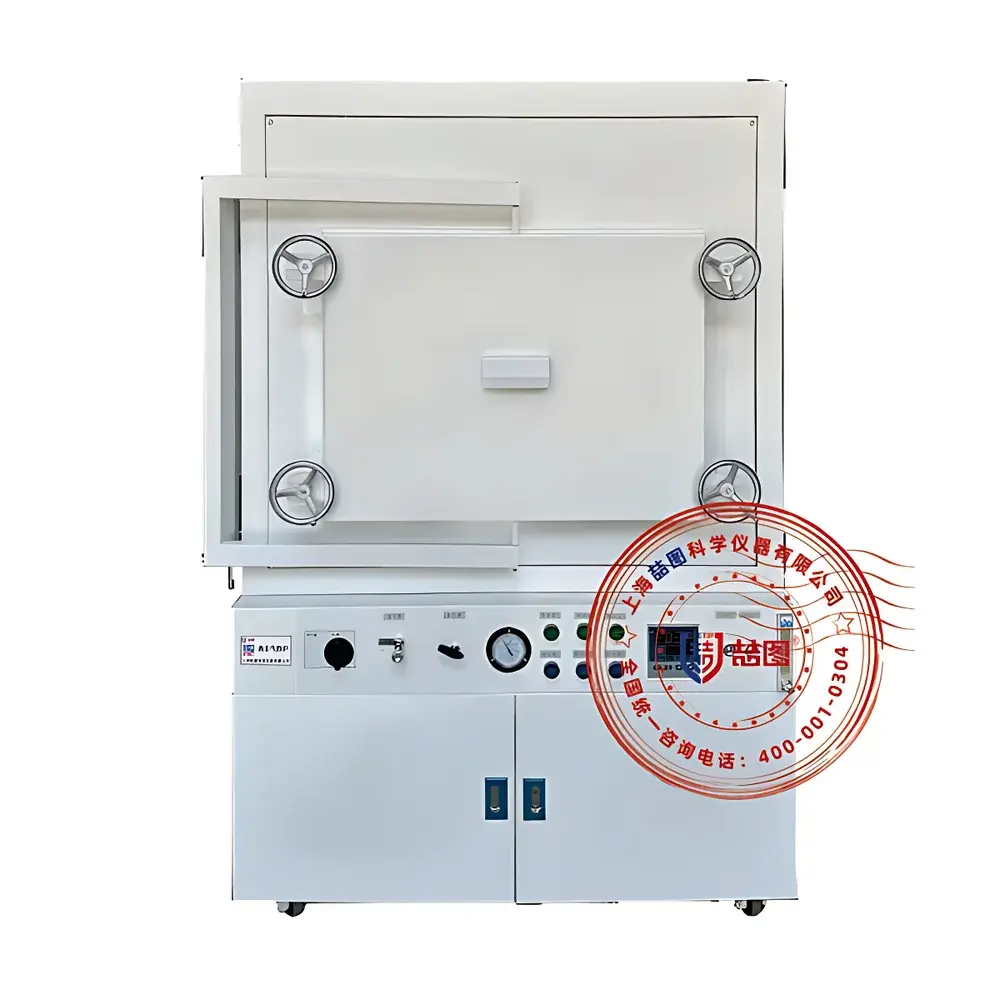
DRETOP QVB-9-16P Box-Type Vacuum & Controlled Atmosphere Muffle Furnace
| Brand | DRETOP |
|---|---|
| Origin | Shanghai, China |
| Manufacturer Type | Direct Manufacturer |
| Product Category | Domestic |
| Model | QVB-9-16P |
| Instrument Type | Box-Type Furnace |
| Maximum Temperature | 1600 °C |
| Temperature Control Accuracy | ±1 °C |
| Rated Power | 9000 W |
| Heating Element | Silicon Molybdenum (MoSi₂) Rods |
| Internal Chamber Dimensions | 200 × 300 × 150 mm |
| Nominal Volume | 9 L |
| Control System | Microcomputer-Based AI Controller with PID and Self-Tuning Algorithms |
| Vacuum Performance | Ultimate Vacuum ≤ −0.1 MPa (100 Pa) |
| Pressure Regulation Range | 10–1000 mbar (gauge), capable of maintaining ±0.01 MPa internal overpressure/underpressure |
| Safety Features | Overtemperature, overpressure, overcurrent, leakage protection, thermocouple failure cutoff, parameter password lock |
Overview
The DRETOP QVB-9-16P is a high-temperature box-type muffle furnace engineered for precise thermal processing under vacuum or controlled reactive/inert atmospheres. It integrates vacuum technology with programmable temperature control to enable oxidation-free, decarburization-free, and contamination-free heat treatment—critical for advanced materials synthesis, sintering, annealing, and brazing applications. Operating up to 1600 °C, the furnace employs silicon molybdenum (MoSi₂) heating elements mounted in a double-walled, insulated chamber structure. Its vacuum capability (≤100 Pa ultimate pressure) and regulated gas pressure control (10–1000 mbar) allow users to establish reproducible low-oxygen or tailored partial-pressure environments—essential for processing sensitive ceramics, refractory metals, battery cathode precursors, and high-purity alloys. Unlike conventional air furnaces, the QVB-9-16P eliminates surface oxidation, intergranular corrosion, and carbon pickup, ensuring consistent microstructural development and surface integrity across R&D and small-batch production workflows.
Key Features
- Double-shell construction with high-efficiency ceramic fiber insulation, minimizing external surface temperature (<60 °C at ambient) and improving thermal retention.
- MoSi₂ heating elements rated for continuous operation at 1500 °C and peak service at 1600 °C—offering stable output, long service life, and resistance to thermal shock.
- Microcomputer-based AI controller with PID algorithm, auto-tuning function, and multi-segment programmable ramp-soak profiles (up to 30 segments per program).
- Integrated safety architecture: dual-limit overtemperature protection, pressure sensor interlock, current monitoring, ground-fault detection, and thermocouple break alarm with automatic power cutoff.
- Modular gas delivery system with mass flow controllers (MFCs), stainless-steel tubing, solenoid valves, and digital pressure transducers—supporting N₂, Ar, He, forming gas (N₂/H₂), and other non-explosive process gases.
- Front-loading chamber with reinforced quartz-glass viewport (optional), water-cooled flange, and ISO-KF vacuum port compatible with standard rotary vane or turbomolecular pumps.
Sample Compatibility & Compliance
The QVB-9-16P accommodates diverse sample geometries within its 9 L chamber (200 × 300 × 150 mm), including crucibles (alumina, zirconia, graphite), boat assemblies, substrate wafers, and powder compacts. It supports ASTM F2627 (vacuum sintering of titanium alloys), ISO 2738-2 (sintering of metal powders), and USP (thermal sterilization validation protocols). The furnace’s pressure regulation and vacuum integrity meet requirements for GLP-compliant thermal processing; audit trails for temperature, pressure, and gas flow can be logged via optional RS485/Modbus or Ethernet interface. All electrical components comply with IEC 61000-6-3 (EMC) and IEC 61000-6-4 (immunity); structural design adheres to EN 60519-2 (safety in industrial electroheating equipment).
Software & Data Management
The embedded controller supports local operation via 5.7″ TFT touchscreen with intuitive icon-driven navigation. Full data logging—including time-stamped temperature, pressure, setpoint, and alarm status—is stored internally (≥100,000 records) and exportable via USB flash drive in CSV format. Optional PC software (DRETOP FurnaceLink™) enables remote monitoring, real-time graphing, recipe management, and compliance-ready reporting. When configured with optional 21 CFR Part 11 modules, the system provides electronic signatures, user role-based access control, and immutable audit trails—meeting FDA-regulated lab documentation standards for pharmaceutical excipient calcination or medical device component annealing.
Applications
- Sintering of advanced ceramics (Al₂O₃, SiC, ZrO₂), lithium-ion battery cathode materials (NMC, LFP), and solid electrolytes (LLZO, LATP).
- High-purity annealing of refractory metals (Mo, W, Nb), precious metals (Pt, Pd, Au), and specialty alloys (Inconel, Hastelloy).
- Controlled-atmosphere brazing of aerospace components using Cu-P or Ag-Cu-Zn filler metals under N₂/H₂ mixtures.
- Thermal gravimetric analysis (TGA) pre-conditioning, ashing of organic composites, and catalyst activation under reducing or inert conditions.
- Research-scale crystal growth (e.g., flux growth of oxides), glass frit densification, and metallurgical phase transformation studies.
FAQ
What vacuum level can the QVB-9-16P achieve without auxiliary pumping?
The furnace achieves ≤−0.1 MPa (100 Pa) with the included two-stage rotary vane pump. For pressures below 10⁻² Pa, a turbomolecular pump with cold trap is recommended.
Can hydrogen be used safely in this furnace?
H₂ is not recommended unless equipped with explosion-proof certification, H₂-specific leak-tested gas lines, and integrated O₂ monitoring with automatic purge interlock—none of which are standard on the base QVB-9-16P configuration.
Is the furnace suitable for continuous operation at 1600 °C?
No. Continuous operation is rated at ≤1500 °C per IEC 60519-2. 1600 °C is a short-term maximum (≤2 hours per cycle) to preserve MoSi₂ element longevity and insulation integrity.
How is temperature uniformity validated across the chamber?
DRETOP provides a factory calibration certificate indicating ±5 °C uniformity (at 1400 °C, 3-point measurement per ASTM E220) and includes a 3-zone thermocouple mapping procedure in the operator manual.
Does the system support automated gas switching during a single thermal cycle?
Yes—when configured with optional multi-gas manifold and MFCs, the controller can trigger sequential gas purges, atmosphere transitions, and pressure ramps synchronized with temperature segments.



