
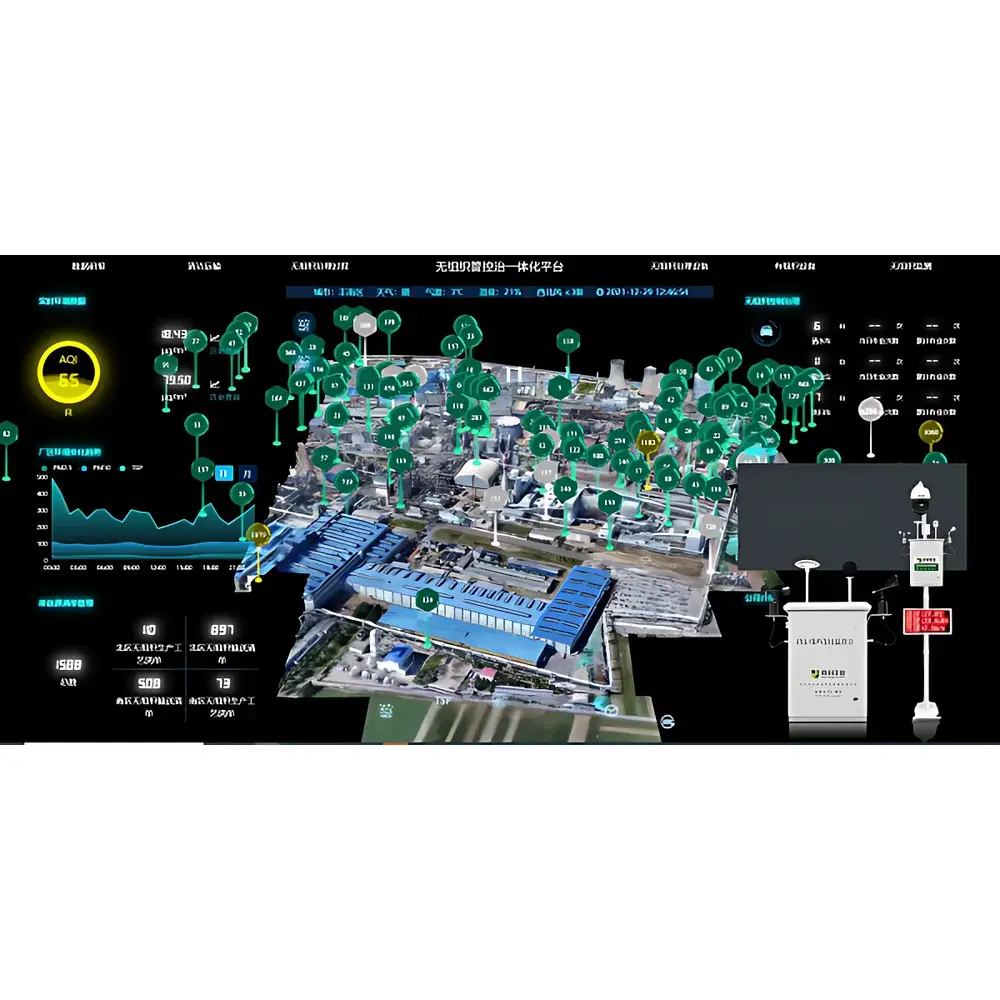
BCNX Integrated Unorganized Emission Monitoring and Control Platform
| Origin | Beijing, China |
|---|---|
| Manufacturer Type | Authorized Distributor |
| Country of Origin | China |
| Model | BCNX |
| Price Range | USD 1,400 – 7,000 (FOB) |
| Measurement Principle | Beta Attenuation + Laser Scattering Hybrid Method |
| Measured Parameters | TSP, PM₁₀, PM₂.₅, PM₁ |
| Measurement Ranges | 0–1000 µg/m³, 0–2000 µg/m³, 0–10 mg/m³, 0–20 mg/m³ (field-selectable) |
| Sampling Flow Rate | 16.7 L/min (standard), configurable up to 30 L/min |
| Detection Limit | ≤2 µg/m³ (PM₂.₅, 1-hour average, ISO 12103-1 A2 dust reference) |
| Flow Stability | ±2% over 24 h (at 25°C, 1 atm, with integrated mass flow controller) |
| Compliance | Designed per HJ 653–2013, HJ 93–2013, and GB 3095–2012 |
| supports audit-ready data logging per EPA 40 CFR Part 58 Appendix A & ISO/IEC 17025 | 2017 requirements |
Overview
The BCNX Integrated Unorganized Emission Monitoring and Control Platform is an industrial-grade environmental intelligence system engineered for real-time, spatially resolved monitoring and adaptive management of fugitive particulate emissions across large-scale metallurgical facilities. Unlike conventional point-source gas analyzers or standalone PM monitors, the BCNX platform operates on a distributed sensor network architecture—integrating beta attenuation and laser scattering hybrid measurement modules with edge-based AI vision analytics, georeferenced micro-stations, and centralized IoT orchestration. It is specifically validated for continuous operation in high-dust, high-humidity, and thermally variable environments typical of sintering plants, blast furnaces, coke oven batteries, raw material stockyards, and transfer points. The system adheres to the technical framework defined in the Technical Guidelines for Ultra-Low Emission Transformation of Iron and Steel Enterprises (CAEPI, 2020) and aligns with provincial-level implementation directives such as Shandong Provincial Ecological Environment Department’s Guidance on Fugitive Emission Control for Key Industries (2020). Its core function is not merely data acquisition but closed-loop emission attribution—mapping ambient concentration gradients to specific emission sources (e.g., conveyor drop points, open storage piles, unsealed silos) via spatiotemporal correlation algorithms.
Key Features
- Dual-Principle Particulate Measurement: Simultaneous beta-ray absorption (for gravimetric traceability) and forward-scatter laser detection (for dynamic response), enabling cross-validated PM₁, PM₂.₅, PM₁₀, and TSP quantification under varying humidity and particle morphology conditions.
- Source-Resolved Monitoring Grid: Modular deployment of up to 128 autonomous micro-stations per site, each equipped with GPS/GNSS positioning, tilt-compensated wind vector sensing, and synchronized timestamping (NTP/PTP), enabling plume trajectory modeling and source apportionment via inverse dispersion algorithms.
- AI-Powered Visual Emission Verification: Edge-integrated computer vision modules process HD video feeds from strategically mounted PTZ cameras to detect visible dust plumes, quantify opacity (per ASTM D7520), classify emission event types (e.g., loading spillage vs. wind-blown pile erosion), and trigger automated alerts with geotagged metadata.
- Unified Data Orchestration Layer: Cloud-native backend (AWS IoT Core + TimescaleDB) ingests heterogeneous streams—including CEMS data, gate access logs, truck weight-in-motion records, energy metering, and weather station telemetry—into a unified time-series graph database with semantic tagging per ISO 14064-1 GHG accounting conventions.
- Audit-Ready Compliance Engine: Automated generation of regulatory reports aligned with HJ 653–2013 Annex B (fugitive emission inventory templates), including daily exceedance logs, control effectiveness metrics (e.g., suppression efficiency % per dust suppression system), and GLP-compliant chain-of-custody metadata (user actions, firmware versions, calibration timestamps).
Sample Compatibility & Compliance
The BCNX platform is certified for continuous monitoring of airborne particulate matter in ambient and near-source industrial boundary environments. It meets the metrological performance criteria specified in HJ 93–2013 (Technical Requirements for Ambient Air Particulate Matter Samplers) and HJ 653–2013 (Technical Specification for Continuous Monitoring Systems of Ambient Air Particulate Matter). All optical and radiometric components undergo annual factory recalibration traceable to NIM (National Institute of Metrology, China) standards. The system supports optional integration with third-party meteorological sensors compliant with WMO Guide to Instruments and Methods of Observation (CIMO Guide, 2022 edition). For international deployment, firmware supports dual-unit reporting (µg/m³ and mg/m³), UTC+0 timestamping, and export formats compatible with EU Air Quality Directive (2008/50/EC) Annex XI reporting schemas.
Software & Data Management
The BCNX Control Suite is a web-based SaaS application accessible via role-based authentication (RBAC) with TLS 1.3 encryption. It includes a GIS-enabled dashboard overlaying real-time PM concentration heatmaps onto 3D厂区 models (imported as CityGML or IFC). Historical trend analysis supports rolling 1-hour, 24-hour, and monthly percentile calculations (e.g., 98th percentile PM₁₀ for compliance verification). All raw sensor data, image frames, and AI inference logs are retained for ≥18 months with immutable SHA-256 hashing. The system implements full 21 CFR Part 11 compliance for electronic records: audit trails capture operator identity, action timestamp, data value before/after modification, and reason code for any manual override. Data exports comply with ISO/IEC 17025:2017 Clause 7.8.2 requirements for report integrity and traceability.
Applications
- Real-time identification and quantification of fugitive dust sources across bulk material handling zones (e.g., coal/pellet stockyards, ore unloading docks, slag disposal areas)
- Performance validation of engineering controls—including fogging systems, tarping mechanisms, and enclosed conveyor transitions—via before/after concentration delta analysis
- Dynamic adjustment of operational protocols during high-wind or low-humidity events using predictive emission risk scoring (integrated with local meteorological API feeds)
- Supporting differentiated production scheduling during government-mandated air pollution response periods (e.g., Tiered Emergency Response Plans per MEP Notice No. 121 [2019])
- Generating auditable evidence for environmental performance scoring under China’s Enterprise Environmental Credit Evaluation System (MEP Order No. 39)
FAQ
Does the BCNX platform support integration with existing DCS or MES systems?
Yes—via OPC UA (IEC 62541) and RESTful API interfaces. Pre-built connectors are available for Siemens PCS7, Honeywell Experion PKS, and Baosight iCentro platforms.
What is the recommended maintenance interval for field-deployed micro-stations?
Bi-monthly visual inspection and quarterly filter replacement; annual full recalibration at authorized service centers. Remote diagnostics reduce unscheduled site visits by >60%.
Can the system distinguish between process-related dust and ambient background contributions?
Yes—using baseline subtraction algorithms trained on collocated reference stations and wind-directional sector filtering (minimum 16-sector resolution).
Is the platform certified for use in explosion-hazardous areas (ATEX/IECEx)?
Standard units are rated IP65. ATEX Zone 2 / IECEx Zone 2 variants (II 2G Ex db IIB T4 Gb) are available upon request with customized housing and intrinsically safe power design.
How does the system handle data gaps caused by temporary sensor downtime or communication loss?
It applies gap-filling using multivariate kriging interpolation based on spatially adjacent nodes and correlated meteorological variables, with uncertainty bounds reported in all derived metrics.
Related Products







