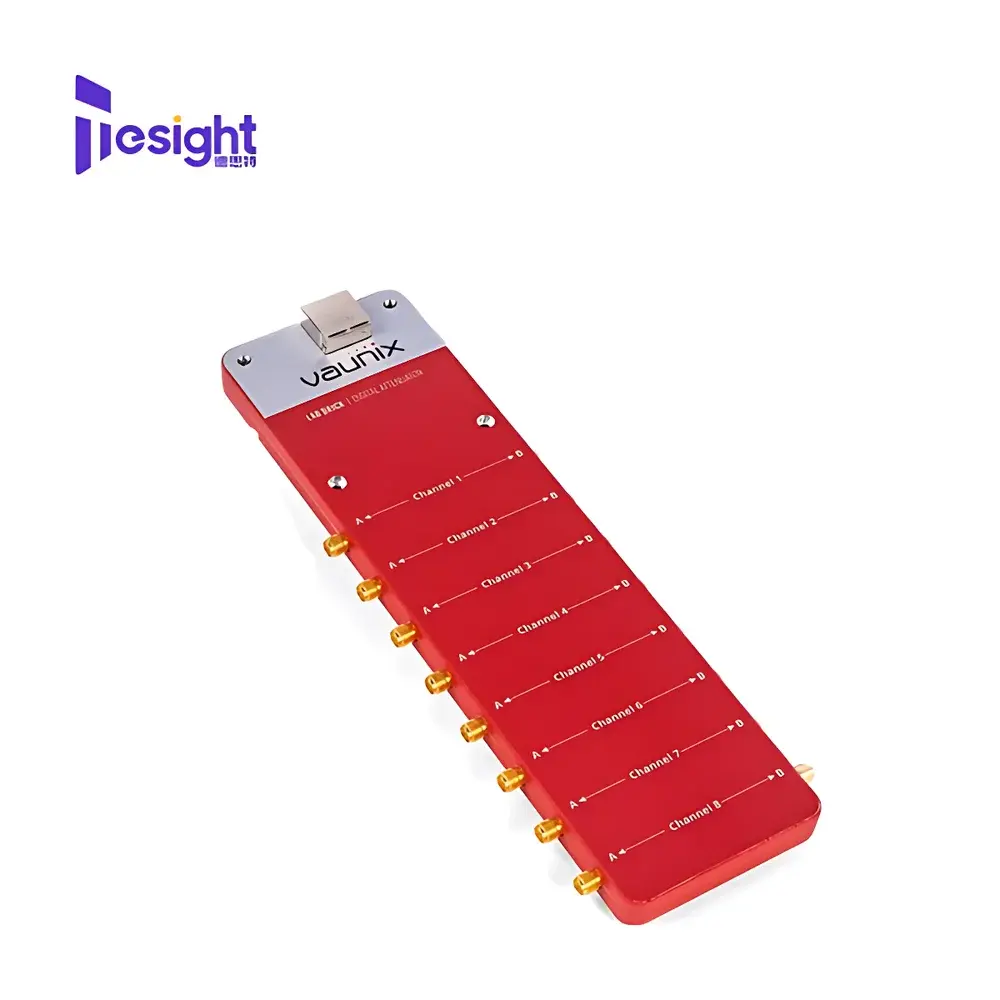
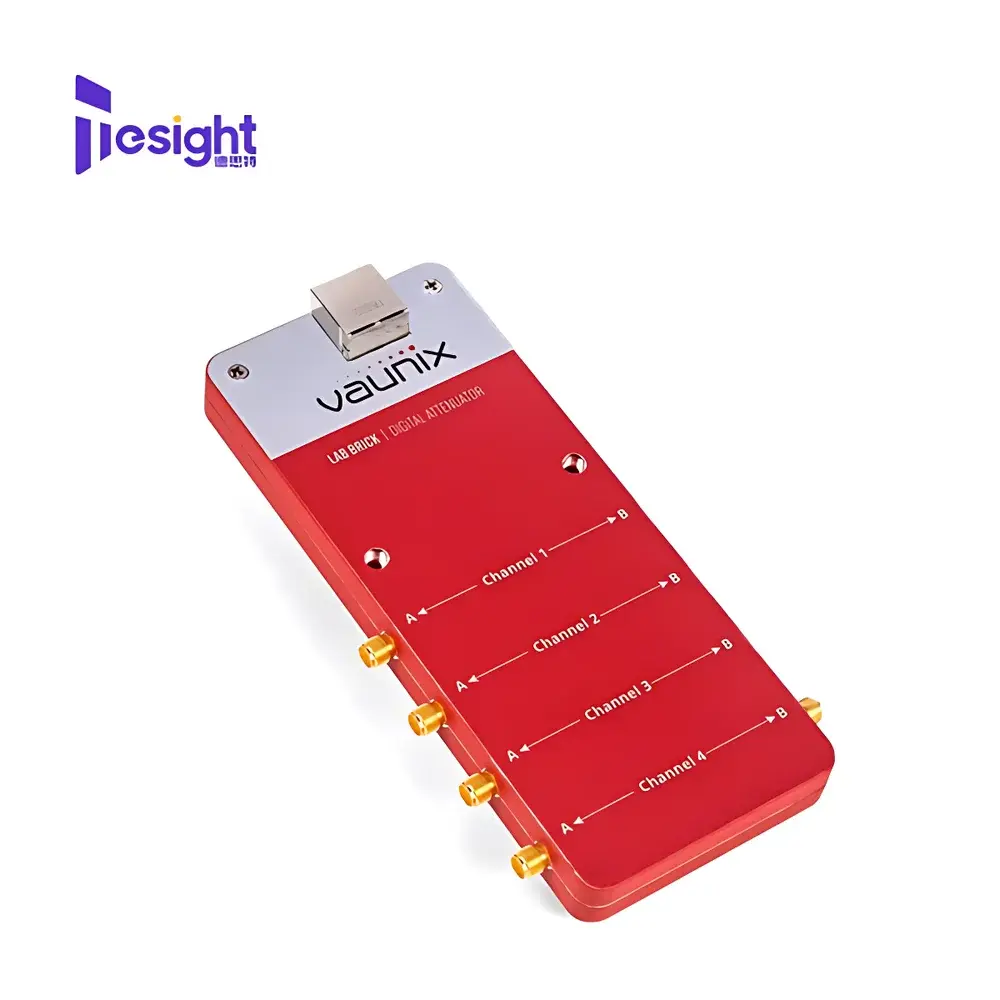
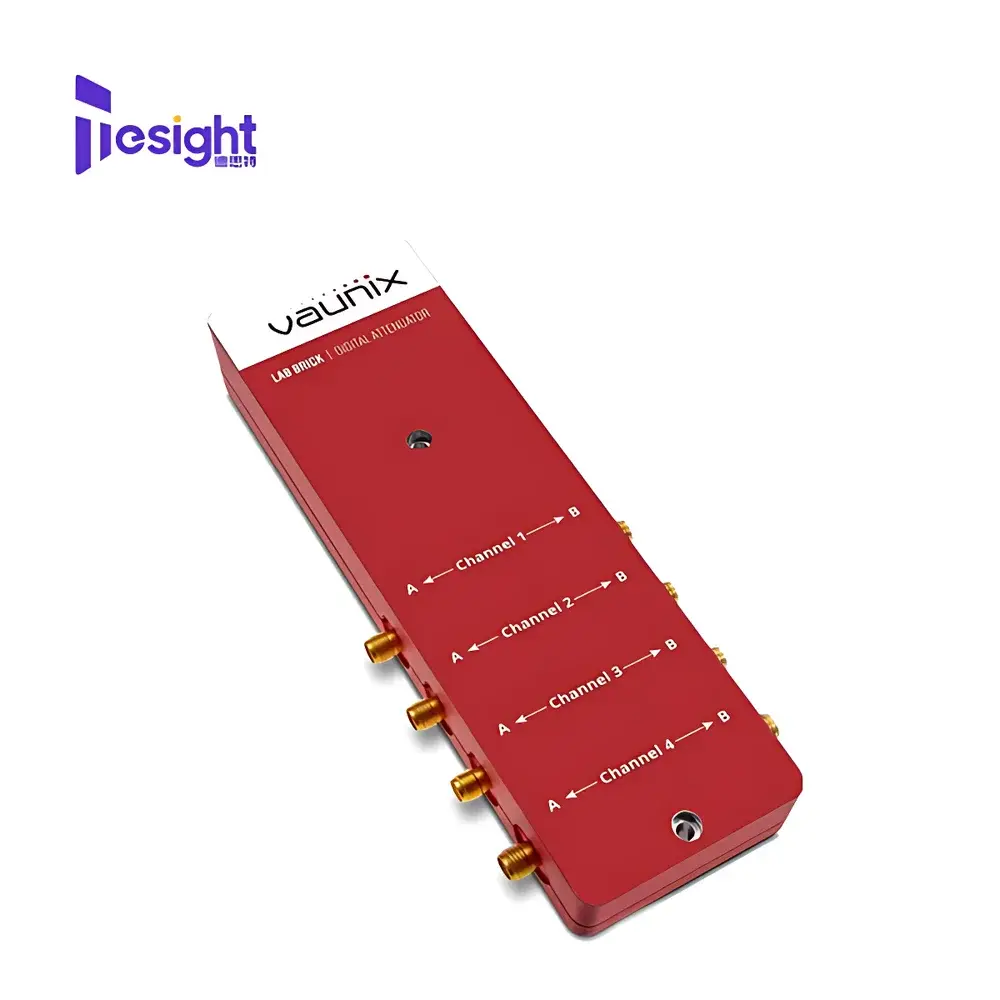
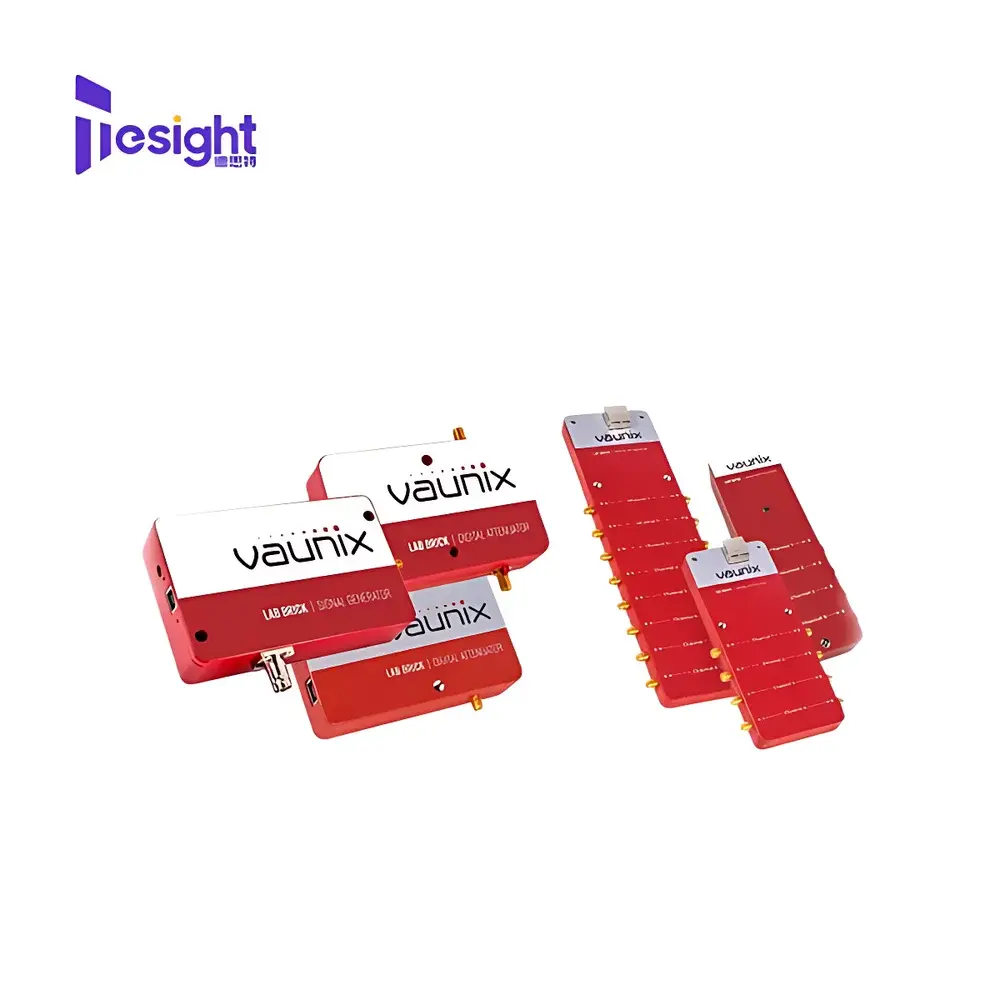
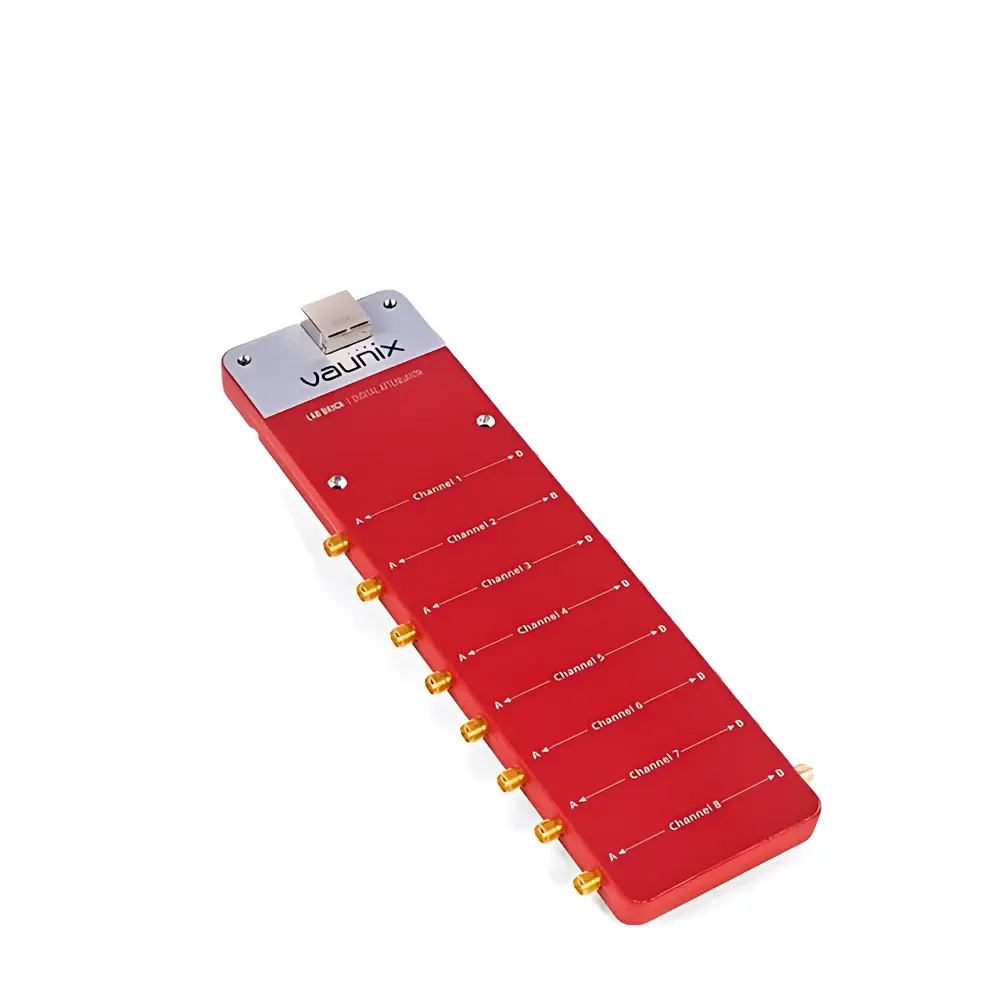
Vaunix TS-LDA-802-8-Ethernet Compact Miniature RF Digital Attenuator
| Brand | Vaunix |
|---|---|
| Origin | Italy |
| Model | LDA-802-8-Ethernet |
| Frequency Range | Up to 20 GHz |
| Interface | Ethernet (IEEE 802.3) |
| Attenuation Range | 0–63 dB in 1 dB steps |
| Insertion Loss | < 2.5 dB (typ. at 20 GHz) |
| VSWR | ≤ 1.5:1 (DC–20 GHz) |
| Power Handling | +27 dBm (max, CW) |
| Operating Temperature | –20 °C to +70 °C |
| Compliance | RoHS 2, CE, FCC Part 15B |
Overview
The Vaunix TS-LDA-802-8-Ethernet is a high-performance, compact miniature RF digital attenuator engineered for precision signal level control in automated test environments, RF system calibration, and laboratory-grade signal conditioning applications. Based on solid-state PIN diode architecture, it delivers repeatable, stepwise attenuation across a continuous frequency band from DC to 20 GHz—enabling accurate amplitude management in microwave and millimeter-wave systems. Unlike analog or mechanical alternatives, this Ethernet-controlled attenuator eliminates manual intervention and supports deterministic, software-synchronized attenuation sequencing with sub-millisecond command response times. Its miniature form factor (89 × 51 × 17 mm) and low power consumption (< 1.5 W) make it suitable for integration into dense rack-mounted ATE systems, PXIe-based RF test benches, and embedded instrumentation platforms where thermal management and spatial constraints are critical.
Key Features
- Ethernet (TCP/IP) interface compliant with IEEE 802.3, supporting remote configuration via standard SCPI commands over IPv4; no USB dongles or proprietary drivers required.
- Digital attenuation range of 0–63 dB in precise 1 dB increments, calibrated and traceable to NIST-traceable standards per unit serial number.
- Ultra-low insertion loss (< 2.5 dB typical at 20 GHz) and consistent VSWR (≤ 1.5:1 across full bandwidth), minimizing measurement uncertainty in cascaded RF paths.
- Integrated temperature compensation circuitry ensures attenuation accuracy stability within ±0.25 dB over the full operating range (–20 °C to +70 °C).
- Robust metal housing with SMA female connectors (50 Ω) rated for ≥ 500,000 mating cycles; designed for long-term reliability under repeated thermal cycling and vibration exposure.
- Firmware-upgradable architecture enables future protocol enhancements, extended calibration data loading, and compatibility with evolving lab automation frameworks (e.g., TestStand, LabVIEW NXG, Python PyVISA).
Sample Compatibility & Compliance
The TS-LDA-802-8-Ethernet is compatible with all standard 50 Ω RF signal sources, spectrum analyzers, vector network analyzers (VNAs), and RF power meters operating within its specified frequency and power envelope. It maintains signal integrity for both pulsed and CW waveforms, including modulated signals compliant with 5G NR FR1/FR2, Wi-Fi 6E/7, and radar waveform standards (e.g., MIL-STD-461 RS103). The device meets electromagnetic compatibility requirements per EN 55032 Class B and EN 55035, carries CE marking under the EU Radio Equipment Directive (RED 2014/53/EU), and complies with RoHS 2 (2011/65/EU) and REACH SVHC regulations. For regulated environments—including ISO/IEC 17025-accredited calibration labs—the attenuator ships with a factory calibration certificate documenting attenuation error vs. frequency and temperature, supporting audit readiness under GLP and GMP-aligned quality systems.
Software & Data Management
Vaunix provides the open-source LDA Control Suite—a cross-platform application (Windows/macOS/Linux) supporting SCPI command scripting, batch attenuation sequence generation, and real-time logging to CSV or HDF5 formats. The Ethernet interface exposes a RESTful API endpoint (/api/v1/attenuation) for seamless integration into CI/CD pipelines and enterprise test orchestration platforms. All configuration changes are logged with timestamps and user identifiers (when authenticated), satisfying FDA 21 CFR Part 11 requirements for electronic records and signatures when deployed behind an authorized authentication gateway. Firmware updates are performed via signed binary packages verified using SHA-256 checksums and ECDSA signatures, ensuring supply chain integrity.
Applications
- Automated receiver sensitivity testing in wireless device certification labs (e.g., CTIA, PTCRB, FCC SAR evaluation).
- Dynamic range extension and gain staging in RF front-end validation for phased array radars and satellite communication transceivers.
- Reference-level signal attenuation during VNA calibration kit verification and S-parameter measurement uncertainty analysis.
- Signal fidelity preservation in multi-channel MIMO OTA testing setups where channel-to-channel attenuation matching must remain within ±0.1 dB.
- Embedded use in DOCSIS 4.0 cable modem test fixtures requiring programmable upstream path loss emulation.
FAQ
Is the TS-LDA-802-8-Ethernet compatible with existing SCPI-based test automation frameworks?
Yes—it fully implements IEEE 488.2 and SCPI-1999 syntax for attenuation control (e.g., “ATT:STAT ON”, “ATT:LEV 32.0 DB”), enabling drop-in replacement for legacy GPIB or USB attenuators without script modification.
Does the device support synchronization with external triggers or clock references?
No native trigger input is provided; however, latency-critical applications may achieve sub-100 µs command-to-attenuation settling via TCP socket keep-alive optimization and firmware v2.3+.
Can attenuation calibration data be imported from third-party metrology labs?
Yes—the LDA Control Suite accepts user-defined CSV-formatted correction tables (frequency, temp, attenuation, error) for application-specific compensation.
What is the mean time between failures (MTBF) under continuous operation?
Based on Telcordia SR-332 Issue 4 accelerated life testing, MTBF exceeds 250,000 hours at 25 °C ambient, with derating applied above 50 °C per MIL-HDBK-217F.
Is there a version with optical fiber interface or dual-channel capability?
Not currently; Vaunix offers the LDA-802-16-Ethernet for 0–127 dB range, and the ODA series for fiber-coupled optical attenuation—but no hybrid RF/optical or dual-port variants exist in the TS-LDA product line.
Related Products