
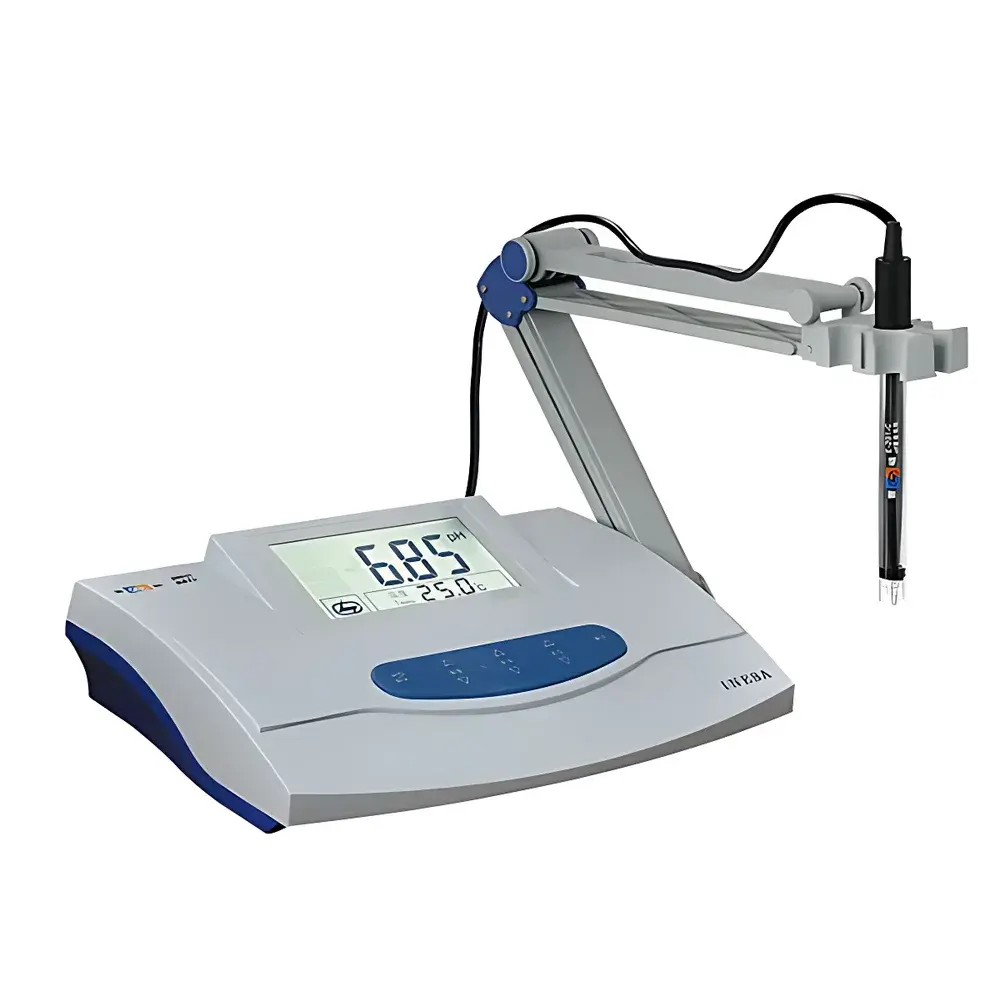
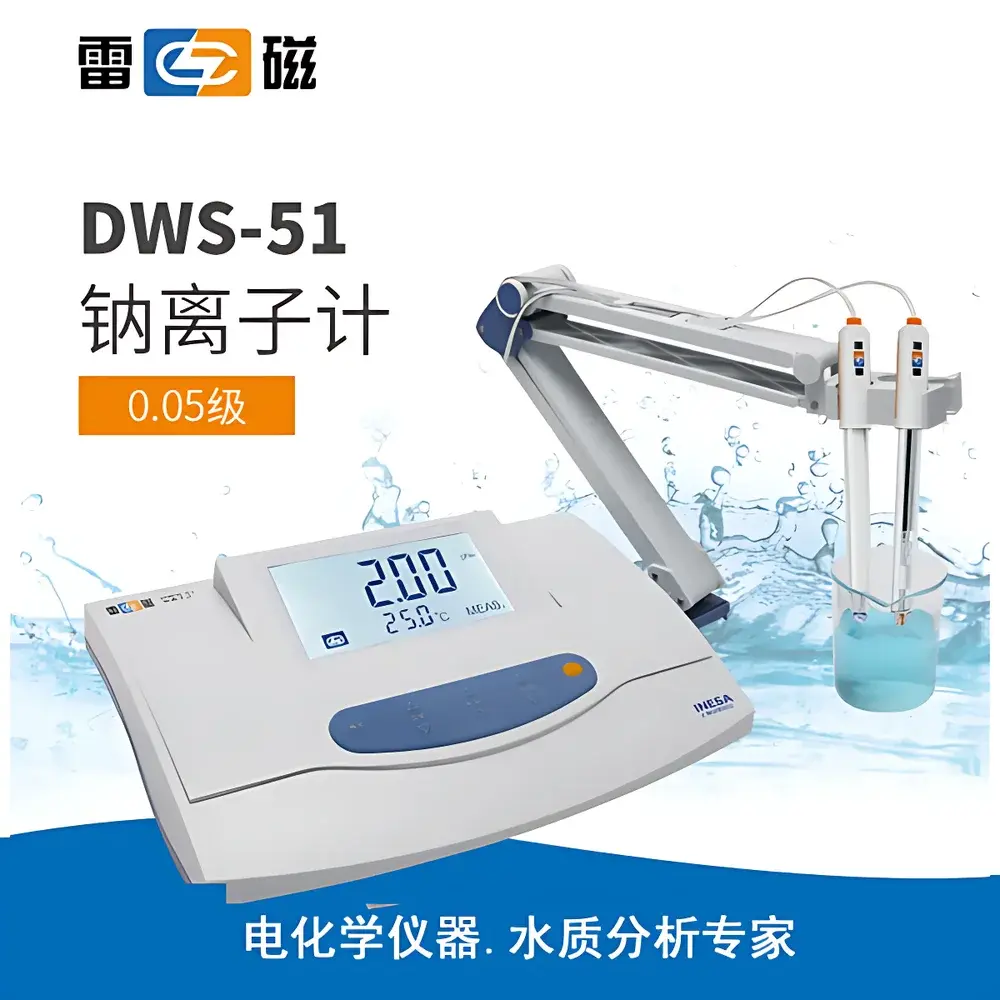
Leici DWS-51 Sodium Ion Analyzer
| Brand | Leici |
|---|---|
| Origin | Shanghai, China |
| Manufacturer Type | Direct Manufacturer |
| Regional Classification | Domestic (China) |
| Model | DWS-51 |
| Instrument Category | Sodium Ion Analyzer |
| Form Factor | Benchtop |
| Measurement Accuracy | ±0.02 pNa |
| Display | Segment LCD |
| Temperature Compensation | Manual |
| Calibration | Two-point (Static & Dynamic) |
| Measurement Modes | Static and Dynamic (Dynamic mode requires optional DWS-51-1 Alkalinization Unit) |
| Output Units | pNa and [Na⁺] (μg/L) |
| Measurement Range | pNa 0.00–9.00 |
| Conversion Error | ≤±3% of reading |
| Electrical Supply | AC 220 V ±10%, 50 Hz ±1% |
| Dimensions | 290 × 210 × 95 mm |
| Weight | 1.5 kg |
Overview
The Leici DWS-51 Sodium Ion Analyzer is a benchtop potentiometric instrument engineered for precise, trace-level sodium ion quantification in aqueous samples—primarily applied in high-purity water monitoring for power generation (e.g., boiler feedwater, steam condensate), semiconductor ultrapure water (UPW) systems, pharmaceutical water-for-injection (WFI) validation, and environmental surface/groundwater assessment. It operates on the principle of ion-selective electrode (ISE) potentiometry, utilizing a solid-state or glass-membrane sodium-selective electrode to generate a Nernstian potential response proportional to the logarithm of sodium ion activity. The instrument outputs both pNa (–log₁₀[Na⁺]) and direct concentration values in μg/L, enabling seamless interpretation across regulatory reporting formats and process control thresholds. Designed to meet the functional requirements of ISO 5667-3 (water sampling), ASTM D1129 (standard terminology relating to water), and GLP-aligned laboratory workflows, the DWS-51 delivers stable baseline performance under controlled ambient conditions with manual temperature compensation.
Key Features
- Benchtop architecture with compact footprint (290 × 210 × 95 mm) and lightweight design (1.5 kg) for integration into QC labs, field-deployable mobile labs, or central monitoring stations.
- Segment-type LCD display optimized for legibility under varied lighting conditions—simultaneously showing pNa value, [Na⁺] concentration (μg/L), and status indicators (e.g., calibration mode, temperature input).
- Two-point calibration protocol supporting both static (immersed electrode in standard solutions) and dynamic (flow-through cell with optional DWS-51-1 alkalinization unit) configurations—enabling adaptation to low-conductivity, high-resistivity samples where pH elevation (>10.5) suppresses interfering H⁺ activity.
- Manual temperature compensation (0–50 °C range) allows user-defined correction using a calibrated thermometer, ensuring thermodynamic consistency when reference temperature differs from measurement environment.
- Direct pNa ↔ [Na⁺] (μg/L) conversion with ≤±3% computational error relative to displayed reading—traceable to NIST-traceable NaCl standards and compliant with USP conductivity–ion correlation expectations.
- 0.05-class accuracy per JJG 757–2015 (Chinese metrological verification regulation for ion meters), corresponding to ±0.02 pNa uncertainty at 25 °C under repeatability conditions.
Sample Compatibility & Compliance
The DWS-51 is validated for use with deionized water, demineralized water, condensate, and low-TDS natural waters (TDS < 100 mg/L). Sample pH must be adjusted to ≥10.5 for sub-ppb sodium detection to minimize hydrogen ion interference—a requirement aligned with IAPWS TR-10 (International Association for the Properties of Water and Steam) guidelines for boiler water sodium monitoring. While the base instrument does not include digital audit trail or electronic signature functionality, its analog output and manual calibration log support paper-based GLP documentation. When deployed in regulated environments (e.g., FDA-regulated pharmaceutical water systems), users are advised to supplement with external calibration logs, electrode certification records, and periodic interlaboratory verification per ISO/IEC 17025 clause 7.7.
Software & Data Management
The DWS-51 operates as a standalone hardware platform without embedded firmware-based data logging or PC connectivity. All measurements are displayed in real time and require manual transcription into laboratory notebooks or LIMS-compatible spreadsheets. Users may integrate the instrument into automated workflows via optional analog voltage output (0–1 V or 4–20 mA, configurable with external signal conditioner) for connection to PLCs or SCADA systems. For compliance with 21 CFR Part 11, third-party data acquisition software (e.g., LabVIEW or custom Python-based DAQ) must implement independent user authentication, electronic signatures, and immutable audit trails—functions not natively provided by the device.
Applications
- Monitoring sodium breakthrough in mixed-bed ion exchange resins used in power plant makeup water treatment.
- Verification of sodium leaching from stainless-steel piping during clean-in-place (CIP) validation in biopharmaceutical facilities.
- Field assessment of sodium contamination in freshwater aquifers impacted by road salt infiltration or seawater intrusion.
- Calibration verification of online sodium analyzers using grab-sample cross-check methodology.
- Educational laboratories conducting potentiometric ISE fundamentals, Nernst equation derivation, and selectivity coefficient evaluation (e.g., against K⁺ or Li⁺ interference).
FAQ
What is the minimum detectable sodium concentration using the DWS-51?
The theoretical lower limit corresponds to pNa 9.00, equivalent to 2.3×10⁻² μg/L (0.023 ng/L); however, practical detection is constrained by electrode conditioning, sample matrix, and contamination control—typical operational limit is ~0.1 μg/L in ultra-clean lab environments.
Is automatic temperature compensation (ATC) supported?
No—the DWS-51 implements manual temperature entry only; an external Pt100 or thermistor probe is not integrated.
Can the DWS-51 measure other ions besides sodium?
No—it is dedicated to sodium-selective potentiometry; electrode replacement with other ISEs (e.g., fluoride or chloride) is not supported due to fixed amplifier gain and calibration algorithm constraints.
Does the instrument comply with ASTM D4192 or ISO 10523?
While not certified to those standards, its measurement principle and accuracy specification align with the potentiometric methodology described in ASTM D4192 (for sodium in water) and ISO 10523 (pH determination, relevant for alkalinization step control).
What electrode types are compatible with the DWS-51?
It accepts standard BNC-input sodium ISEs meeting DIN 19263 or ASTM D1129 physical interface specifications—commonly used models include Leici 6801-01 (glass membrane) and Orion 93-15 (solid-state), subject to proper hydration and storage protocols.
Related Products







