
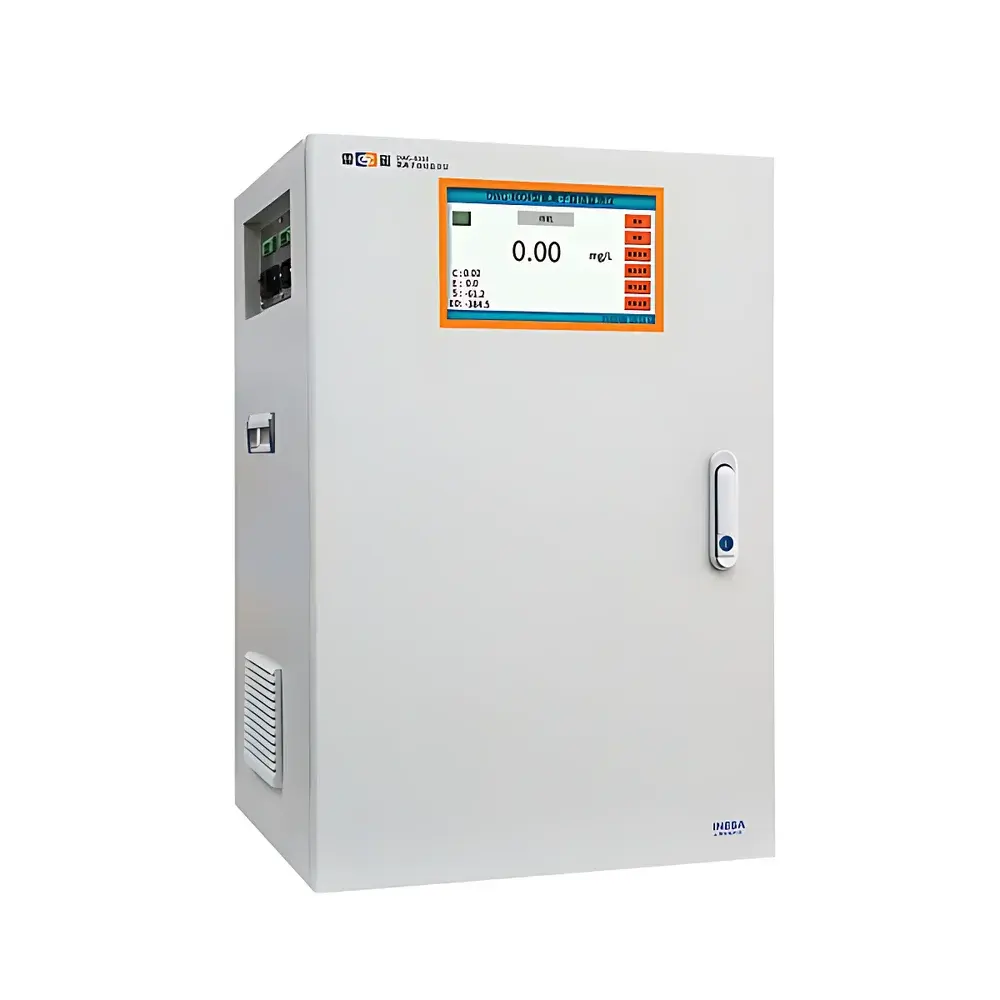
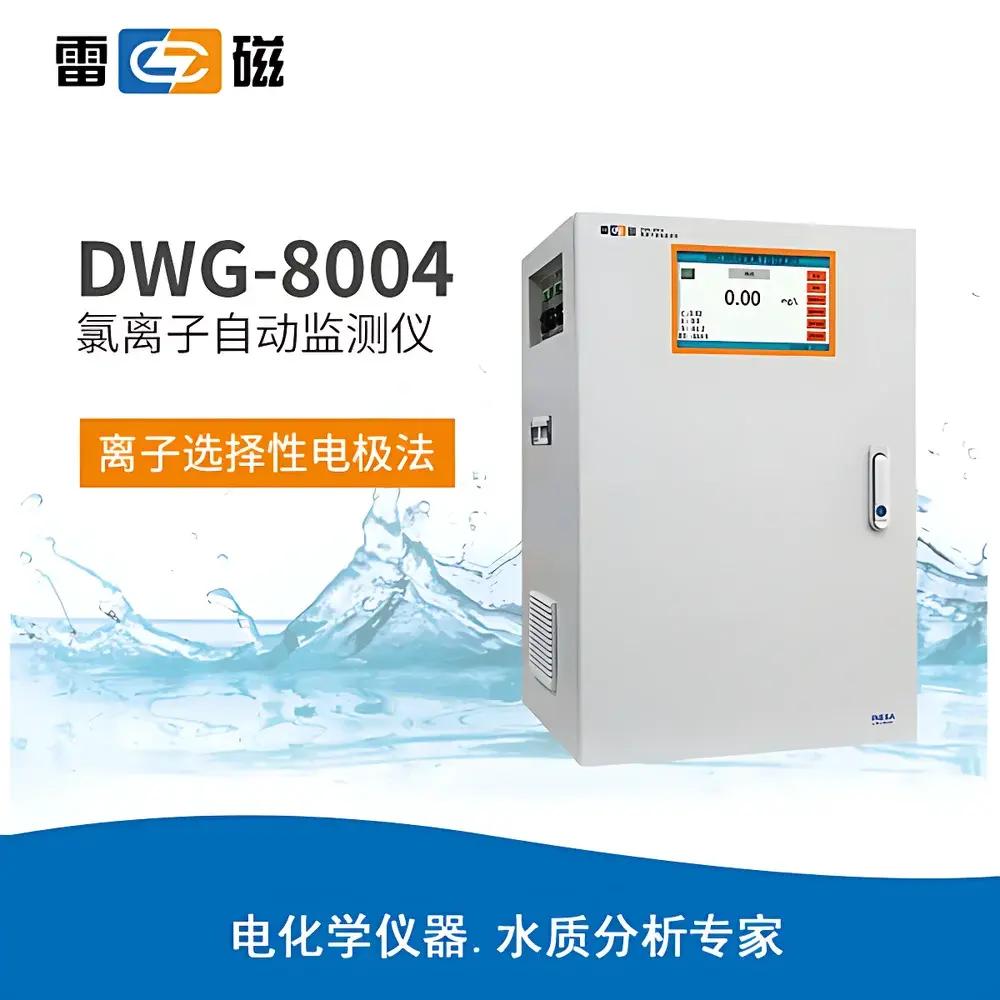
Leici DWG-8004 Chloride Ion Online Analyzer
| Brand | Leici |
|---|---|
| Origin | Shanghai, China |
| Manufacturer Type | Direct Manufacturer |
| Regional Origin | Domestic (China) |
| Model | DWG-8004 |
| Price Range | USD 7,000–14,000 (FOB Shanghai) |
| Instrument Category | Chloride Ion Analyzer |
| Instrument Type | Online Continuous Monitoring System |
| Measurement Range | 2.00–1900 mg/L Cl⁻ |
| Resolution | 0.01 mg/L |
| Accuracy | ±10% of reading |
| Repeatability | ≤3% RSD |
| Drift | ±10% over 4 h |
| 90% Response Time | ≤5 min |
| Operating Power | 220 ± 22 V AC, 50 ± 1 Hz |
| Dimensions (W×H×D) | 600 × 450 × 160 mm |
| Weight | 50 kg |
| Temperature Control | Integrated Peltier-based thermostatic module (±0.5 °C stability) |
| Output Signals | Isolated 4–20 mA DC (user-configurable span) |
| Display | 7-inch color TFT-LCD touchscreen with Chinese GUI |
| Data Storage | Internal non-volatile memory supporting ≥100,000 timestamped measurement and calibration records |
| Auto-calibration | Programmable interval (1 h to 7 days) |
| Cleaning | Motor-driven wiper + optional air-pulse or water-jet cleaning cycle |
| Alarm Outputs | Dual relay outputs (NO/NC), configurable high/low concentration thresholds |
| Power Failure Recovery | Automatic resume with data integrity preservation |
| Compliance | Designed per GB/T 32205–2015 (Chinese Standard for Online Water Quality Analyzers), compatible with ISO 7027 (turbidity interference mitigation), and supports audit-ready logging for GLP/GMP-aligned operations |
Overview
The Leici DWG-8004 Chloride Ion Online Analyzer is an industrial-grade, continuous-monitoring instrument engineered for real-time quantification of chloride ion (Cl⁻) concentration in aqueous environmental and process streams. It operates on the potentiometric principle using a solid-state, polymeric membrane chloride-selective electrode (CSE) paired with a stable Ag/AgCl reference electrode—fully compliant with ISO 10523 and ASTM D6508 methodologies for ion-selective electrode (ISE) analysis. Unlike batch-mode laboratory instruments, the DWG-8004 integrates flow-through cell architecture with temperature-compensated signal conditioning, enabling robust field deployment in fluctuating ambient conditions. Its design prioritizes long-term operational stability in unattended applications—including raw water intakes, drinking water distribution networks, wastewater effluent channels, and industrial discharge points—where regulatory compliance (e.g., China’s GB 3838–2002 Class III/IV surface water limits or EU Urban Wastewater Treatment Directive Annex I thresholds) mandates sub-hourly chloride surveillance.
Key Features
- Integrated thermostatic control via Peltier element ensures sample temperature stabilization within ±0.5 °C—critical for minimizing ISE potential drift caused by thermal gradients.
- 7-inch capacitive touchscreen interface with localized Chinese firmware enables intuitive configuration of measurement intervals, alarm thresholds, auto-calibration schedules, and cleaning cycles—no external PC required for routine operation.
- Dual-output architecture: isolated 4–20 mA analog output (span programmable from 0–500 mg/L to 0–2000 mg/L) for PLC/SCADA integration, plus selectable RS-232 or RS-485 serial interface supporting Modbus RTU protocol for bidirectional data exchange.
- Non-volatile internal memory retains ≥100,000 timestamped entries—including raw mV readings, calibrated concentrations, calibration solution IDs, operator-initiated events, and system diagnostics—structured for traceability and regulatory review.
- Automated maintenance routines include scheduled electrode surface wiping, optional compressed-air purging, and configurable flush intervals—reducing manual intervention and fouling-related downtime in turbid or high-suspended-solid matrices.
- Built-in power-fail recovery preserves calibration coefficients, measurement history, and system settings; resumes monitoring within <30 seconds after mains restoration without recalibration.
Sample Compatibility & Compliance
The DWG-8004 accepts liquid samples with pH 4–10 and conductivity <5 mS/cm, accommodating natural waters, clarified effluents, and low-turbidity process streams. It is validated for use with common chloride standards (KCl, NaCl) and exhibits minimal interference from bromide (<5% signal cross-sensitivity at [Br⁻]/[Cl⁻] ≤ 1:10) and sulfate (negligible below 500 mg/L). All wetted parts—flow cell, tubing, and electrode housing—are constructed from chemically inert PVDF and EPDM elastomers, certified to NSF/ANSI 61 for potable water contact. The analyzer meets electromagnetic compatibility requirements per GB/T 18268.1–2010 (equivalent to IEC 61326-1) and includes hardware-level watchdog timers and cyclic redundancy check (CRC) validation on all serial communications—supporting audit-ready deployments under GLP, ISO/IEC 17025, and municipal water utility QA/QC frameworks.
Software & Data Management
Data logging follows a fixed-interval or event-triggered paradigm: measurements are recorded at user-defined frequencies (1 min to 24 h), with automatic tagging of calibration events, cleaning actions, and alarm activations. Export is supported via USB flash drive (CSV format) or direct serial dump; no proprietary software is required for data retrieval. Audit trails include operator ID (if configured), timestamp (UTC-sync capable via NTP if external controller is used), and system status flags (e.g., “temp_out_of_range”, “electrode_drift_exceeded”). While native firmware does not implement FDA 21 CFR Part 11 digital signatures, its immutable log structure—with write-once memory allocation and sequential record indexing—satisfies core ALCOA+ principles (Attributable, Legible, Contemporaneous, Original, Accurate) for regulated environments.
Applications
- Surface water quality monitoring stations tracking chloride intrusion from road de-icing runoff or saline groundwater seepage.
- Drinking water treatment plants verifying post-chlorination residual stability and detecting distribution system corrosion indicators.
- Municipal wastewater treatment facilities complying with discharge permits limiting chloride to ≤1000 mg/L (e.g., China’s DB11/307–2013).
- Power plant cooling water circuits where elevated chloride accelerates stress corrosion cracking in stainless steel condensers.
- Food & beverage processing lines requiring chloride control in rinse water or brine recovery loops.
FAQ
What is the recommended calibration frequency for routine operation?
Calibration is programmable from hourly to weekly; for regulatory compliance in Class III surface water monitoring, daily 2-point calibration (e.g., 50 mg/L and 500 mg/L KCl) is advised.
Can the DWG-8004 operate in seawater-influenced estuaries?
It is rated for up to 1900 mg/L Cl⁻—sufficient for brackish zones but not full seawater (~19,000 mg/L); for higher ranges, consider dilution protocols or alternative methods such as titration-coupled flow injection.
Is remote firmware update supported?
Firmware updates require local USB connection and are performed offline; no over-the-air (OTA) capability is provided due to industrial cybersecurity requirements.
How is electrode lifetime managed?
The system logs cumulative operating hours and mV stability metrics; manufacturer-recommended replacement interval is 12 months under continuous operation with weekly cleaning.
Does it support integration with cloud-based SCADA platforms?
Yes—via RS-485 Modbus RTU, it interfaces with industry-standard gateways (e.g., Siemens Desigo, Ignition SCADA) that handle MQTT/OPC UA translation for cloud ingestion.
Related Products







