
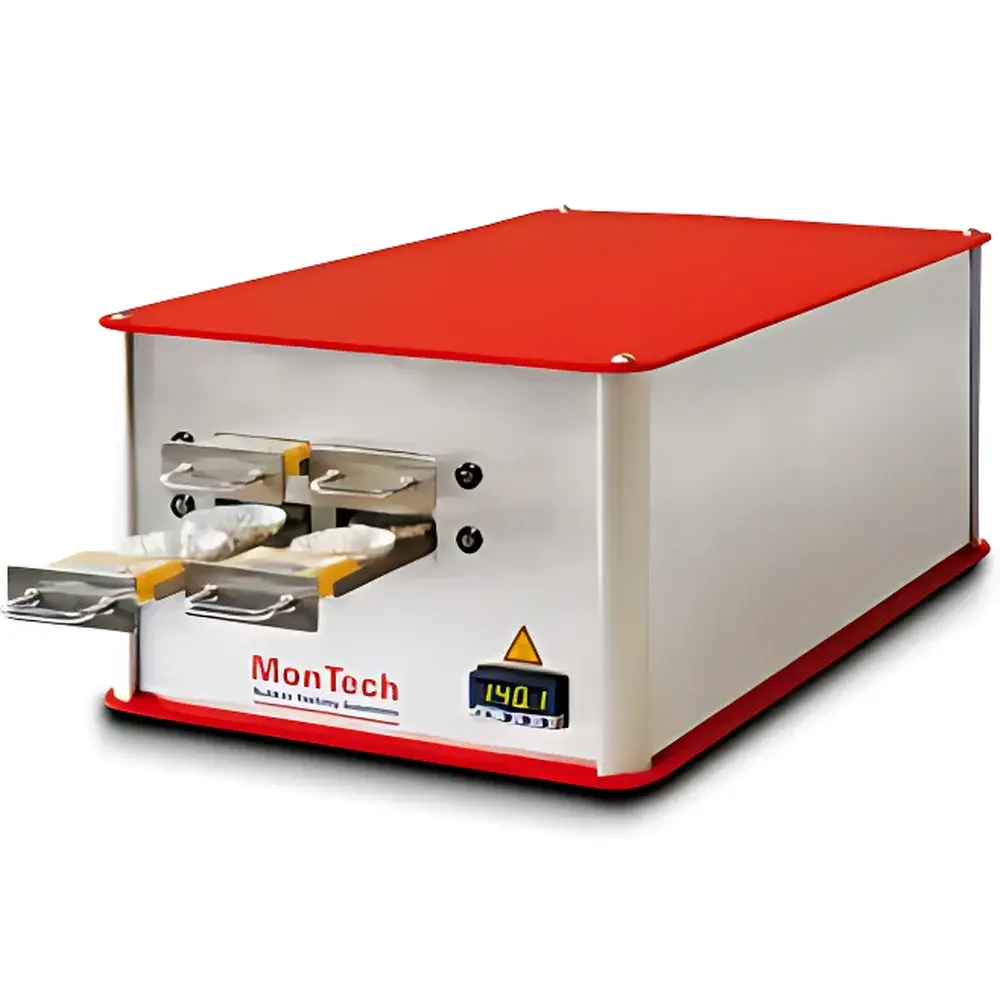
MonTech PO 3000 Plastometer Aging Oven
| Brand | MonTech |
|---|---|
| Origin | Germany |
| Model | PO 3000 Plastometer Aging Oven |
| Construction | Stainless Steel Enclosure |
| Heating Chambers | 4 Independent PID-Controlled Zones |
| Temperature Range | Ambient to 200 °C (Standard Operating Point: 140 ± 0.2 °C) |
| Temperature Recovery Time | ≤ 1 min after Sample Insertion |
| Max. Sample Capacity | 48 specimens (12 per Tray × 4 Trays) |
| Air Exchange Rate | 0–120 air changes/hour (adjustable) |
| Chamber Dimensions (W × H × D) | 500 × 120 × 280 mm |
| Max. Power Consumption | 2.5 kW |
| Compliance | ASTM D3194, BS 903-A59 |
| Safety Features | Overheat Protection, Stability Monitoring, Timeout Alert |
Overview
The MonTech PO 3000 Plastometer Aging Oven is a precision-engineered thermal aging system designed specifically for standardized rubber plasticity evaluation under controlled oxidative and thermal stress conditions. It operates on the principle of accelerated aging—exposing vulcanized or raw rubber compounds to elevated, highly stable temperatures in accordance with internationally recognized test methods including ASTM D3194 (Standard Test Method for Rubber Property—Plasticity Retention Index) and BS 903-A59 (Plasticity of Raw Rubber). Unlike general-purpose ovens, the PO 3000 integrates four thermally isolated, independently controlled chambers, each equipped with high-stability PID temperature regulation and real-time digital monitoring. This architecture ensures minimal thermal cross-talk and exceptional repeatability across parallel aging trials—critical for comparative studies of antioxidant efficiency, compound formulation stability, or shelf-life prediction in rubber compounding laboratories.
Key Features
- Four independent stainless-steel heating chambers with full thermal isolation, enabling simultaneous multi-condition aging experiments without inter-chamber interference.
- PID-controlled temperature regulation delivering ±0.2 °C stability at the standard test point of 140 °C, with full operational range from ambient up to 200 °C.
- Rapid thermal recovery system: chamber temperature re-stabilizes to setpoint within ≤60 seconds following tray insertion—ensuring consistent exposure time integrity per ASTM D3194 requirements.
- Adjustable forced-air circulation (0–120 air changes/hour), allowing precise control over oxidative kinetics during aging—essential for replicating field-relevant degradation pathways.
- Modular tray-based sample handling: four removable trays (12 specimens per tray, 48 total), each engineered for uniform heat transfer and unobstructed airflow around test specimens.
- Integrated safety architecture featuring dual-stage overheat protection, continuous stability verification, and programmable aging timeout alerts to prevent unintended overexposure.
Sample Compatibility & Compliance
The PO 3000 accommodates standard rubber test specimens as defined in ASTM D3194 and BS 903-A59—including 12.7 mm diameter × 12.7 mm height cylindrical samples prepared from milled or extruded stock. Its chamber geometry (500 × 120 × 280 mm W × H × D) permits flexible adaptation for non-standard geometries when required by internal R&D protocols. The oven’s design conforms to ISO/IEC 17025 laboratory accreditation prerequisites for equipment qualification, supporting documented IQ/OQ protocols. Its temperature uniformity profile (<±0.5 °C across active zone) and traceable calibration path meet GLP-compliant validation requirements for QC/QA labs operating under FDA 21 CFR Part 11 or ICH Q5C guidelines.
Software & Data Management
While the PO 3000 operates via an embedded digital controller with local display and manual parameter input, it supports external data logging through analog voltage output (0–10 V) for chamber temperature and optional RS-485 Modbus RTU interface (available via factory configuration). This enables integration into centralized LIMS or SCADA environments for automated audit trails, timestamped event logging (e.g., door opening, timeout activation), and long-term trending of thermal performance. All temperature setpoints, dwell times, and alarm thresholds are user-configurable and retained in non-volatile memory—supporting 21 CFR Part 11-compliant electronic record retention when paired with validated third-party data acquisition software.
Applications
- Determination of Plasticity Retention Index (PRI) for antioxidant screening and rubber compound optimization.
- Accelerated aging studies for automotive elastomer components (e.g., engine mounts, seals) prior to dynamic fatigue testing.
- Quality conformance testing of incoming raw rubber lots against supplier specifications per ASTM D3194.
- Stability assessment of latex-based formulations and thermoplastic elastomers (TPEs) under controlled oxidative stress.
- Method development and inter-laboratory round-robin testing where thermal reproducibility across multiple aging units is essential.
FAQ
What standards does the PO 3000 explicitly support?
ASTM D3194 and BS 903-A59 are fully implemented in its thermal control logic, chamber geometry, and timing functionality.
Can the oven operate continuously at 200 °C?
Yes—the system is rated for sustained operation up to 200 °C; however, extended use above 140 °C requires periodic verification of sensor drift and chamber uniformity per ISO/IEC 17025 Annex A.3.
Is calibration documentation provided with shipment?
Each unit ships with a factory calibration certificate traceable to DKD/DAkkS-accredited standards, covering temperature uniformity and controller accuracy at 140 °C and 180 °C.
How is maintenance access facilitated?
All critical components—including heaters, fans, sensors, and control boards—are front-accessible behind quick-release panels; no tools required for routine inspection or replacement.
Does the PO 3000 support automated start/stop scheduling?
Yes—via the built-in timer function with up to 99-hour programmable dwell time and automatic power-down sequence upon cycle completion.






